Grindrod Peter, Brennan Martin
Mathematical Institute, University of Oxford, Oxford OX2 6GG, UK.
Brain Sci. 2023 May 28;13(6):872. doi: 10.3390/brainsci13060872.
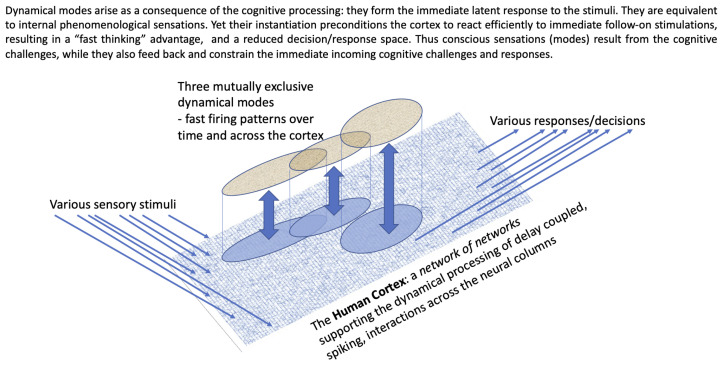
We argue that cognition (information processing) and internal phenomenological sensations, including emotions, are intimately related and are not separable. We aver that phenomenological sensations are dynamical "modes" of firing behaviour that (i) exist over time and over large parts of the cortex's neuron-to-neuron network and (ii) are consequences of the network-of-networks architecture, coupling the individual neuronal dynamics and the necessary time delay incurred by neuron-to-neuron transmission: if you possess those system properties, then you will have the dynamical modes and, thus, the phenomenological sensations. These modes are consequences of incoming external stimuli and are competitive within the system, suppressing and locking-out one another. On the other hand, the presence of any such mode acts as a preconditioner for the immediate (dynamic) cognitive processing of information. Thus, internal phenomenological sensations, including emotions, reduce the immediate decision set (of feasible interpretations) and hence the cognitive load. For organisms with such a mental inner life, there would clearly be a large cognitive evolutionary advantage, resulting in the well-known "thinking fast, thinking slow" phenomena. We call this the : how latent conscious phenomena arise from the dynamics of the cognitive processing load, and how these precondition the cognitive tasks immediately following. We discuss how internal dynamical modes, which are candidates for emotions down to single qualia, can be observed by reverse engineering large sets of simulations of system's stimulated responses, either using vast supercomputers (with full 10B neuronal network analyses) or else using laptops to do the same for appropriately generalised Kuramoto models (networks of -dimensional clocks, each representing the 10,000 neurons within a single neural column). We explain why such simplifications are appropriate. We also discuss the consequent cognitive advantages for information-processing systems exhibiting internal sensations and the exciting implications for next-generation (non-binary) computation and for AI.
我们认为,认知(信息处理)与包括情感在内的内部现象学感觉密切相关且不可分割。我们断言,现象学感觉是动态的“激发行为模式”,(i)随时间存在于皮层神经元到神经元网络的大部分区域,(ii)是网络架构的结果,它将个体神经元动力学与神经元到神经元传递所产生的必要时间延迟耦合在一起:如果你具备那些系统属性,那么你就会拥有动态模式,进而拥有现象学感觉。这些模式是外部传入刺激的结果,并且在系统内相互竞争,相互抑制和排除。另一方面,任何此类模式的存在都作为信息即时(动态)认知处理的前提条件。因此,包括情感在内的内部现象学感觉减少了即时决策集(可行解释的集合),从而减轻了认知负荷。对于具有这种精神内在生活的生物体来说,显然会有巨大的认知进化优势,导致众所周知的“快速思考,慢速思考”现象。我们将此称为:潜在的意识现象如何从认知处理负荷的动态中产生,以及这些现象如何立即为随后的认知任务设定前提条件。我们讨论如何通过对系统刺激响应的大量模拟进行逆向工程来观察内部动态模式,这些模拟可以使用巨型超级计算机(进行完整的100亿神经元网络分析),也可以使用笔记本电脑对适当广义的Kuramoto模型(二维时钟网络,每个代表单个神经柱内的10000个神经元)进行同样的操作。我们解释了为什么这种简化是合适的。我们还讨论了对于表现出内部感觉的信息处理系统随之而来的认知优势,以及对下一代(非二进制)计算和人工智能的令人兴奋的影响。