Beijing Key Laboratory of Pediatric Hematology Oncology, National Discipline of Pediatrics, Ministry of Education, MOE Key Laboratory of Major Diseases in Children; Hematology Oncology Center, Beijing Children's Hospital, Capital Medical University, National Center for Children's Health, Beijing, China.
Beijing Keyin Technology Company Limited, Beijing Keyin Evergreen Institutes for Medical Research Company limited, Beijing, China.
Cancer Med. 2019 Apr;8(4):1558-1566. doi: 10.1002/cam4.2045. Epub 2019 Feb 21.
To improve cure rates for neuroblastoma (NB), it is important and necessary to evaluate therapy response. Our investigation focuses on using plasma cell free DNA (cfDNA) as a biomarker to determine tumor burden and minimal residual disease (MRD) of NB patients during chemotherapy.
Total 58 NB patients were recruited from July 2016 to December 2017. Therapy regime and risk classification were based on COG standard and BCH-NB-2007 protocol. RECIST study was used to judge response to therapy at the end of fourth cycle of chemotherapy (CC4) and maintenance stage (MS) respectively. Serial quantifications of cfDNA, NSE, and LDH were examined at four stages, including newly diagnosed, second and CC4, and maintenance.
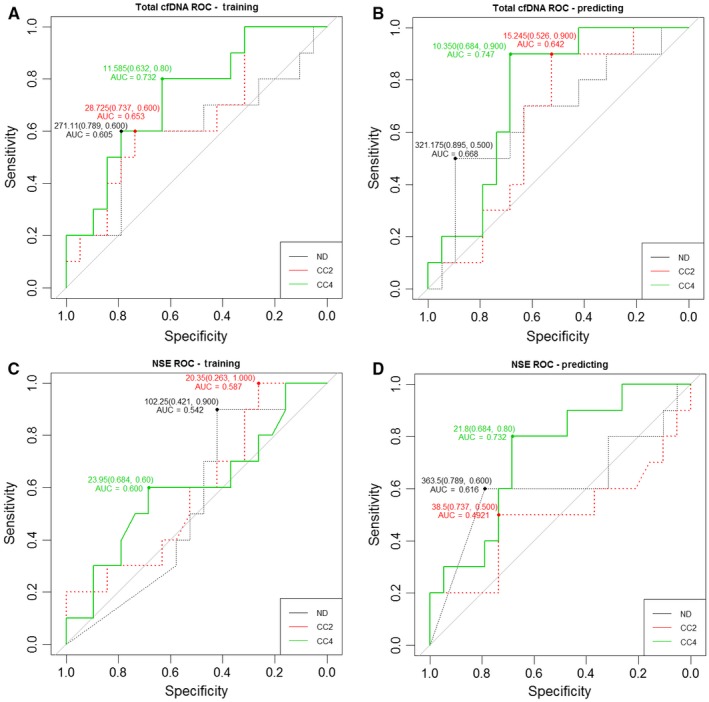
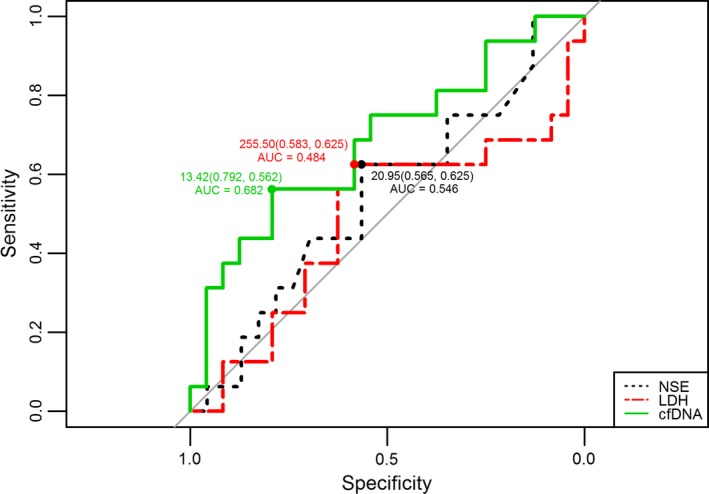
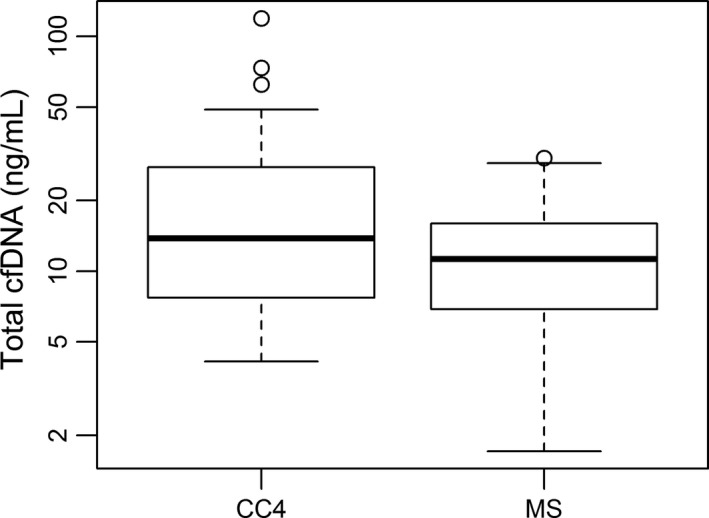
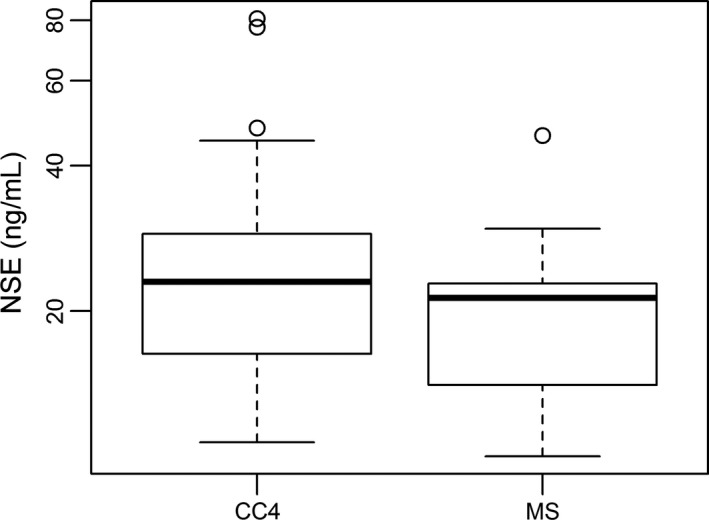
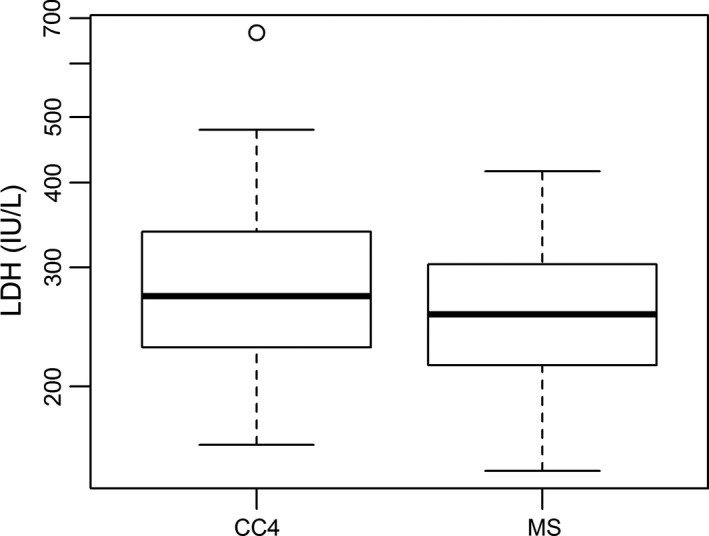
During early chemotherapy, 65.5% of NB kids responded well. Consistently, cfDNA, NSE, and LDH levels were down-regulated in NB patients with partial remission (PR) compared to those with stable disease (SD). In both training and predicting sets, the levels of cfDNA were significantly comparable between PR and SD only at CC4 stage. To predict the insufficient response to early chemotherapy, the optimal AUC value of cfDNA was 0.732 and 0.747 in training and predicting sets respectively, with a sensitivity of 63.2% and 80% specificity at 11.59 ng/ml and a sensitivity of 68.4% and 90% specificity at 10.35 ng/ml. At MS, responded NB patients were slightly increased up to 70%. This evaluation was confirmed by further decrease in cfDNA and NSE levels during intermediate chemotherapy in comparison with early stage.
The dynamic change of cfDNA was considered as a surrogate biomarker to evaluate tumor burden and MRD of NB during early and intermediate therapy periods.
为提高神经母细胞瘤(NB)的治愈率,评估治疗反应非常重要且必要。我们的研究重点是使用无细胞血浆 DNA(cfDNA)作为生物标志物,来确定 NB 患者在化疗过程中的肿瘤负担和微小残留病(MRD)。
2016 年 7 月至 2017 年 12 月,共招募了 58 名 NB 患者。治疗方案和危险度分类基于 COG 标准和 BCH-NB-2007 方案。RECIST 研究用于分别在第 4 周期化疗(CC4)和维持阶段(MS)结束时判断治疗反应。在四个阶段(初诊、第 2 次和 CC4、维持)检测 cfDNA、NSE 和 LDH 的连续定量。
在早期化疗期间,65.5%的 NB 患儿反应良好。同样,与稳定疾病(SD)患者相比,部分缓解(PR)的 NB 患者的 cfDNA、NSE 和 LDH 水平降低。在训练集和预测集中,仅在 CC4 阶段,PR 和 SD 患者的 cfDNA 水平具有显著差异。为预测早期化疗反应不足,cfDNA 的最佳 AUC 值在训练集和预测集中分别为 0.732 和 0.747,在 11.59ng/ml 时灵敏度为 63.2%,特异性为 80%,在 10.35ng/ml 时灵敏度为 68.4%,特异性为 90%。在 MS 时,反应良好的 NB 患者略有增加,达到 70%。与早期相比,中间化疗期间 cfDNA 和 NSE 水平的进一步降低证实了这一评估。
cfDNA 的动态变化被认为是一种替代生物标志物,可用于评估早期和中期治疗期间 NB 的肿瘤负担和 MRD。