Wang Xisi, Wang Lijun, Su Yan, Yue Zhixia, Xing Tianyu, Zhao Wen, Zhao Qian, Duan Chao, Huang Cheng, Zhang Dawei, Jin Mei, Cheng Xianfeng, Chen Shenglan, Liu Yi, Ma Xiaoli
Beijing Key Laboratory of Pediatric Hematology Oncology, National Discipline of Pediatrics, Ministry of Education, MOE Key Laboratory of Major Diseases in Children, Hematology Oncology Center, Beijing Children's Hospital, National Center for Children's Health, Capital Medical University, Beijing, China.
Beijing Keyin Technology Company, Beijing Keyin Evergreen Institutes for Medical Research Company Limited, Chaoyang District, Beijing, China.
Cancer Med. 2018 Jul;7(7):3022-3030. doi: 10.1002/cam4.1586. Epub 2018 Jun 14.
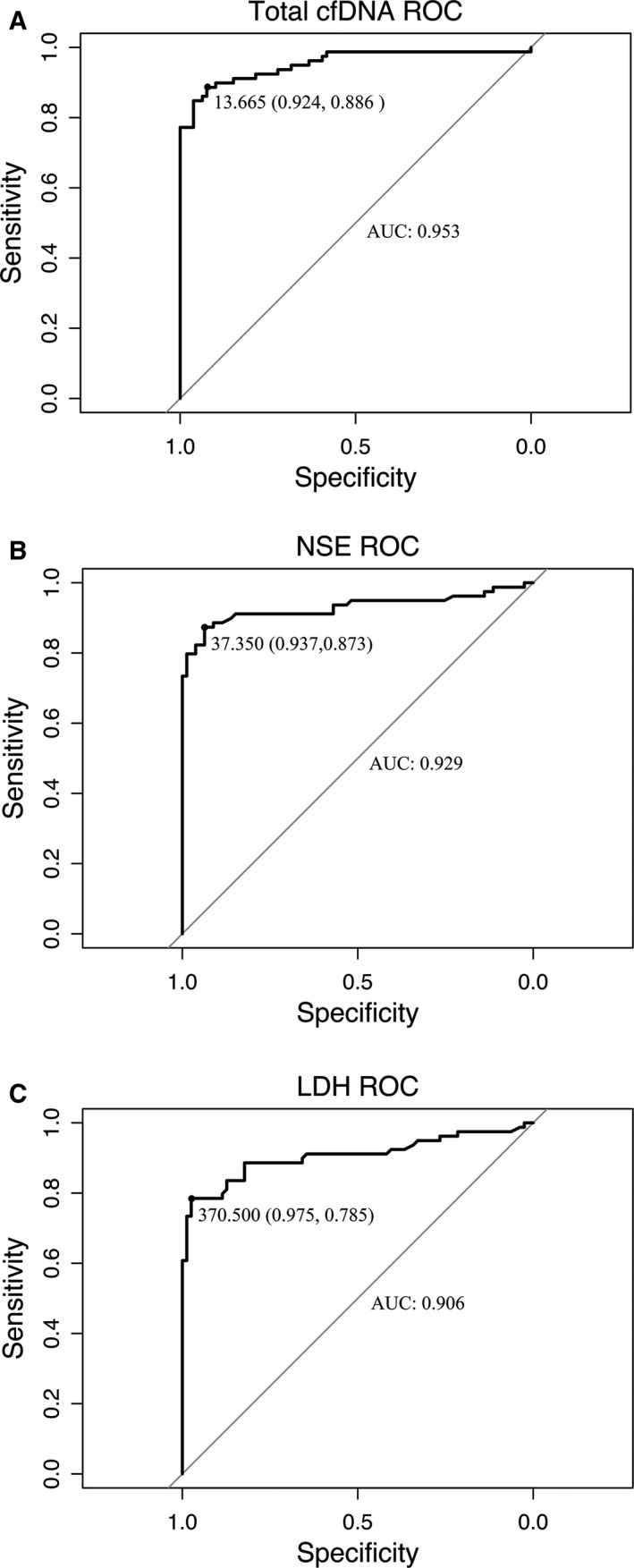
To evaluate plasma cell-free DNA (cfDNA) as a promising biomarker for neuroblastoma (NB) tumor burden. Seventy-nine eligible patients with newly diagnosed NB were recruited from Beijing Children's Hospital between April 2016 and April 2017. Additionally, from September 2011 to June 2017, 79 patients with stable NB were evaluated with a median follow-up time of 21 months. Approximately 2 mL of peripheral blood was drawn upon enrollment, and plasma cfDNA levels were measured via quantitative polymerase chain reaction (qPCR). Total cfDNA analysis was performed using the long interspersed nuclear element 1 (LINE-1) 79 bp fragment, and DNA integrity was calculated by the ratio of the LINE-1 300 bp fragment to the LINE-1 79 bp fragment. A total of 79 NB patients with a median age of 36 months comprised the group of newly diagnosed NB patients. The main primary tumor site was the retroperitoneal and adrenal region (81%). Three or more metastatic sites were found in 17.7% of patients. Stable NB patients older than 18 months comprised 98.7% of the stable NB patients. Neuron-specific enolase (NSE), lactate dehydrogenase (LDH), and cfDNA levels were dramatically increased in the newly diagnosed NB patients and significantly different from those in the stable NB patients. Moreover, the concentration of cfDNA was much higher in patients with larger tumors. By analyzing the area under the receiver operator characteristic (ROC) curve (AUC), the areas of total cfDNA, NSE, and LDH levels were 0.953, 0.929, and 0.906, respectively. The sensitivity and specificity data clarified that the level of circulating cfDNA in plasma can be considered as a reliable biomarker for describing tumor load in NB. The plasma cfDNA concentration was as good as the levels of LDH and NSE to discriminate the tumor burden in children with NB.
评估血浆游离DNA(cfDNA)作为神经母细胞瘤(NB)肿瘤负荷的一种有前景的生物标志物。2016年4月至2017年4月期间,从北京儿童医院招募了79例新诊断为NB的符合条件的患者。此外,2011年9月至2017年6月期间,对79例病情稳定的NB患者进行了评估,中位随访时间为21个月。入组时抽取约2 mL外周血,通过定量聚合酶链反应(qPCR)测量血浆cfDNA水平。使用长散在核元件1(LINE-1)79 bp片段进行总cfDNA分析,并通过LINE-1 300 bp片段与LINE-1 79 bp片段的比率计算DNA完整性。共有79例中位年龄为36个月的NB患者组成新诊断为NB的患者组。主要原发肿瘤部位是腹膜后和肾上腺区域(81%)。17.7%的患者发现有三个或更多转移部位。18个月以上的病情稳定的NB患者占病情稳定的NB患者的98.7%。新诊断为NB的患者中神经元特异性烯醇化酶(NSE)、乳酸脱氢酶(LDH)和cfDNA水平显著升高,且与病情稳定的NB患者有显著差异。此外,肿瘤较大的患者中cfDNA浓度更高。通过分析受试者操作特征(ROC)曲线下面积(AUC),总cfDNA、NSE和LDH水平的面积分别为0.953、0.929和0.906。敏感性和特异性数据表明,血浆中循环cfDNA水平可被视为描述NB肿瘤负荷的可靠生物标志物。血浆cfDNA浓度在区分NB患儿的肿瘤负荷方面与LDH和NSE水平相当。