Division of Biological Sciences, University of California San Diego, La Jolla, California.
Department of Chemistry and Biochemistry, University of California San Diego, La Jolla, California.
Wiley Interdiscip Rev RNA. 2019 May;10(3):e1524. doi: 10.1002/wrna.1524. Epub 2019 Feb 21.
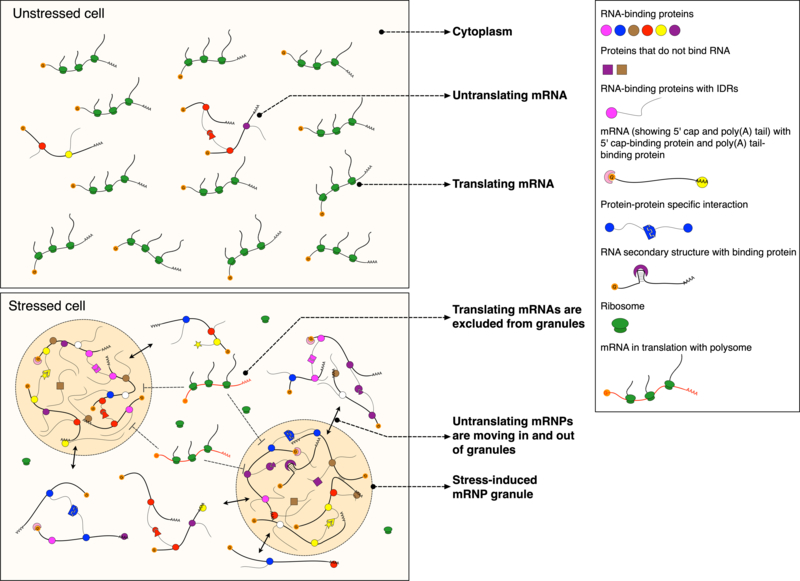
In response to stress, cells must quickly reprogram gene expression to adapt and survive. This is achieved in part by altering levels of mRNAs and their translation into proteins. Recently, the formation of two stress-induced messenger ribonucleoprotein (mRNP) assemblies named stress granules and processing bodies has been postulated to directly impact gene expression during stress. These assemblies sequester and concentrate specific proteins and RNAs away from the larger cytoplasm during stress, thereby providing a layer of posttranscriptional gene regulation with the potential to directly impact mRNA levels, protein translation, and cell survival. The function of these granules has generally been ascribed either by the protein components concentrated into them or, more broadly, by global changes that occur during stress. Recent proteome- and transcriptome-wide studies have provided a more complete view of stress-induced mRNP granule composition in varied cell types and stress conditions. However, direct measurements of the phenotypic and functional consequences of stress granule and processing body formation are lacking. This leaves our understanding of their roles during stress incomplete. Continued study into the function of these granules will be an important part in elucidating how cells respond to and survive stressful environmental changes. This article is categorized under: Translation > Translation Regulation RNA Interactions with Proteins and Other Molecules > RNA-Protein Complexes RNA Export and Localization > RNA Localization.
面对压力,细胞必须迅速重新编程基因表达以适应和存活。这在一定程度上是通过改变 mRNA 的水平及其翻译为蛋白质来实现的。最近,人们假设两种应激诱导的信使核糖核蛋白(mRNP)组装体,即应激颗粒和处理体的形成,直接影响应激过程中的基因表达。这些组装体在应激期间将特定的蛋白质和 RNA 隔离并集中在细胞质中,从而提供了一层转录后基因调控,有可能直接影响 mRNA 水平、蛋白质翻译和细胞存活。这些颗粒的功能通常归因于集中在其中的蛋白质成分,或者更广泛地归因于应激过程中发生的全局变化。最近的蛋白质组学和转录组学研究为不同细胞类型和应激条件下应激诱导的 mRNP 颗粒组成提供了更全面的视图。然而,应激颗粒和处理体形成的表型和功能后果的直接测量仍然缺乏。这使得我们对它们在应激过程中的作用的理解不完整。对这些颗粒功能的持续研究将是阐明细胞如何应对和存活于应激性环境变化的重要组成部分。本文属于以下类别:翻译 > 翻译调控 RNA 与蛋白质和其他分子的相互作用 > RNA-蛋白质复合物 RNA 输出和定位 > RNA 定位。