Department of Physical Therapy, University of Pittsburgh, Pittsburgh, Pennsylvania.
Department of Orthopaedic Surgery, University of Pittsburgh, Pittsburgh, Pennsylvania.
JAMA Netw Open. 2019 Feb 1;2(2):e190018. doi: 10.1001/jamanetworkopen.2019.0018.
Several functional limitations persist after total knee replacement (TKR). Intensive exercise programs could resolve these limitations but are not well tolerated by many patients until a later stage (>2 months) after surgery. Evidence for exercise at a later stage after TKR is limited.
To compare the effectiveness of later-stage exercise programs after TKR and to explore heterogeneity of treatment effects.
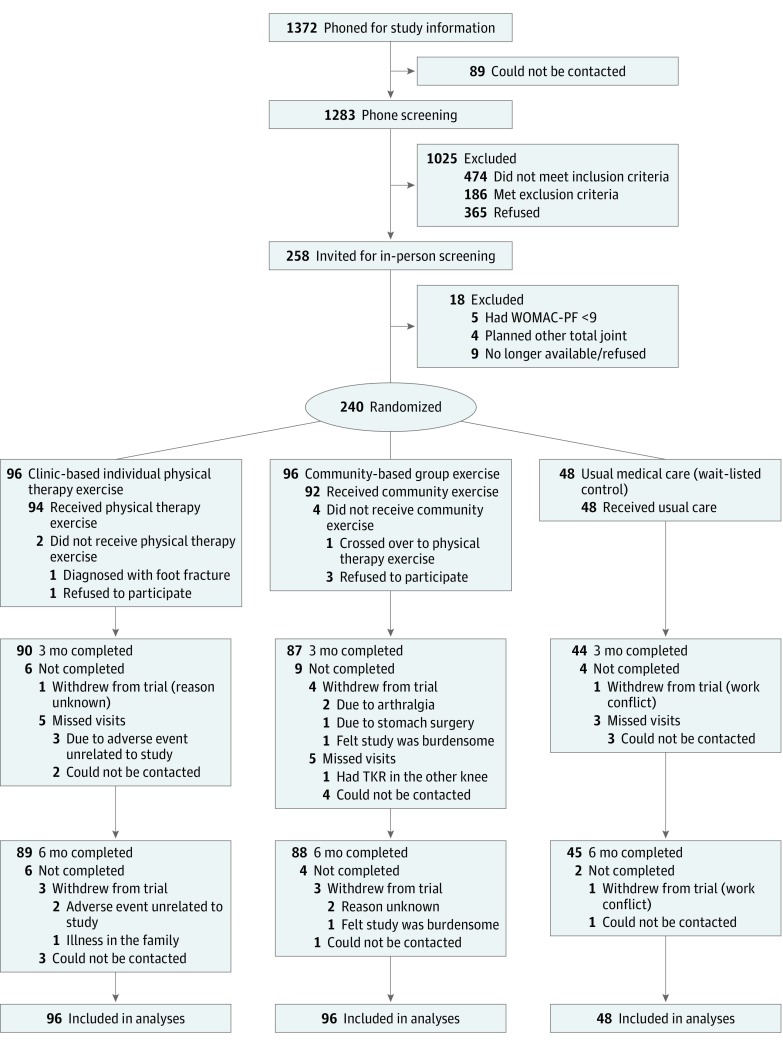
DESIGN, SETTING, AND PARTICIPANTS: Three-arm single-blind randomized clinical trial (January 7, 2015, to November 9, 2017) using an intent-to-treat approach with follow-ups at 3 months and 6 months. The setting was Allegheny County, Pennsylvania (an outpatient physical therapy clinic and 4 community centers). Participants had primary TKR performed more than 2 months previously, were 60 years or older, experienced moderate functional limitations, and were medically cleared to exercise.
Clinic-based physical therapy exercise (physical therapy arm), community-based group exercise (community arm), and usual care (control arm). The control arm continued their usual care, whereas the exercise arms participated in supervised exercise programs lasting 12 weeks.
The primary outcome was arm differences in the Western Ontario and McMaster Universities Osteoarthritis Index-Physical Function (WOMAC-PF) at 3 months. The secondary outcomes included performance-based tests germane to knee replacement and additional surveys of physical function. Data were analyzed by linear mixed models and responder analysis.
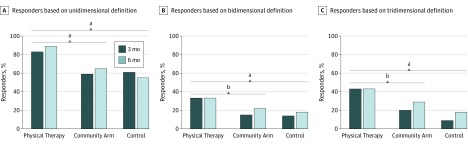
A total of 240 participants (mean [SD] age, 70 [7] years; 61.7% female) were allocated to physical therapy (n = 96), community exercise (n = 96), or control (n = 48). All 3 arms demonstrated clinically important improvement. At 3 months, between-arm analyses for the WOMAC-PF demonstrated no differences between physical therapy and community (-2.2; 98.3% CI, -4.5 to 0.1), physical therapy and control (-2.1; 98.3% CI, -4.9 to 0.7), and community and control (0.1; 98.3% CI, -2.7 to 2.9). Performance-based tests demonstrated greater improvement in the physical therapy arm compared with both the community (0.1 z score units; 98.3% CI, 0.0-0.2) and control (0.3 z score units; 98.3% CI, 0.1-0.4) arms and the community arm compared with the control arm (0.2 z score units; 98.3% CI, 0.0-0.3). The physical therapy arm had more than 17.7% responders than the community arm and more than 19.0% responders than the control arm. There was no difference in responder rates between the community and control arms.
Based on the primary outcome, participation in late-stage exercise programs after TKR offered no benefit over usual care. The benefits of physical therapy identified by the secondary outcomes and responder analysis require confirmation.
ClinicalTrials.gov Identifier: NCT02237911.
全膝关节置换术(TKR)后仍存在多种功能障碍。强化运动方案可以解决这些问题,但在手术后的晚期(>2 个月),许多患者难以耐受。TKR 后晚期运动的证据有限。
比较 TKR 后晚期运动方案的有效性,并探讨治疗效果的异质性。
设计、设置和参与者:采用意向治疗方法的三臂单盲随机临床试验(2015 年 1 月 7 日至 2017 年 11 月 9 日),随访时间为 3 个月和 6 个月。该研究地点在宾夕法尼亚州阿勒格尼县(门诊物理治疗诊所和 4 个社区中心)。参与者为接受 TKR 治疗超过 2 个月、年龄在 60 岁及以上、存在中度功能障碍且经医学检查允许运动的患者。
诊所的物理治疗运动(物理治疗组)、社区的团体运动(社区组)和常规护理(对照组)。对照组继续接受常规护理,而运动组则参加持续 12 周的监督运动计划。
主要结局是 3 个月时 Western Ontario and McMaster Universities Osteoarthritis Index-Physical Function(WOMAC-PF)的手臂差异。次要结局包括与膝关节置换相关的表现测试以及对身体功能的额外调查。数据通过线性混合模型和应答者分析进行分析。
共有 240 名参与者(平均[标准差]年龄 70[7]岁;61.7%为女性)被分配到物理治疗组(n=96)、社区运动组(n=96)或对照组(n=48)。所有 3 个组均表现出有临床意义的改善。在 3 个月时,WOMAC-PF 的组间分析显示,物理治疗组与社区组(-2.2;98.3%CI,-4.5 至 0.1)、物理治疗组与对照组(-2.1;98.3%CI,-4.9 至 0.7)以及社区组与对照组(0.1;98.3%CI,-2.7 至 2.9)之间没有差异。表现测试显示,物理治疗组与社区组(0.1 z 评分单位;98.3%CI,0.0-0.2)和对照组(0.3 z 评分单位;98.3%CI,0.1-0.4)相比,以及社区组与对照组(0.2 z 评分单位;98.3%CI,0.0-0.3)相比,改善程度更大。物理治疗组的应答者比例高于社区组(17.7%)和对照组(19.0%),而社区组和对照组之间的应答者比例没有差异。
基于主要结局,TKR 后晚期参加运动方案与常规护理相比没有益处。次要结局和应答者分析所确定的物理治疗的益处需要进一步证实。
ClinicalTrials.gov 标识符:NCT02237911。