Department of Surgery, University of Illinois at Chicago, and the Creticos Cancer Center, AIMMC, Chicago, IL.
Department of Bioinformatics, University of Illinois at Chicago, Chicago, IL.
J Am Coll Surg. 2019 May;228(5):721-729. doi: 10.1016/j.jamcollsurg.2019.02.040. Epub 2019 Feb 19.
Current standard-of-care technologies, such as imaging and cyst fluid analysis, are unable to consistently distinguish intraductal papillary mucinous neoplasms (IPMNs) of the pancreas at high risk of pancreatic cancer from low-risk IPMNs. The objective was to create a single-platform assay to identify IPMNs that are at high risk for malignant progression.
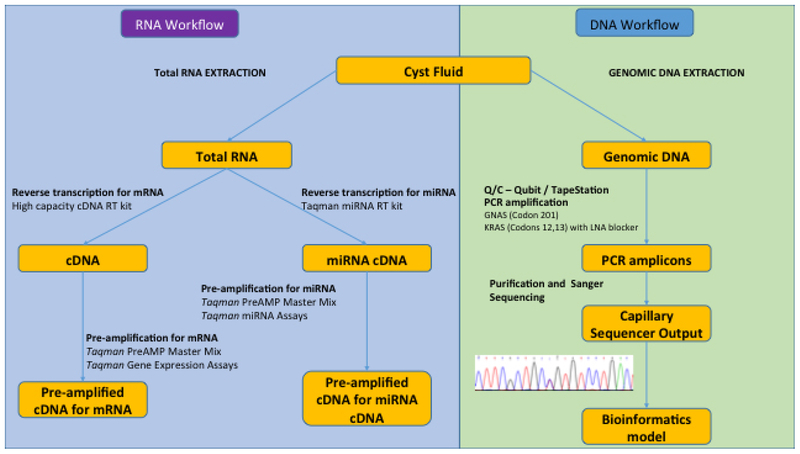
Building on the Verona International Consensus Conference branch duct IPMN biomarker review, additional protein, cytokine, mucin, DNA, and microRNA cyst fluid targets were identified for creation of a quantitative polymerase chain reaction-based assay. This included messenger RNA markers: ERBB2, GNAS, interleukin 1β, KRAS, MUCs1, 2, 4, 5AC, 7, prostaglandin E2R, PTGER2, prostaglandin E synthase 2, prostaglandin E synthase 1, TP63; microRNA targets: miRs 101, 106b, 10a, 142, 155, 17, 18a, 21, 217, 24, 30a, 342, 532, 92a, and 99b; and GNAS and KRAS mutational analysis. A multi-institutional international collaborative contributed IPMN cyst fluid samples to validate this platform. Cyst fluid gene expression levels were normalized, z-transformed, and used in classification and regression analysis by a support vector machine training algorithm.
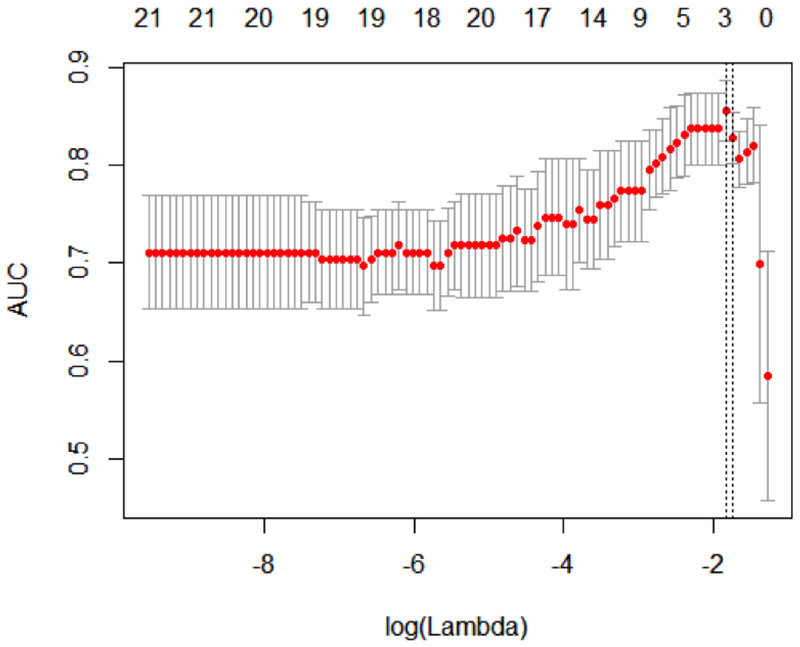
From cyst fluids of 59 IPMN patients, principal component analysis confirmed no institutional bias/clustering. Lasso (least absolute shrinkage and selection operator)-penalized logistic regression with binary classification and 5-fold cross-validation used area under the curve as the evaluation criterion to create the optimal signature to discriminate IPMNs as low risk (low/moderate dysplasia) or high risk (high-grade dysplasia/invasive cancer). The most predictive signature was achieved with interleukin 1β, MUC4, and prostaglandin E synthase 2 to accurately discriminate high-risk cysts from low-risk cysts with an area under the curve of up to 0.86 (p = 0.002).
We have identified a single-platform polymerase chain reaction-based assay of cyst fluid to accurately predict IPMNs with high malignant potential for additional studies.
目前的标准治疗技术,如影像学和囊液分析,无法始终区分具有高胰腺癌风险的胰腺导管内乳头状黏液性肿瘤(IPMN)与低风险的 IPMN。目的是创建一种单一平台检测方法,以识别具有恶性进展高风险的 IPMN。
在维罗纳国际共识会议分支导管 IPMN 生物标志物综述的基础上,确定了其他蛋白质、细胞因子、黏蛋白、DNA 和 microRNA 囊液靶标,以创建基于定量聚合酶链反应的检测方法。这包括信使 RNA 标志物:ERBB2、GNAS、白细胞介素 1β、KRAS、MUCs1、2、4、5AC、7、前列腺素 E2R、PTGER2、前列腺素 E 合酶 2、前列腺素 E 合酶 1、TP63;microRNA 靶标:miRs 101、106b、10a、142、155、17、18a、21、217、24、30a、342、532、92a 和 99b;以及 GNAS 和 KRAS 突变分析。一个多机构的国际合作组织为验证该平台提供了 IPMN 囊液样本。通过支持向量机训练算法对囊液基因表达水平进行归一化、z 变换,并用于分类和回归分析。
从 59 名 IPMN 患者的囊液中,主成分分析证实没有机构偏见/聚类。使用最小绝对收缩和选择算子(Lasso)-惩罚逻辑回归进行二元分类和 5 倍交叉验证,使用曲线下面积作为评估标准,创建了最佳特征以区分低风险(低/中等级别异型增生)或高风险(高级别异型增生/浸润性癌)的 IPMN。通过白细胞介素 1β、MUC4 和前列腺素 E 合酶 2 实现了最具预测性的特征,以高达 0.86 的曲线下面积(p=0.002)准确区分高危囊肿和低危囊肿。
我们已经确定了一种基于单一平台聚合酶链反应的囊液检测方法,可准确预测具有高恶性潜能的 IPMN,以便进行进一步研究。