Department of Paediatric Gastroenterology, University Medical Center Groningen, Groningen, The Netherlands.
Department of Paediatric Gastroenterology, Antwerp University Hospital, Edegem, Belgium.
Arch Dis Child. 2019 Jul;104(7):686-689. doi: 10.1136/archdischild-2018-316383. Epub 2019 Feb 23.
To study the association between colonisation and faecal calprotectin to see whether the parasite is a harmless commensal or a gut pathogen.
Cross-sectional study of previously collected stool samples.
Two hundred stool samples originated from children aged 5-19 years with chronic abdominal pain and diarrhoea, who were seen in paediatric clinics in the Netherlands and Belgium and in whom somatic gastrointestinal disorders were excluded. Another 122 samples came from a healthy community-based reference population of the same age. All stool samples were analysed with real-time PCR for the detection of and with an ELISA for calprotectin-a biomarker of gastrointestinal inflammation.
Prevalence of colonisation and results of stool calprotectin testing.
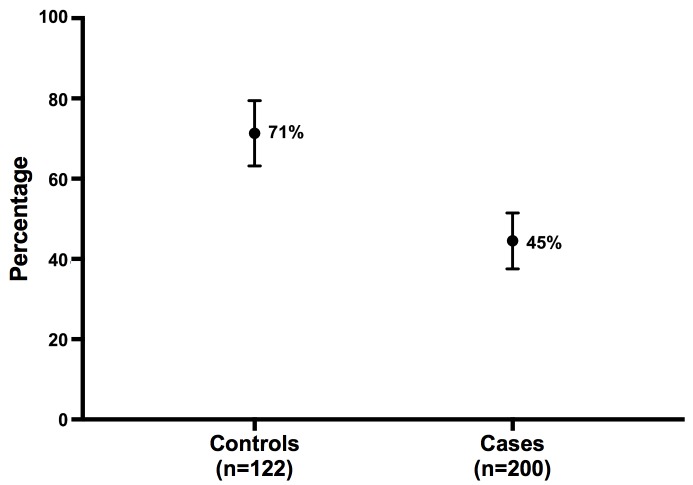
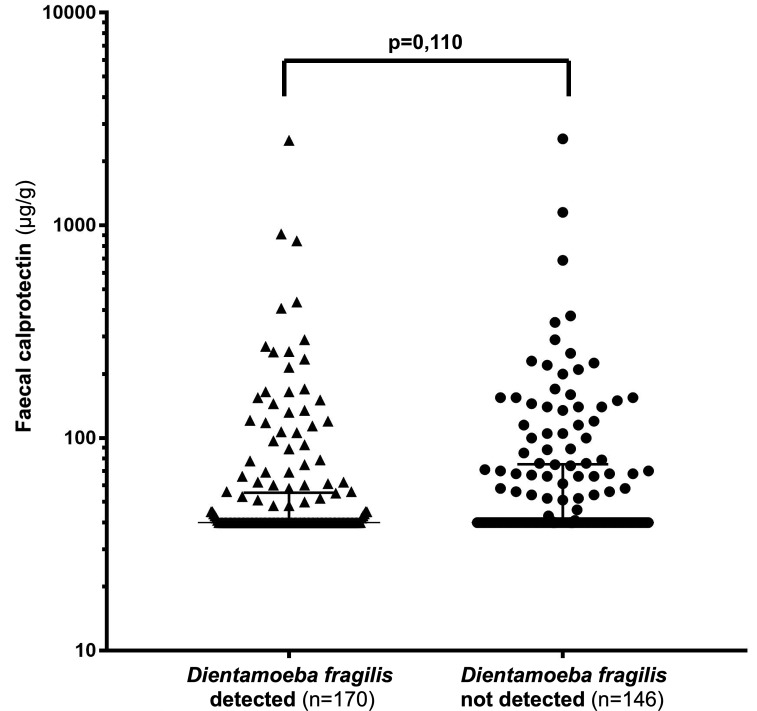
was detected in 45% (95% CI 38% to 51%) of patients and in 71% (95% CI 63% to 79%) of healthy children. Median (IQR) concentrations of calprotectin in patients and healthy children with a positive PCR result were not different from those with a negative PCR result (40 (40-55) μg/g vs 40 (40-75) μg/g, respectively).
Since colonisation is most prevalent in healthy children and is not associated with an increase in faecal calprotectin concentration, our data do not support the inference that is a pathogenic parasite. Routinely testing for in children with chronic abdominal pain should therefore be discouraged.
研究定植与粪便钙卫蛋白之间的关联,以明确寄生虫是无害共生体还是肠道病原体。
对先前收集的粪便样本进行横断面研究。
200 份粪便样本来自荷兰和比利时儿科诊所就诊的 5-19 岁慢性腹痛和腹泻的儿童,排除了胃肠道躯体疾病。另外 122 份样本来自具有相同年龄的基于社区的健康参考人群。所有粪便样本均采用实时 PCR 检测 和 ELISA 检测钙卫蛋白(胃肠道炎症的生物标志物)。
定植的流行率和粪便钙卫蛋白检测结果。
患者中 定植的检出率为 45%(95%CI 38%51%),健康儿童中为 71%(95%CI 63%79%)。PCR 结果阳性的患者和健康儿童的粪便钙卫蛋白中位数(IQR)浓度与 PCR 结果阴性的患者和健康儿童无差异(分别为 40(4055)μg/g 比 40(4075)μg/g)。
由于 定植在健康儿童中最为普遍,且与粪便钙卫蛋白浓度升高无关,因此我们的数据不支持 是病原体的推断。因此,不应常规检测慢性腹痛儿童的 。