Chauhan Akashdeep Singh, Prinja Shankar, Ghoshal Sushmita, Verma Roshan
School of Public Health, Post Graduate Institute of Medical Education and Research, Chandigarh, India. Email:
Asian Pac J Cancer Prev. 2019 Feb 26;20(2):403-409. doi: 10.31557/APJCP.2019.20.2.403.
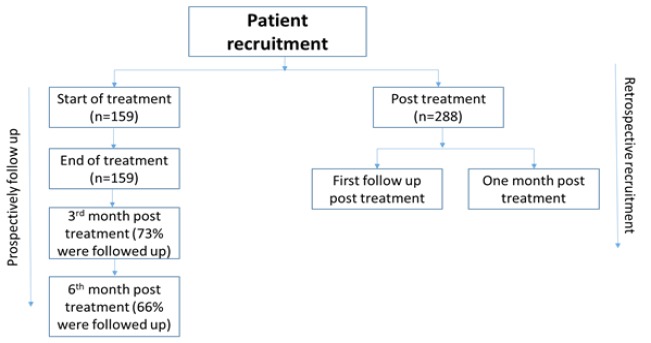
Background: The rising cost of cancer treatment has imposed a huge financial burden on the affected households, leading to catastrophic outcomes and impoverishment. The present study was designed to estimate the economic burden incurred by households for the treatment of head and neck cancer (HNC) in India. Methods: The present study was undertaken in a large public sector tertiary care hospital of North India. A total of 159 patients were recruited at time of their first registration in the department of Radiation Oncology, and were followed after completion of their treatment. Another 288 were recruited within one month after completion of treatment. Economic burden was assessed in terms of out of pocket (OOP) expenditure incurred, prevalence of catastrophic health expenditure and distress financing (borrowing or selling of assets) related to different modalities of cancer treatment. Results: The average OOP expenditure incurred by a patient of HNC patient was INR 37, 845 (USD 563), which varied from INR 32,379 (USD 482) when a patient undergoes radiotherapy alone to INR 67,480 (USD 1,004) for surgery along with chemo-radiotherapy. Specifically, patients undergoing 2-DRT and IMRT alone had to spend INR 31,487 (USD 469) and INR 42,405 (USD 631) respectively. The prevalence of catastrophic health expenditure (CHE) and distress financing (DF) was 34% and 45% respectively. The odds of incurring both CHE and DF were found to be higher for patients in the lowest income quartile and for those in the younger age groups. Conclusion: Cancer imposes significant economic burden on households. The existing public health system should be strengthened to reduce OOP expenditure incurred by patients. In addition, enhanced coverage of risk pooling mechanisms should be ensured.
癌症治疗费用的不断上涨给受影响家庭带来了巨大的经济负担,导致灾难性后果和贫困。本研究旨在估计印度家庭治疗头颈癌(HNC)所产生的经济负担。方法:本研究在印度北部一家大型公共部门三级护理医院进行。共有159名患者在放射肿瘤学部门首次登记时被招募,并在治疗完成后进行随访。另外288名患者在治疗完成后一个月内被招募。经济负担根据所产生的自付费用、灾难性医疗支出的发生率以及与不同癌症治疗方式相关的困境融资(借款或出售资产)来评估。结果:一名头颈癌患者的平均自付费用为37,845印度卢比(563美元),仅接受放射治疗的患者为32,379印度卢比(482美元),而接受手术加放化疗的患者为67,480印度卢比(1,004美元)。具体而言,仅接受二维放疗(2-DRT)和调强放疗(IMRT)的患者分别需花费31,487印度卢比(469美元)和42,405印度卢比(631美元)。灾难性医疗支出(CHE)和困境融资(DF)的发生率分别为34%和45%。发现收入最低四分位数的患者以及较年轻年龄组的患者同时发生CHE和DF的几率更高。结论:癌症给家庭带来了巨大的经济负担。应加强现有的公共卫生系统,以减少患者的自付费用。此外,应确保扩大风险分担机制的覆盖范围。