Department of Medicine, Johns Hopkins University School of Medicine, Orleans Street, Baltimore, MD, 21231, USA.
Bloomberg-Kimmel Institute for Immunotherapy and Department of Oncology, Sidney Kimmel Comprehensive Cancer Center, Johns Hopkins Medical Institutions, North Broadway, Baltimore, MD, 21231, USA.
Genome Med. 2019 Feb 25;11(1):11. doi: 10.1186/s13073-019-0621-2.
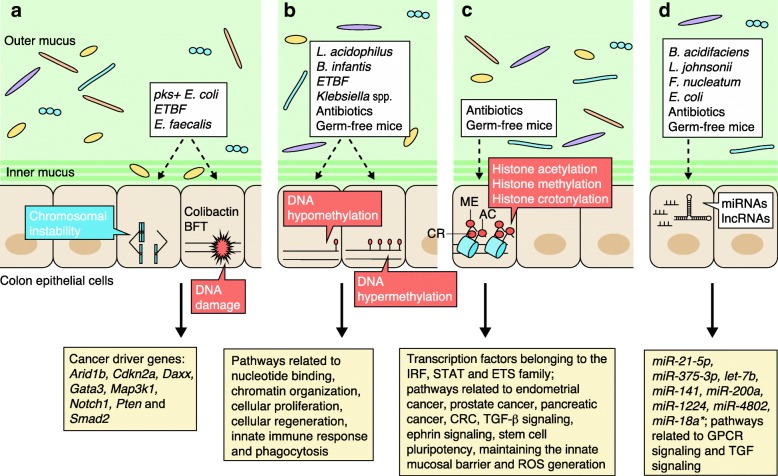
In recent years, the number of studies investigating the impact of the gut microbiome in colorectal cancer (CRC) has risen sharply. As a result, we now know that various microbes (and microbial communities) are found more frequently in the stool and mucosa of individuals with CRC than healthy controls, including in the primary tumors themselves, and even in distant metastases. We also know that these microbes induce tumors in various mouse models, but we know little about how they impact colon epithelial cells (CECs) directly, or about how these interactions might lead to modifications at the genetic and epigenetic levels that trigger and propagate tumor growth. Rates of CRC are increasing in younger individuals, and CRC remains the second most frequent cause of cancer-related deaths globally. Hence, a more in-depth understanding of the role that gut microbes play in CRC is needed. Here, we review recent advances in understanding the impact of gut microbes on the genome and epigenome of CECs, as it relates to CRC. Overall, numerous studies in the past few years have definitively shown that gut microbes exert distinct impacts on DNA damage, DNA methylation, chromatin structure and non-coding RNA expression in CECs. Some of the genes and pathways that are altered by gut microbes relate to CRC development, particularly those involved in cell proliferation and WNT signaling. We need to implement more standardized analysis strategies, collate data from multiple studies, and utilize CRC mouse models to better assess these effects, understand their functional relevance, and leverage this information to improve patient care.
近年来,研究肠道微生物组对结直肠癌(CRC)影响的研究数量急剧增加。因此,我们现在知道,与健康对照组相比,CRC 患者的粪便和黏膜中存在更多种类的微生物(和微生物群落),包括原发性肿瘤本身,甚至远处转移灶。我们还知道这些微生物在各种小鼠模型中诱导肿瘤,但我们对它们如何直接影响结肠上皮细胞(CEC)知之甚少,也不知道这些相互作用如何导致引发和促进肿瘤生长的遗传和表观遗传水平的改变。CRC 在年轻人中的发病率正在上升,CRC 仍然是全球癌症相关死亡的第二大常见原因。因此,需要更深入地了解肠道微生物在 CRC 中的作用。在这里,我们回顾了近年来关于肠道微生物对 CEC 基因组和表观基因组影响的研究进展,与 CRC 相关。总的来说,过去几年的大量研究明确表明,肠道微生物对 CEC 中的 DNA 损伤、DNA 甲基化、染色质结构和非编码 RNA 表达有明显的影响。一些受肠道微生物改变的基因和途径与 CRC 发展有关,特别是那些与细胞增殖和 WNT 信号通路相关的基因和途径。我们需要实施更标准化的分析策略,整理来自多个研究的数据,并利用 CRC 小鼠模型来更好地评估这些影响,了解其功能相关性,并利用这些信息来改善患者护理。