Medical Research Council Laboratory of Molecular Biology, Cambridge CB2 0QH, United Kingdom.
Medical Research Council Laboratory of Molecular Biology, Cambridge CB2 0QH, United Kingdom
Proc Natl Acad Sci U S A. 2019 Mar 12;116(11):4946-4954. doi: 10.1073/pnas.1813352116. Epub 2019 Feb 25.
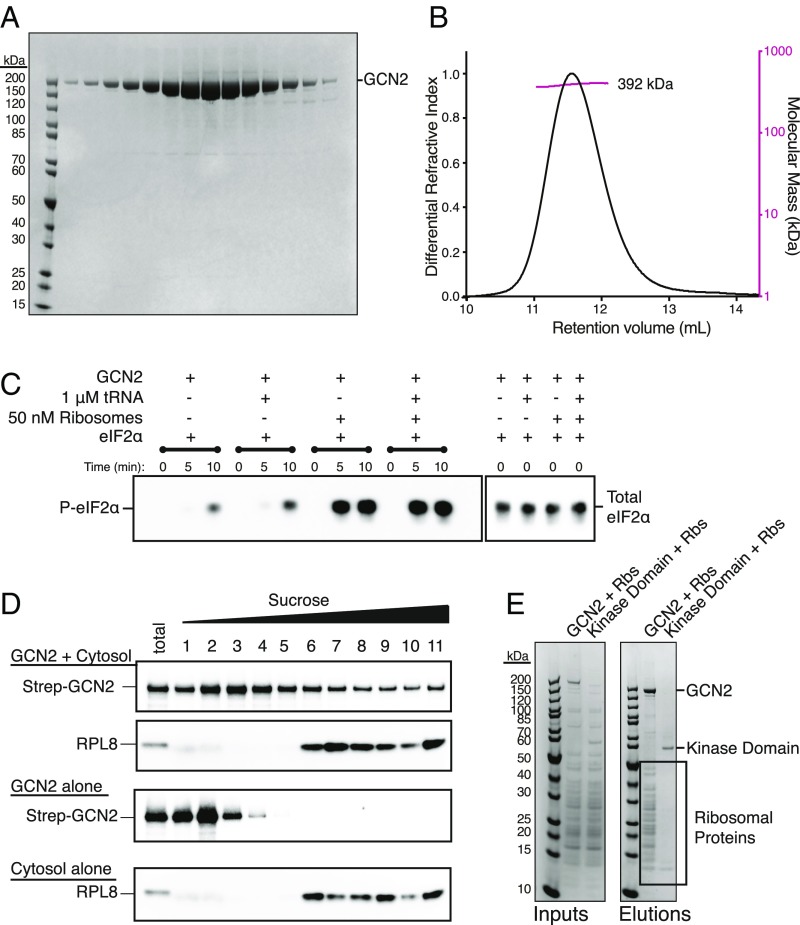
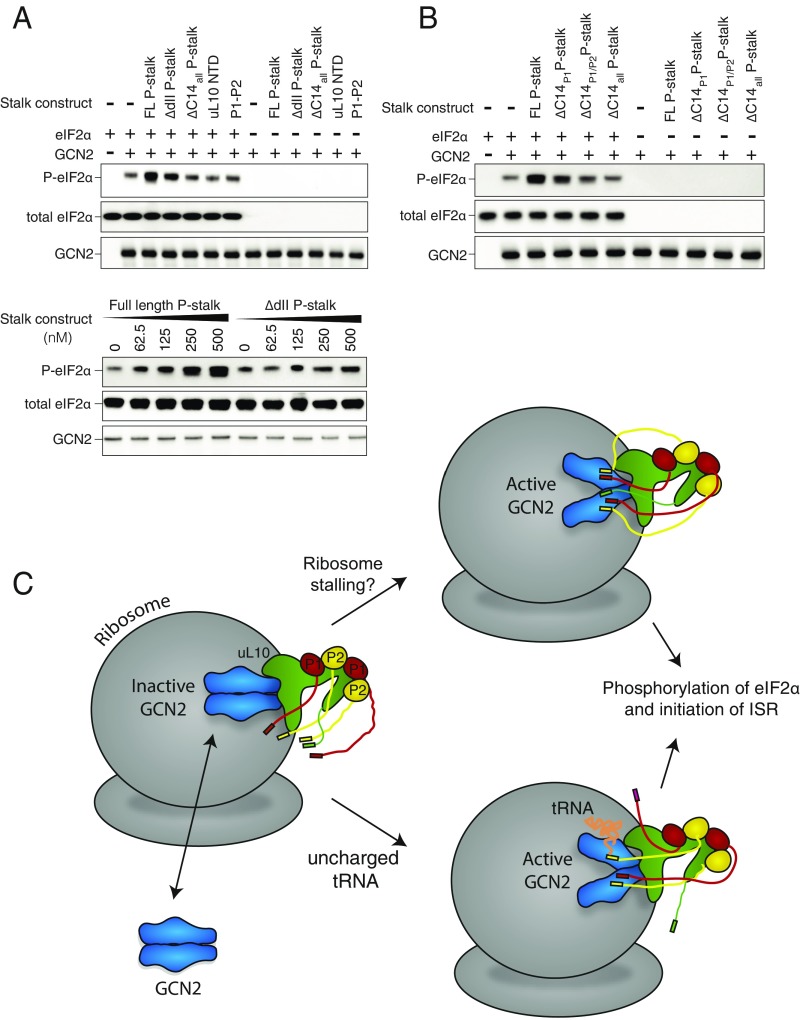
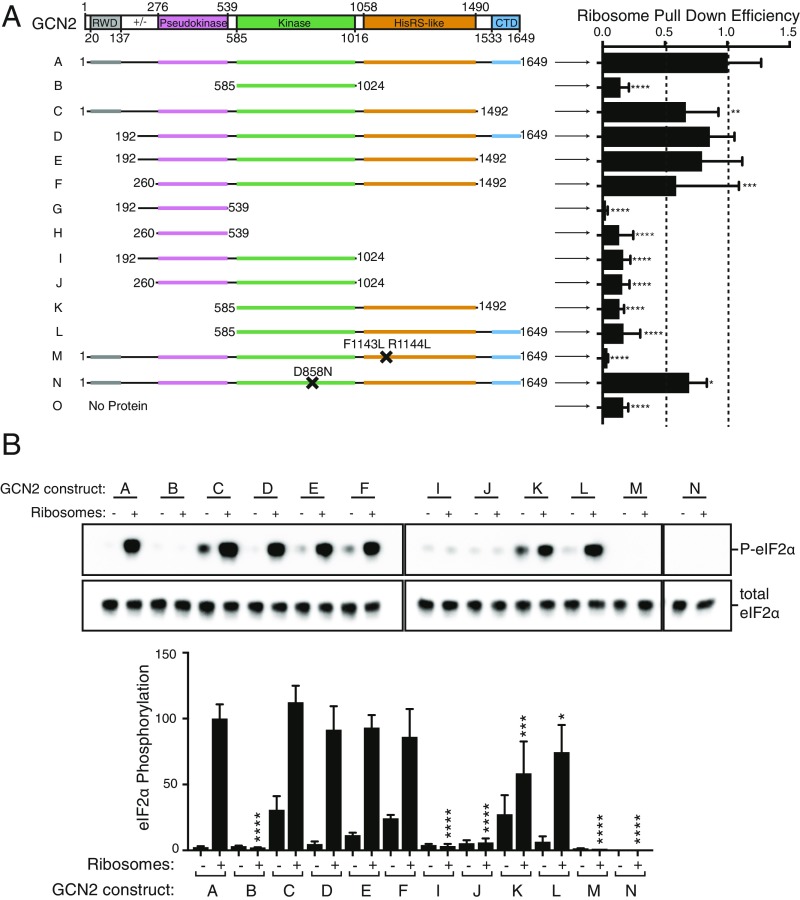
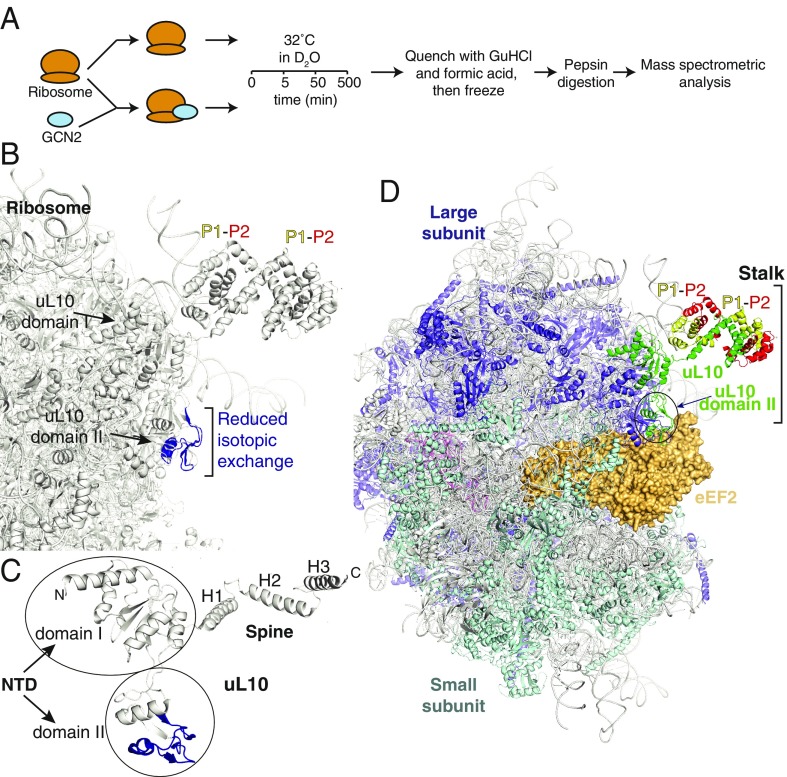
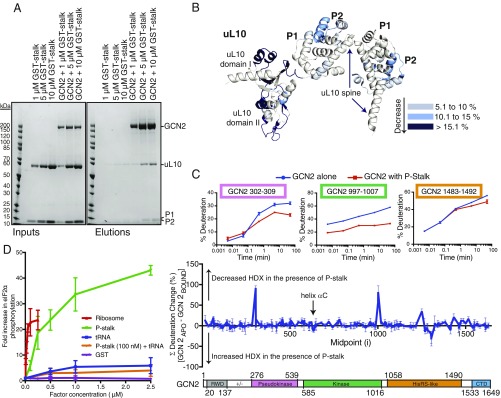
Cells dynamically adjust their protein translation profile to maintain homeostasis in changing environments. During nutrient stress, the kinase general control nonderepressible 2 (GCN2) phosphorylates translation initiation factor eIF2α, initiating the integrated stress response (ISR). To examine the mechanism of GCN2 activation, we have reconstituted this process in vitro, using purified components. We find that recombinant human GCN2 is potently stimulated by ribosomes and, to a lesser extent, by tRNA. Hydrogen/deuterium exchange-mass spectrometry (HDX-MS) mapped GCN2-ribosome interactions to domain II of the uL10 subunit of the ribosomal P-stalk. Using recombinant, purified P-stalk, we showed that this domain of uL10 is the principal component of binding to GCN2; however, the conserved 14-residue C-terminal tails (CTTs) in the P1 and P2 P-stalk proteins are also essential for GCN2 activation. The HisRS-like and kinase domains of GCN2 show conformational changes upon binding recombinant P-stalk complex. Given that the ribosomal P-stalk stimulates the GTPase activity of elongation factors during translation, we propose that the P-stalk could link GCN2 activation to translational stress, leading to initiation of ISR.
细胞会动态调整其蛋白质翻译谱,以维持在不断变化的环境中的内稳态。在营养胁迫下,激酶一般控制不可抑制 2(GCN2)磷酸化翻译起始因子 eIF2α,启动综合应激反应(ISR)。为了研究 GCN2 激活的机制,我们使用纯化的成分在体外重新构建了这个过程。我们发现重组人 GCN2 被核糖体强烈刺激,并且在较小程度上被 tRNA 刺激。氢/氘交换-质谱(HDX-MS)将 GCN2-核糖体相互作用映射到核糖体 P stalk 的 uL10 亚基的 II 结构域。使用重组的、纯化的 P stalk,我们表明 uL10 的这个结构域是与 GCN2 结合的主要成分;然而,P stalk 中的 P1 和 P2 保守的 14 残基 C 末端尾巴(CTTs)对于 GCN2 激活也是必不可少的。GCN2 的 HisRS 样和激酶结构域在结合重组 P stalk 复合物时会发生构象变化。鉴于核糖体 P stalk 在翻译过程中刺激延伸因子的 GTPase 活性,我们提出 P stalk 可以将 GCN2 激活与翻译应激联系起来,从而引发 ISR 的启动。