Lin Yao-Fa, Xie Zheng, Zhou Jun, Chen Hui-Hao, Shao Wan-Wan, Lin Hao-Dong
Department of Orthopedics, Changzheng Hospital, The Second Military Medical University, Shanghai, China.
Department of Orthopedics, Changzheng Hospital, The Second Military Medical University, Shanghai; Department of Orthopedics, The Second People's Hospital of Karamay, Karamay, Xinjiang Uygur Autonomous Region, China.
Neural Regen Res. 2019 Jul;14(7):1271-1279. doi: 10.4103/1673-5374.251336.
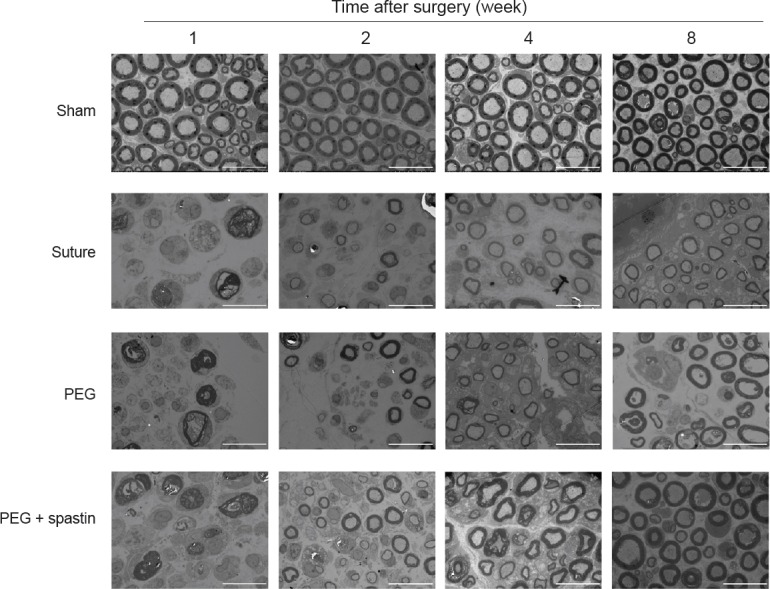
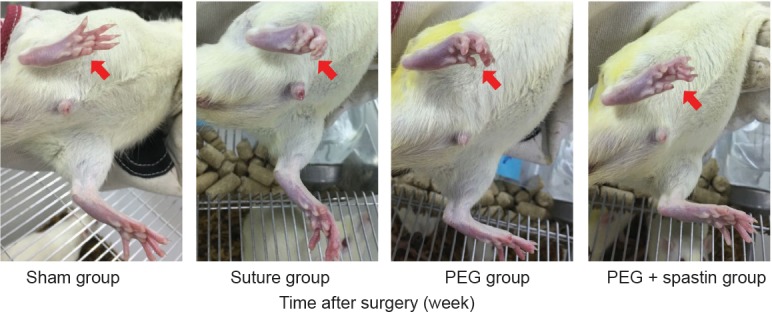
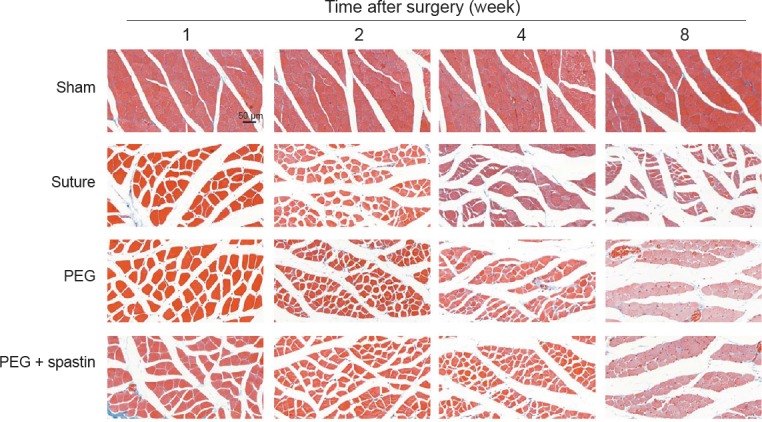
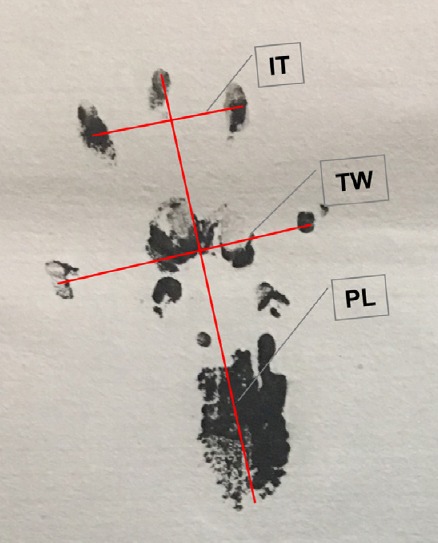
Polyethylene glycol can connect the distal and proximal ends of an injured nerve at the cellular level through axonal fusion to avoid Wallerian degeneration of the injured distal nerve and promote peripheral nerve regeneration. However, this method can only prevent Wallerian degeneration in 10% of axons because the cytoskeleton is not repaired in a timely fashion. Reconstruction of the cytoskeletal trunk and microtubule network has been suggested to be the key for improving the efficiency of axonal fusion. As a microtubule-severing protein, spastin has been used to enhance cytoskeletal reconstruction. Therefore, we hypothesized that spastin combined with polyethylene glycol can more effectively promote peripheral nerve regeneration. A total of 120 male Sprague-Dawley rats were randomly divided into sham, suture, polyethylene glycol, and polyethylene glycol + spastin groups. In suture group rats, only traditional nerve anastomosis of the end-to-end suture was performed after transection of the sciatic nerve. In polyethylene glycol and polyethylene glycol + spastin groups, 50 μL of polyethylene glycol or 25 μL of polyethylene glycol + 25 μL of spastin, respectively, were injected immediately under the epineurium of the distal suture. Sensory fiber regeneration distance, which was used to assess early nerve regeneration at 1 week after surgery, was shortest in the suture group, followed by polyethylene glycol group and greatest in the polyethylene glycol + spastin group. Behavioral assessment of motor function recovery in rats showed that limb function was restored in polyethylene glycol and polyethylene glycol + spastin groups at 8 weeks after surgery. At 1, 2, 4 and 8 weeks after surgery, sciatic functional index values and percentages of gastrocnemius muscle wet weight were highest in the sham group, followed by polyethylene glycol + spastin and polyethylene glycol groups, and lowest in the suture group. Masson staining was utilized to assess the morphology of muscle tissue. Morphological changes in skeletal muscle were detectable in suture, polyethylene glycol, and polyethylene glycol + spastin groups at 1, 2, 4, and 8 weeks after surgery. Among them, muscular atrophy of the suture group was most serious, followed by polyethylene glycol and polyethylene glycol + spastin groups. Ultrastructure of distal sciatic nerve tissue, as detected by transmission electron microscopy, showed a pattern of initial destruction, subsequent disintegration, and gradual repair in suture, polyethylene glycol, and polyethylene glycol + spastin groups at 1, 2, 4, and 8 weeks after surgery. As time proceeded, axonal ultrastructure gradually recovered. Indeed, the polyethylene glycol + spastin group was similar to the sham group at 8 weeks after surgery. Our findings indicate that the combination of polyethylene glycol and spastin can promote peripheral nerve regeneration. Moreover, the effect of this combination was better than that of polyethylene glycol alone, and both were superior to the traditional neurorrhaphy. This study was approved by the Animal Ethics Committee of the Second Military Medical University, China (approval No. CZ20170216) on March 16, 2017.
聚乙二醇可通过轴突融合在细胞水平连接受损神经的远端和近端,以避免受损远端神经发生华勒氏变性,并促进周围神经再生。然而,这种方法仅能防止10%的轴突发生华勒氏变性,因为细胞骨架未能及时修复。细胞骨架主干和微管网络的重建被认为是提高轴突融合效率的关键。作为一种微管切割蛋白,痉挛素已被用于增强细胞骨架重建。因此,我们推测痉挛素与聚乙二醇联合使用能更有效地促进周围神经再生。总共120只雄性斯普拉格-道利大鼠被随机分为假手术组、缝合组、聚乙二醇组和聚乙二醇+痉挛素组。在缝合组大鼠中,坐骨神经横断后仅进行传统的端端缝合神经吻合术。在聚乙二醇组和聚乙二醇+痉挛素组中,分别在远端缝合处的神经外膜下立即注射50 μL聚乙二醇或25 μL聚乙二醇+25 μL痉挛素。用于评估术后1周早期神经再生的感觉纤维再生距离,在缝合组最短,其次是聚乙二醇组,在聚乙二醇+痉挛素组最长。对大鼠运动功能恢复的行为评估显示,术后8周聚乙二醇组和聚乙二醇+痉挛素组的肢体功能得到恢复。术后1、2、4和8周,假手术组的坐骨神经功能指数值和腓肠肌湿重百分比最高,其次是聚乙二醇+痉挛素组和聚乙二醇组,在缝合组最低。采用Masson染色评估肌肉组织形态。术后1、2、4和8周,在缝合组、聚乙二醇组和聚乙二醇+痉挛素组均能检测到骨骼肌的形态学变化。其中,缝合组的肌肉萎缩最严重,其次是聚乙二醇组和聚乙二醇+痉挛素组。通过透射电子显微镜检测坐骨神经远端组织的超微结构,发现在术后1、2、4和8周,缝合组、聚乙二醇组和聚乙二醇+痉挛素组呈现出初始破坏、随后解体并逐渐修复的模式。随着时间推移,轴突超微结构逐渐恢复。实际上,术后8周聚乙二醇+痉挛素组与假手术组相似。我们的研究结果表明,聚乙二醇与痉挛素联合使用可促进周围神经再生。此外,这种联合使用的效果优于单独使用聚乙二醇,且两者均优于传统的神经缝合术。本研究于2017年3月16日获得中国第二军医大学动物伦理委员会批准(批准号:CZ20170216)。