Liu Jiang-Hui, Tang Qing, Liu Xiang-Xia, Qi Jian, Zeng Rui-Xi, Zhu Zhao-Wei, He Bo, Xu Yang-Bin
Department of Emergency, First Affiliated Hospital of Sun Yat-sen University, Guangzhou, Guangdong Province, China.
Department of Plastic Surgery, First Affiliated Hospital of Sun Yat-sen University, Guangzhou, Guangdong Province, China.
Neural Regen Res. 2018 Dec;13(12):2182-2190. doi: 10.4103/1673-5374.241469.
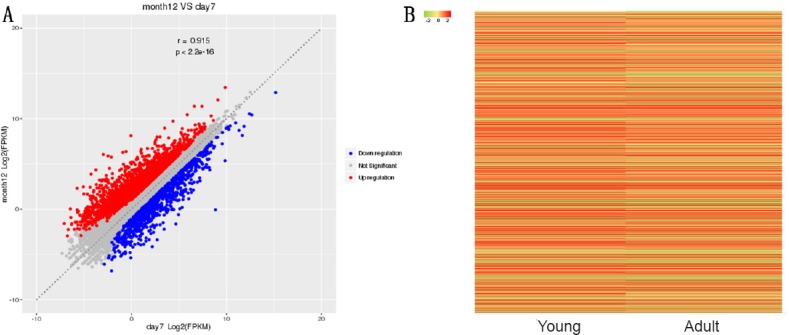
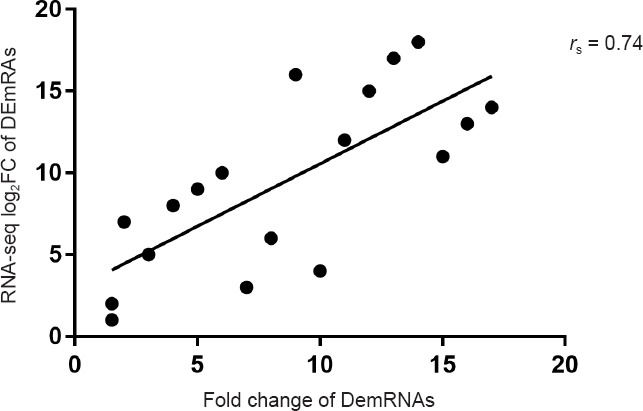
An aging-induced decrease in Schwann cell viability can affect regeneration following peripheral nerve injury in mammals. It is therefore necessary to investigate possible age-related changes in gene expression that may affect the biological function of peripheral nerves. Ten 1-week-old and ten 12-month-old healthy male Sprague-Dawley rats were divided into young (1 week old) and adult (12 months old) groups according to their ages. mRNA expression in the sciatic nerve was compared between young and adult rats using next-generation sequencing (NGS) and bioinformatics (n = 4/group). The 18 groups of differentially expressed mRNA (DEmRNAs) were also tested by quantitative reverse transcription polymerase chain reaction (n = 6/group). Results revealed that (1) compared with young rats, adult rats had 3608 groups of DEmRNAs. Of these, 2684 were groups of upregulated genes, and 924 were groups of downregulated genes. Their functions mainly involved cell viability, proliferation, differentiation, regeneration, and myelination. (2) The gene with the most obvious increase of all DEmRNAs in adult rats was Thrsp (logFC = 9.01, P < 0.05), and the gene with the most obvious reduction was Col2a1 (logFC = -8.89, P < 0.05). (3) Gene Ontology analysis showed that DEmRNAs were mainly concentrated in oligosaccharide binding, nucleotide-binding oligomerization domain containing one signaling pathway, and peptide-transporting ATPase activity. (4) Analysis using the Kyoto Encyclopedia of Genes and Genomes showed that, with increased age, DEmRNAs were mainly enriched in steroid biosynthesis, Staphylococcus aureus infection, and graft-versus-host disease. (5) Spearman's correlation coefficient method for evaluating NGS accuracy showed that the NGS results and quantitative reverse transcription polymerase chain reaction results were positively correlated (r = 0.74, P < 0.05). These findings confirm a difference in sciatic nerve gene expression between adult and young rats, suggesting that, in peripheral nerves, cells and the microenvironment change with age, thus influencing the function and repair of peripheral nerves.
雪旺细胞活力的衰老诱导性降低会影响哺乳动物外周神经损伤后的再生。因此,有必要研究可能与年龄相关的基因表达变化,这些变化可能会影响外周神经的生物学功能。将十只1周龄和十只12月龄的健康雄性Sprague-Dawley大鼠根据年龄分为幼年组(1周龄)和成年组(12月龄)。使用下一代测序(NGS)和生物信息学方法比较幼年和成年大鼠坐骨神经中的mRNA表达(每组n = 4)。还通过定量逆转录聚合酶链反应对18组差异表达的mRNA(DEmRNAs)进行了检测(每组n = 6)。结果显示:(1)与幼年大鼠相比,成年大鼠有3608组DEmRNAs。其中,2684组为上调基因,924组为下调基因。它们的功能主要涉及细胞活力、增殖、分化、再生和髓鞘形成。(2)成年大鼠所有DEmRNAs中增加最明显的基因是Thrsp(logFC = 9.01,P < 0.05),减少最明显的基因是Col2a1(logFC = -8.89,P < 0.05)。(3)基因本体分析表明,DEmRNAs主要集中在寡糖结合、含一个信号通路的核苷酸结合寡聚化结构域和肽转运ATP酶活性。(4)使用京都基因与基因组百科全书进行分析表明,随着年龄的增长,DEmRNAs主要富集在类固醇生物合成、金黄色葡萄球菌感染和移植物抗宿主病。(5)用于评估NGS准确性的Spearman相关系数法表明,NGS结果与定量逆转录聚合酶链反应结果呈正相关(r = 0.74,P < 0.05)。这些发现证实了成年和幼年大鼠坐骨神经基因表达存在差异,表明在外周神经中,细胞和微环境会随年龄变化,从而影响外周神经的功能和修复。