HMH Center for Discovery and Innovation, Nutley, New Jersey, USA.
Public Health Research Institute, Rutgers University-New Jersey Medical School, Newark, New Jersey, USA.
mBio. 2019 Feb 26;10(1):e00120-19. doi: 10.1128/mBio.00120-19.
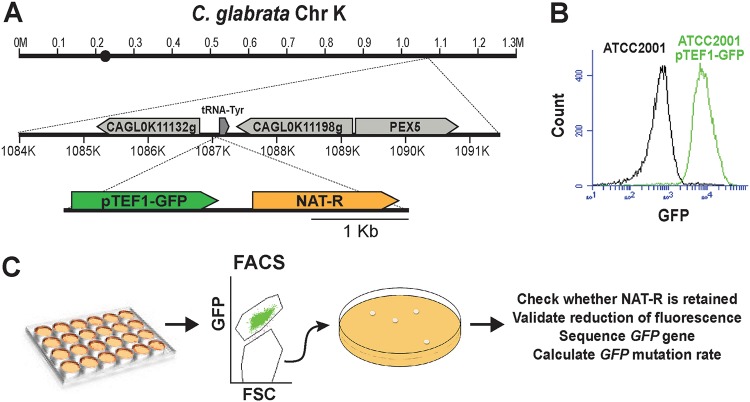
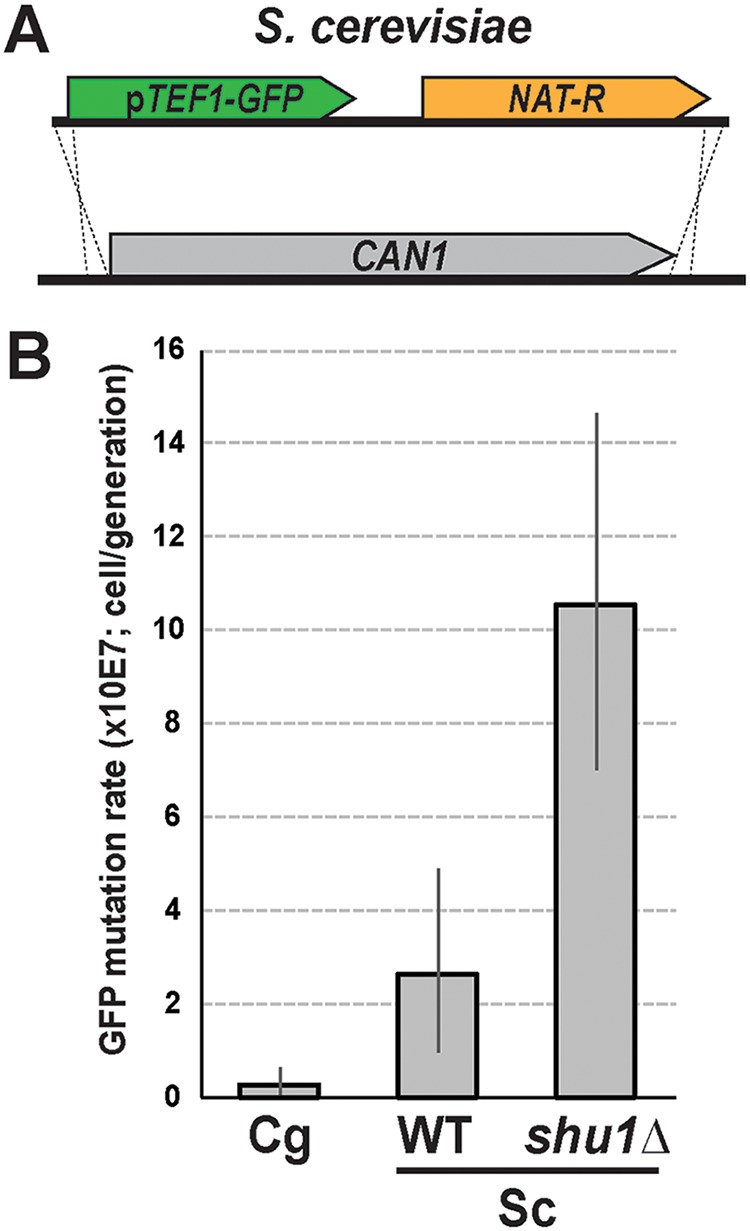
All evolutionary processes are underpinned by a cellular capacity to mutate DNA. To identify factors affecting mutagenesis, it is necessary to compare mutation rates between different strains and conditions. Drug resistance-based mutation reporters are used extensively to measure mutation rates, but they are suitable only when the compared strains have identical drug tolerance levels-a condition that is not satisfied under many "real-world" circumstances, e.g., when comparing mutation rates among a series of environmental or clinical isolates. is a fungal pathogen that shows a high degree of genetic diversity and fast emergence of antifungal drug resistance. To enable meaningful comparisons of mutation rates among clinical isolates, we developed a novel fluorescence-activated cell sorting-based approach to measure the mutation rate of a chromosomally integrated gene. We found that in this approach recapitulated the reported mutation rate of a wild-type strain and the mutator phenotype of a mutant. In , the reporter captured the mutation rate increases caused either by a genotoxic agent or by deletion of DNA mismatch repair gene , as well as the specific mutational signature associated with Finally, the reporter was used to measure the mutation rates of clinical isolates carrying different alleles of Together, these results show that fluorescence-based mutation reporters can be used to measure mutation rates in microbes under conditions of unequal drug susceptibility to reveal new insights about drivers of mutagenesis. Measurements of mutation rates-i.e., how often proliferating cells acquire mutations in their DNA-are essential for understanding cellular processes that maintain genome stability. Many traditional mutation rate measurement assays are based on detecting mutations that cause resistance to a particular drug. Such assays typically work well for laboratory strains but have significant limitations when comparing clinical or environmental isolates that have various intrinsic levels of drug tolerance, which confounds the interpretation of results. Here we report the development and validation of a novel method of measuring mutation rates, which detects mutations that cause loss of fluorescence rather than acquisition of drug resistance. Using this method, we measured the mutation rates of clinical isolates of fungal pathogen This assay can be adapted to other organisms and used to compare mutation rates in contexts where unequal drug sensitivity is anticipated.
所有进化过程都依赖于细胞突变 DNA 的能力。为了确定影响诱变的因素,有必要比较不同菌株和条件下的突变率。基于耐药性的突变报告基因广泛用于测量突变率,但只有在比较菌株具有相同的药物耐受性水平时才适用-在许多“真实世界”情况下,例如,当比较一系列环境或临床分离物之间的突变率时,就不能满足这种条件。 是一种真菌病原体,表现出高度的遗传多样性和快速出现抗真菌药物耐药性。为了能够在 临床分离物之间进行有意义的突变率比较,我们开发了一种新的基于荧光激活细胞分选的方法来测量染色体整合的 基因的突变率。我们发现,在 中,该方法再现了野生型菌株的报道突变率和 突变体的诱变表型。在 中,该报告基因捕获了由遗传毒性剂或 DNA 错配修复基因缺失引起的突变率增加,以及与 相关的特定突变特征。最后,该报告基因用于测量携带不同 等位基因的 临床分离物的突变率。总之,这些结果表明,基于荧光的突变报告基因可用于测量在药物敏感性不等的情况下微生物中的突变率,从而揭示诱变驱动因素的新见解。测量突变率-即增殖细胞在其 DNA 中获得突变的频率-对于了解维持基因组稳定性的细胞过程至关重要。许多传统的突变率测量测定方法都是基于检测导致对特定药物产生抗性的突变。此类测定方法通常适用于实验室菌株,但在比较具有各种内在药物耐受性的临床或环境分离物时具有显著的局限性,这会混淆结果的解释。在这里,我们报告了一种测量突变率的新方法的开发和验证,该方法检测导致荧光丧失而不是获得耐药性的突变。使用这种方法,我们测量了真菌病原体 的临床分离物的突变率。该测定法可适用于其他生物体,并可用于在预期药物敏感性不等的情况下比较突变率。