Department of Gastroenterology, Complejo Hospitalario de Navarra, Pamplona 31008, Spain.
Department of Gastroenterolgy, Hospital Infanta Leonor, Madrid 28031, Spain.
World J Gastroenterol. 2019 Feb 21;25(7):837-847. doi: 10.3748/wjg.v25.i7.837.
Irritable bowel syndrome (IBS) is a highly prevalent condition. It is diagnosed on the basis of chronic symptoms after the clinical and/or investigative exclusion of organic diseases that can cause similar symptoms. There is no reproducible non-invasive test for the diagnosis of IBS, and this raises diagnostic uncertainty among physicians and hinders acceptance of the diagnosis by patients. Functional gastrointestinal (GI) syndromes often present with overlapping upper and lower GI tract symptoms, now believed to be generated by visceral hypersensitivity. This study examines the possibility that, in IBS, a nutrient drink test (NDT) provokes GI symptoms that allow a positive differentiation of these patients from healthy subjects.
To evaluate the NDT for the diagnosis of IBS.
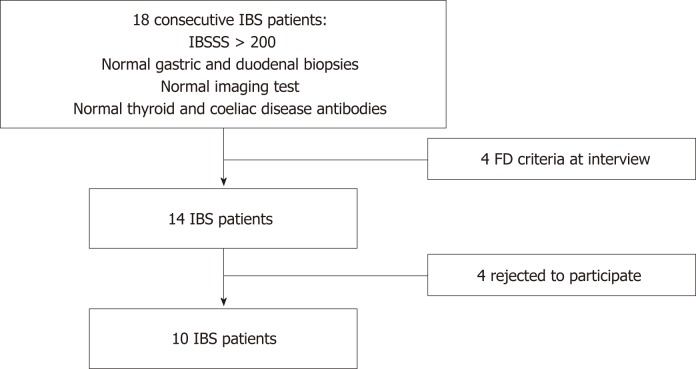
This prospective case-control study compared the effect of two different nutrient drinks on GI symptoms in 10 IBS patients (patients) and 10 healthy controls (controls). The 500 kcal high nutrient drink and the low nutrient 250 kcal drink were given in randomized order on separate days. Symptoms were assessed just before and at several time points after drink ingestion. Global dyspepsia and abdominal scores were derived from individual symptom data recorded by two questionnaires designed by our group, the upper and the general GI symptom questionnaires, respectively. Psycho-social morbidity and quality of life were also formally assessed. The scores of patients and controls were compared using single factor analysis of variance test.
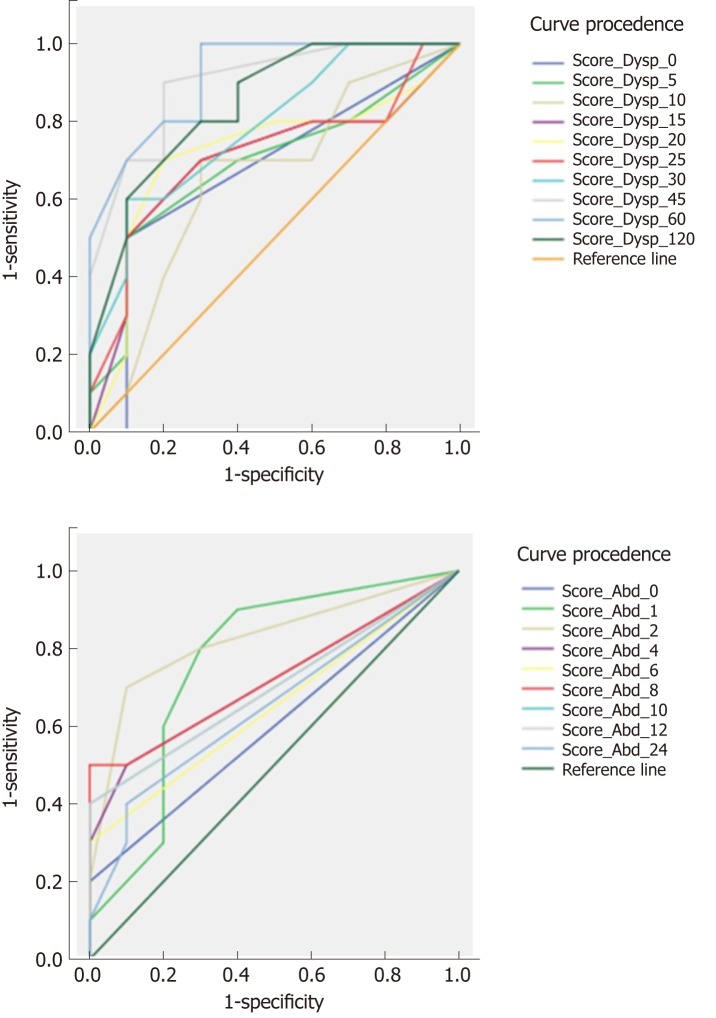
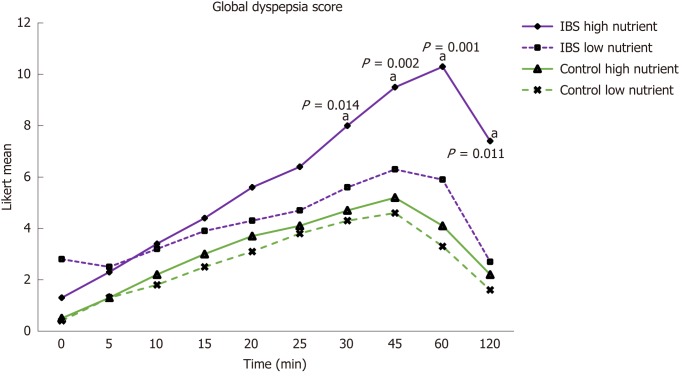
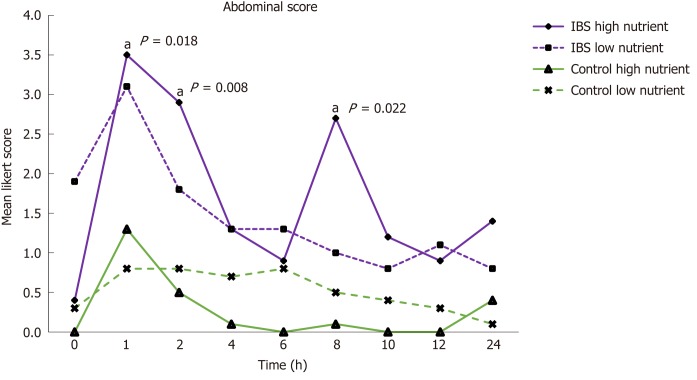
At baseline, IBS patients compared to controls had significantly higher levels of GI symptoms such as gastro-esophageal reflux ( = 0.05), abdominal pain ( = 0.001), dyspepsia ( = 0.001), diarrhea ( = 0.001), and constipation ( = 0.001) as well as higher psycho-social morbidity and lower quality of life. The very low incidence of GI symptoms reported by control subjects did not differ significantly for the two test drinks. Compared with the low nutrient drink, IBS patients with the high nutrient drink had significantly more dyspeptic symptoms at 30 ( = 0.014), 45 ( = 0.002), 60 ( = 0.001), and 120 min ( = 0.011). Dyspeptic symptoms triggered by the high nutrient drink during the first 120 min gave the best differentiation between healthy controls and patients (area under receiver operating curve of 0.915 at 45 min for the dyspepsia score). Continued symptom monitoring for 24 h did not enhance separation of patients from controls.
A high NDT merits further evaluation as a diagnostic tool for IBS.
肠易激综合征(IBS)是一种高发疾病。它是基于慢性症状,在排除可能引起类似症状的器质性疾病的临床和/或调查之后诊断的。目前还没有可重复的非侵入性测试来诊断 IBS,这导致医生在诊断方面存在不确定性,并阻碍了患者对诊断的接受。功能性胃肠(GI)综合征常表现为上消化道和下消化道症状重叠,现在认为这些症状是由内脏高敏引起的。本研究探讨了营养饮料测试(NDT)是否可以引发 GI 症状,从而使这些患者与健康受试者区分开来。
评估 NDT 对 IBS 的诊断价值。
本前瞻性病例对照研究比较了两种不同的营养饮料对 10 名 IBS 患者(患者)和 10 名健康对照(对照)的 GI 症状的影响。在不同的日子里,以随机顺序给予 500 千卡高营养饮料和 250 千卡低营养饮料。在饮料摄入前后的多个时间点评估症状。通过我们小组设计的两个问卷(上消化道症状问卷和一般 GI 症状问卷)记录的个体症状数据得出总体消化不良和腹部评分。还正式评估了心理社会发病率和生活质量。使用单因素方差分析检验比较患者和对照组的评分。
在基线时,与对照组相比,IBS 患者的 GI 症状(如胃食管反流, = 0.05;腹痛, = 0.001;消化不良, = 0.001;腹泻, = 0.001;和便秘, = 0.001)以及更高的心理社会发病率和更低的生活质量显著更高。对照受试者报告的 GI 症状发生率非常低,两种测试饮料之间没有显著差异。与低营养饮料相比,IBS 患者在饮用高营养饮料后 30 分钟( = 0.014)、45 分钟( = 0.002)、60 分钟( = 0.001)和 120 分钟( = 0.011)时的消化不良症状明显更多。高营养饮料在最初 120 分钟内引起的消化不良症状对健康对照组和患者的区分最佳(45 分钟时消化不良评分的受试者工作特征曲线下面积为 0.915)。持续监测 24 小时的症状并不能增强患者与对照组的分离。
高 NDT 值得进一步评估,作为 IBS 的诊断工具。