Section for Gastroenterology, Department of Medicine, Stord Helse-Fonna Hospital, Box 4000, 54 09 Stord, Norway.
Dig Dis Sci. 2012 Apr;57(4):873-8. doi: 10.1007/s10620-011-1948-8. Epub 2011 Nov 5.
The gut hormones are important in regulating gastrointestinal motility. Disturbances in gastrointestinal motility have been reported in patients with irritable bowel syndrome (IBS). Reduced endocrine cell density, as revealed by chromogranin A, has been reported in the colon of IBS patients.
To investigate a possible abnormality in the colonic endocrine cells of IBS patients.
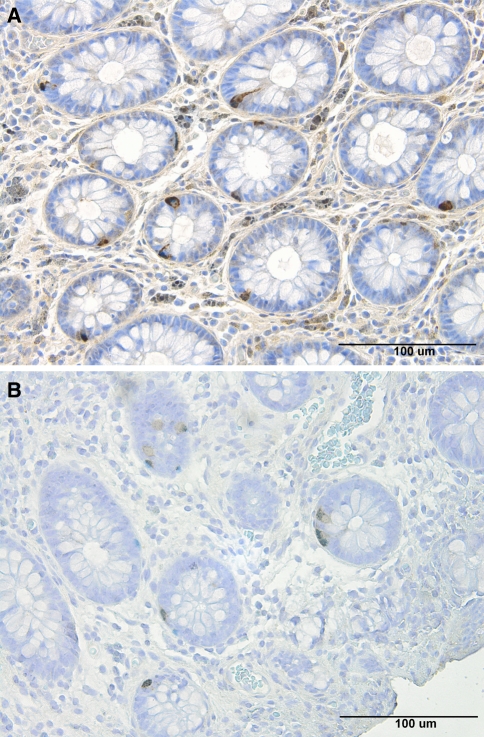
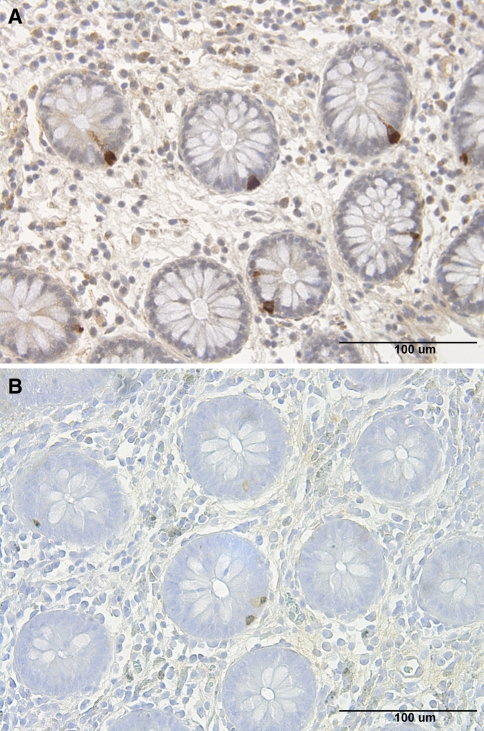
A total of 41 patients with IBS according to Rome Criteria III and 20 controls were included in the study. Biopsies from the right and left colon were obtained from both patients and controls during colonoscopy. The biopsies were immunostained for serotonin, peptide YY (PYY), pancreatic polypeptide (PP), entroglucagon, and somatostatin cells. Cell densities were quantified by computerized image analysis.
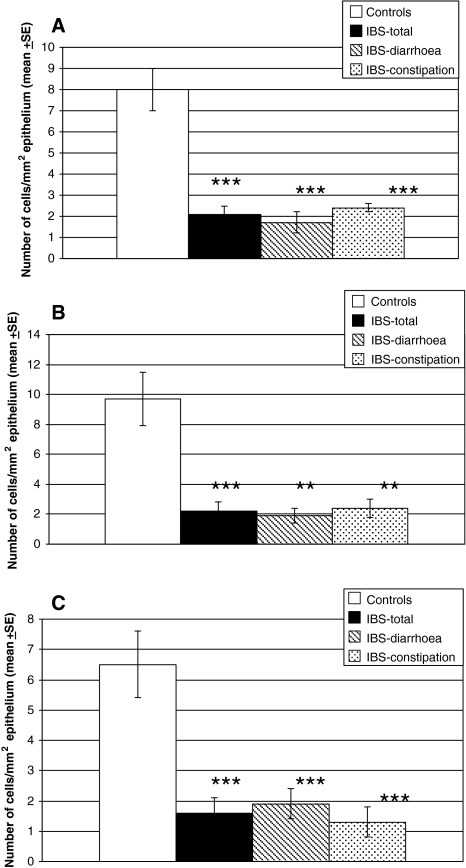
Serotonin and PYY cell densities were reduced in the colon of IBS patients. PP, entroglucagon, and somatostatin-immunoreactive cells were too few to enable reliable quantification.
The cause of these observations could be primary genetic defect(s), secondary to altered serotonin and/or PYY signaling systems and/or subclinical inflammation. Serotonin activates the submucosal sensory branch of the enteric nervous system and controls gastrointestinal motility and chloride secretion via interneurons and motor neurons. PYY stimulates absorption of water and electrolytes, and inhibits prostaglandin (PG) E2, and vasoactive intestinal peptide, which stimulates intestinal fluid secretion and is a major regulator of the "ileal brake". Although the cause and effect relationship of these findings is difficult to elucidate, the abnormalities reported here might contribute to the symptoms associated with IBS.
肠道激素在调节胃肠道动力方面起着重要作用。据报道,肠易激综合征(IBS)患者存在胃肠道动力障碍。据报道,IBS 患者结肠中的嗜铬粒蛋白 A 显示内分泌细胞密度降低。
研究 IBS 患者结肠内分泌细胞是否存在异常。
本研究共纳入 41 例符合罗马 III 标准的 IBS 患者和 20 例对照者。在结肠镜检查过程中,从患者和对照者的右半结肠和左半结肠采集活检。对活检进行 5-羟色胺、肽 YY(PYY)、胰多肽(PP)、肠高血糖素和生长抑素细胞免疫染色。通过计算机图像分析对细胞密度进行定量。
IBS 患者结肠中的 5-羟色胺和 PYY 细胞密度降低。PP、肠高血糖素和生长抑素免疫反应性细胞太少,无法进行可靠的定量。
这些观察结果的原因可能是原发性遗传缺陷(s),继发于改变的 5-羟色胺和/或 PYY 信号系统和/或亚临床炎症。5-羟色胺激活肠神经系统的黏膜下感觉分支,通过中间神经元和运动神经元控制胃肠道动力和氯离子分泌。PYY 刺激水和电解质的吸收,抑制前列腺素(PG)E2 和血管活性肠肽,后者刺激肠道液体分泌,是“回肠制动”的主要调节剂。尽管这些发现的因果关系难以阐明,但此处报道的异常可能与 IBS 相关症状有关。