Drebitz Eric, Schledde Bastian, Kreiter Andreas K, Wegener Detlef
Brain Research Institute, Center for Cognitive Science, University of Bremen, Bremen, Germany.
Front Neurosci. 2019 Feb 12;13:83. doi: 10.3389/fnins.2019.00083. eCollection 2019.
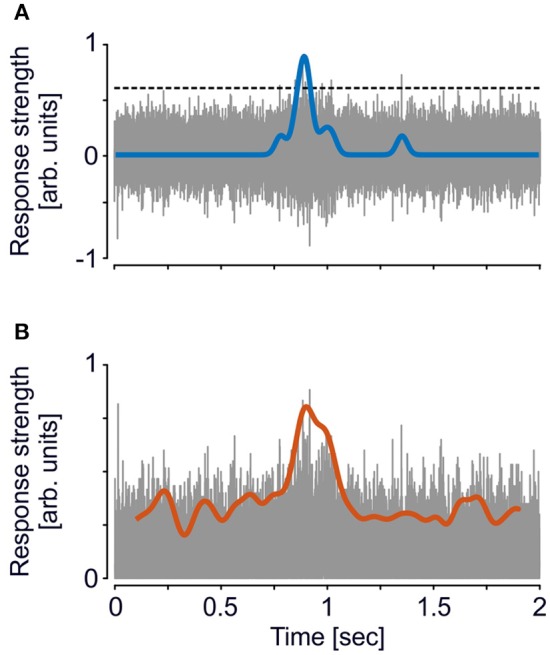
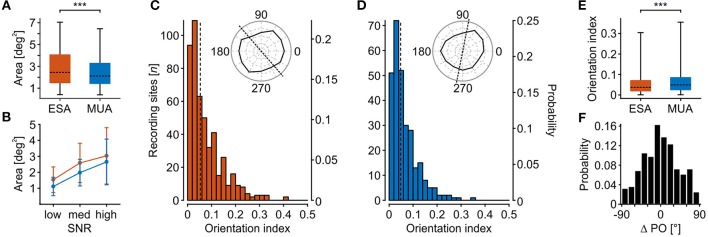
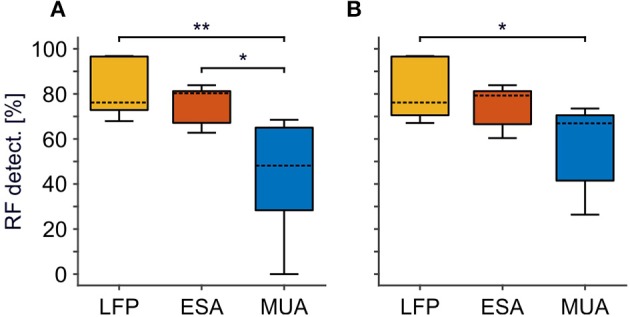
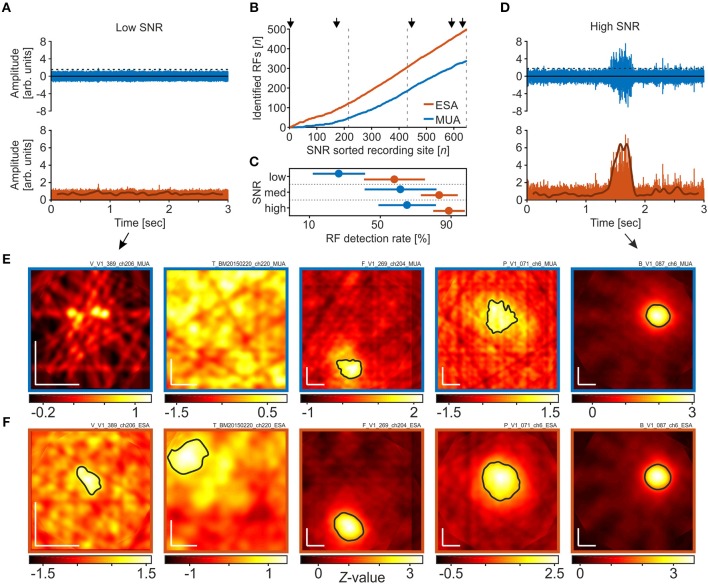
Neurophysiological data acquisition using multi-electrode arrays and/or (semi-) chronic recordings frequently has to deal with low signal-to-noise ratio (SNR) of neuronal responses and potential failure of detecting evoked responses within random background fluctuations. Conventional methods to extract action potentials (spikes) from background noise often apply thresholds to the recorded signal, usually allowing reliable detection of spikes when data exhibit a good SNR, but often failing when SNR is poor. We here investigate a threshold-independent, fast, and automated procedure for analysis of low SNR data, based on fullwave-rectification and low-pass filtering the signal as a measure of the entire spiking activity (ESA). We investigate the sensitivity and reliability of the ESA-signal for detecting evoked responses by applying an automated receptive field (RF) mapping procedure to semi-chronically recorded data from primary visual cortex (V1) of five macaque monkeys. For recording sites with low SNR, the usage of ESA improved the detection rate of RFs by a factor of 2.5 in comparison to MUA-based detection. For recording sites with medium and high SNR, ESA delivered 30% more RFs than MUA. This significantly higher yield of ESA-based RF-detection still hold true when using an iterative procedure for determining the optimal spike threshold for each MUA individually. Moreover, selectivity measures for ESA-based RFs were quite compatible with MUA-based RFs. Regarding RF size, ESA delivered larger RFs than thresholded MUA, but size difference was consistent over all SNR fractions. Regarding orientation selectivity, ESA delivered more sites with significant orientation-dependent responses but with somewhat lower orientation indexes than MUA. However, preferred orientations were similar for both signal types. The results suggest that ESA is a powerful signal for applications requiring automated, fast, and reliable response detection, as e.g., brain-computer interfaces and neuroprosthetics, due to its high sensitivity and its independence from user-dependent intervention. Because the full information of the spiking activity is preserved, ESA also constitutes a valuable alternative for offline analysis of data with limited SNR.
使用多电极阵列和/或(半)慢性记录进行神经生理数据采集时,经常需要处理神经元反应的低信噪比(SNR)以及在随机背景波动中检测诱发反应的潜在失败。从背景噪声中提取动作电位(尖峰)的传统方法通常对记录信号应用阈值,通常在数据具有良好信噪比时允许可靠地检测尖峰,但在信噪比差时往往失败。我们在此研究一种基于全波整流和对信号进行低通滤波以测量整个尖峰活动(ESA)的与阈值无关、快速且自动化的低信噪比数据分析程序。我们通过将自动感受野(RF)映射程序应用于五只猕猴初级视觉皮层(V1)的半慢性记录数据,研究了ESA信号检测诱发反应的敏感性和可靠性。对于低信噪比的记录位点,与基于多单元活动(MUA)的检测相比,ESA的使用将RF的检测率提高了2.5倍。对于中高信噪比的记录位点,ESA比MUA多提供30%的RF。当使用迭代程序为每个MUA单独确定最佳尖峰阈值时,基于ESA的RF检测的这种显著更高的产量仍然成立。此外,基于ESA的RF的选择性测量与基于MUA的RF相当兼容。关于RF大小,ESA提供的RF比阈值化的MUA更大,但大小差异在所有信噪比分数上都是一致的。关于方向选择性,ESA提供了更多具有显著方向依赖性反应的位点,但方向指数比MUA略低。然而,两种信号类型的偏好方向相似。结果表明,由于其高灵敏度和独立于用户依赖干预,ESA对于需要自动、快速和可靠反应检测的应用(如脑机接口和神经假体)是一种强大的信号。由于尖峰活动的完整信息得以保留,ESA对于低信噪比数据的离线分析也构成了一种有价值的替代方法。