Laven Joop S E
Division of Reproductive Endocrinology and Infertility, Department of Obstetrics and Gynaecology, Erasmus University Medical Center, Rotterdam, Netherlands.
Front Endocrinol (Lausanne). 2019 Feb 12;10:23. doi: 10.3389/fendo.2019.00023. eCollection 2019.
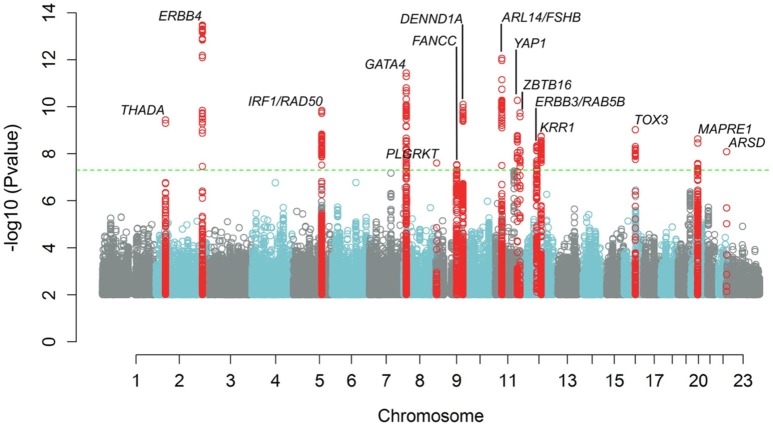
Polycystic ovary syndrome (PCOS) is the commonest endocrine abnormality in women of reproductive age typically presenting with chronic oligo- or anovulation, clinical, or biochemical hyperandrogenism and polycystic ovarian morphology (PCOM). Restoring mono-ovulation is the ultimate goal of ovulation induction and most women do respond to ovulation inducing agents causing their Follicle-stimulating hormone (FSH) levels to rise. Familial clustering and the results from twin studies strongly support an underlying genetic basis for PCOS. Recent Genome wide association studies (GWAS) have identified several genetic variants being genome wide significantly associated with PCOS. Amongst those are variants in or near the Luteinizing hormone (LH) and FSH receptor genes as well as a variant in the FSH-β gene. The aim of this review is to summarize the available evidence as to whether single nucleotide polymorphisms are able to modify the PCOS phenotype or whether they constitute a risk factor for the syndrome. Data on the role of FSHR polymorphisms in PCOS are conflicting. It seems that in large Chinese studies FSHR polymorphisms are not associated with either PCOS risk or with PCOS treatment outcome. However, in large scale studies in Caucasians these polymorphisms seem to influence the risk of having PCOS. Moreover, these studies also showed that some polymorphisms might affect some clinical features of PCOS as well as treatment outcome. Although most research has focussed on the role of FSHR polymorphisms there seems to be also some evidence showing that single nucleotide polymorphisms (SNPs) in the LHCG-Receptor as well as those in FSH-β gene might also alter the phenotype of PCOS. In conclusion most studies confirm that FSHR polymorphisms do alter the phenotype of PCOS in that they either alter the response to exogenous FSH or hat they increase the risk of having PCOS.
多囊卵巢综合征(PCOS)是育龄女性中最常见的内分泌异常疾病,通常表现为慢性少排卵或无排卵、临床或生化高雄激素血症以及多囊卵巢形态(PCOM)。恢复单卵泡排卵是促排卵的最终目标,大多数女性对促排卵药物有反应,导致其促卵泡生成素(FSH)水平升高。家族聚集现象以及双胞胎研究结果有力地支持了PCOS存在潜在遗传基础。最近的全基因组关联研究(GWAS)已经确定了几个与PCOS全基因组显著相关的基因变异。其中包括促黄体生成素(LH)和FSH受体基因内或附近的变异以及FSH-β基因的一个变异。本综述的目的是总结关于单核苷酸多态性是否能够改变PCOS表型或是否构成该综合征危险因素的现有证据。关于FSHR多态性在PCOS中的作用的数据存在冲突。在大型中国研究中,FSHR多态性似乎与PCOS风险或PCOS治疗结果均无关。然而,在高加索人的大规模研究中,这些多态性似乎会影响患PCOS的风险。此外,这些研究还表明,一些多态性可能会影响PCOS的一些临床特征以及治疗结果。尽管大多数研究集中在FSHR多态性的作用上,但似乎也有一些证据表明,LHCG受体中的单核苷酸多态性(SNP)以及FSH-β基因中的单核苷酸多态性也可能改变PCOS的表型。总之,大多数研究证实FSHR多态性确实会改变PCOS的表型,因为它们要么改变对外源性FSH 的反应,要么增加患PCOS的风险。