Seitz Jochen, Belheouane Meriem, Schulz Nina, Dempfle Astrid, Baines John F, Herpertz-Dahlmann Beate
Department of Child and Adolescent Psychiatry, Psychotherapy and Psychosomatics, University Hospital, RWTH University Aachen, Aachen, Germany.
Institute for Experimental Medicine, Kiel University and Max Planck Institute for Evolutionary Biology, Plön, Germany.
Front Endocrinol (Lausanne). 2019 Feb 12;10:41. doi: 10.3389/fendo.2019.00041. eCollection 2019.
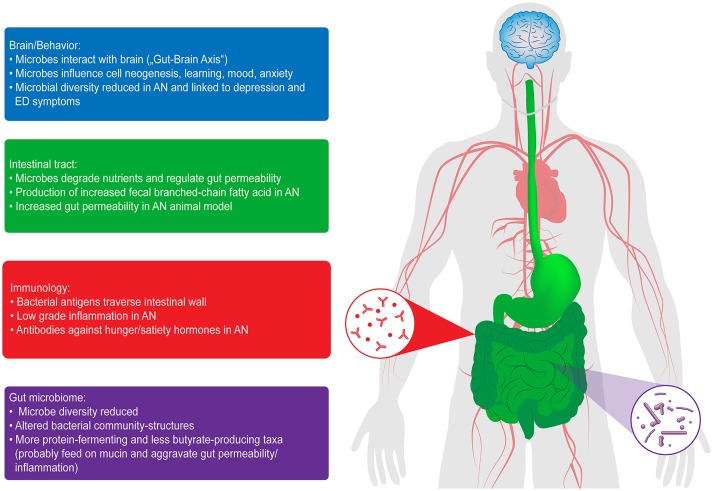
Interactions between the gut microbiome and the brain are of increasing interest to both researchers and clinicians. Evidence is mounting on the causal role of an altered gut microbiome in inflammatory diseases such as arthritis, inflammatory bowel disease, obesity and diabetes, and psychiatric diseases like anxiety and depression. Mechanisms include altered energy harvest from food, hormonal changes, increased gut permeability, inflammation, immune response, and a direct influence on the brain and behavior. Anorexia nervosa (AN) is the third most common disease in adolescence and exacts a high burden on patients and caregivers. It often becomes chronic and has the highest mortality of all psychiatric diseases. As AN is characterized by nutritional restrictions, weight loss, and severe behavioral symptoms including weight phobia, comorbid anxiety and depression, accompanied by endocrine alterations, increased inflammation, and immune response, exploring the role of the gut microbiome is crucial. Here, we present an overview of the potential mechanisms of interaction between the gut microbiome, the host and particularly the brain in AN and summarize the initial findings of microbiome research on AN. We conclude by identifying future research directions and potential therapeutic approaches, including nutritional interventions, probiotics, prebiotics and food supplements, that could become important additions to current AN therapy.
肠道微生物群与大脑之间的相互作用越来越受到研究人员和临床医生的关注。越来越多的证据表明,肠道微生物群改变在关节炎、炎症性肠病、肥胖症和糖尿病等炎症性疾病以及焦虑和抑郁等精神疾病中具有因果作用。其机制包括食物能量摄取改变、激素变化、肠道通透性增加、炎症、免疫反应以及对大脑和行为的直接影响。神经性厌食症(AN)是青少年中第三常见的疾病,给患者和照顾者带来沉重负担。它往往会发展成慢性病,是所有精神疾病中死亡率最高的。由于AN的特征是营养限制、体重减轻以及包括体重恐惧症、合并焦虑和抑郁在内的严重行为症状,同时伴有内分泌改变、炎症增加和免疫反应,因此探索肠道微生物群的作用至关重要。在此,我们概述了肠道微生物群、宿主尤其是大脑在AN中相互作用的潜在机制,并总结了关于AN的微生物群研究的初步发现。我们最后确定了未来的研究方向和潜在的治疗方法,包括营养干预、益生菌、益生元和食品补充剂,这些可能成为当前AN治疗的重要补充。