Li Min, Anand Robbyn K
Department of Chemistry , Iowa State University , Ames , IA 50011 , USA . Email:
Chem Sci. 2018 Nov 26;10(5):1506-1513. doi: 10.1039/c8sc04804e. eCollection 2019 Feb 7.
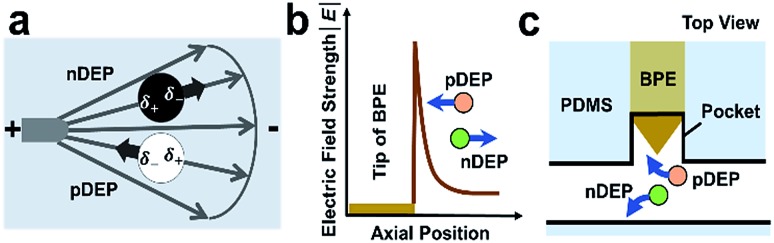
We present integration of selective single-cell capture at an array of wireless electrodes (bipolar electrodes, BPEs) with transfer into chambers, reagent exchange, fluidic isolation and rapid electrical lysis in a single platform, thus minimizing sample loss and manual intervention steps. The whole process is achieved simply by exchanging the solution in a single inlet reservoir and by adjusting the applied voltage at a pair of driving electrodes, thus making this approach particularly well-suited for a broad range of research and clinical applications. Further, the use of BPEs allows the array to be scalable to increase throughput. Specific innovations reported here include the incorporation of a leak channel to balance competing flow paths, the use of 'split BPEs' to create a distinct recapture and electrical lysis point within the reaction chamber, and the dual purposing of an ionic liquid as an immiscible phase to seal the chambers and as a conductive medium to permit electrical lysis at the split BPEs.
我们展示了在无线电极阵列(双极电极,BPEs)上进行选择性单细胞捕获,并将其转移到腔室中,实现试剂交换、流体隔离和快速电裂解,且均在单个平台上完成,从而将样品损失和手动干预步骤降至最低。整个过程只需通过更换单个进样储液器中的溶液,并调节一对驱动电极上施加的电压即可实现,因此该方法特别适用于广泛的研究和临床应用。此外,使用BPEs可使阵列实现扩展以提高通量。此处报道的具体创新包括引入泄漏通道以平衡相互竞争的流动路径,使用“分体BPEs”在反应室内创建独特的重新捕获和电裂解点,以及将离子液体双重用作不混溶相以密封腔室和用作导电介质以在分体BPEs处实现电裂解。