Feng Limin, Li Lifeng, Liu Wennan, Yang Jianzhou, Wang Qing, Shi Le, Luo Mingchi
Department of Cardiology, The Second Affiliated Hospital of Tianjin University of Traditional Chinese Medicine, Tianjin.
Department of Traditional Chinese Medicine, Tianjin Public Security Hospital, Tianjin.
Medicine (Baltimore). 2019 Feb;98(8):e14596. doi: 10.1097/MD.0000000000014596.
Depression is common in the aftermath of myocardial infarction (MI) and may not only lead to impaired long-term quality of life, but also cause increased mortality among patients with MI. The reported prevalence of depression among patients with MI varied considerably across studies, for which a pooled prevalence was obtained in the only 1 meta-analysis conducted in March 2004. Subsequently, numerous relevant studies have been published, indicating the need for an update on the pooled prevalence. Therefore, this study was aimed at updating the pooled prevalence of depression among patients with MI.
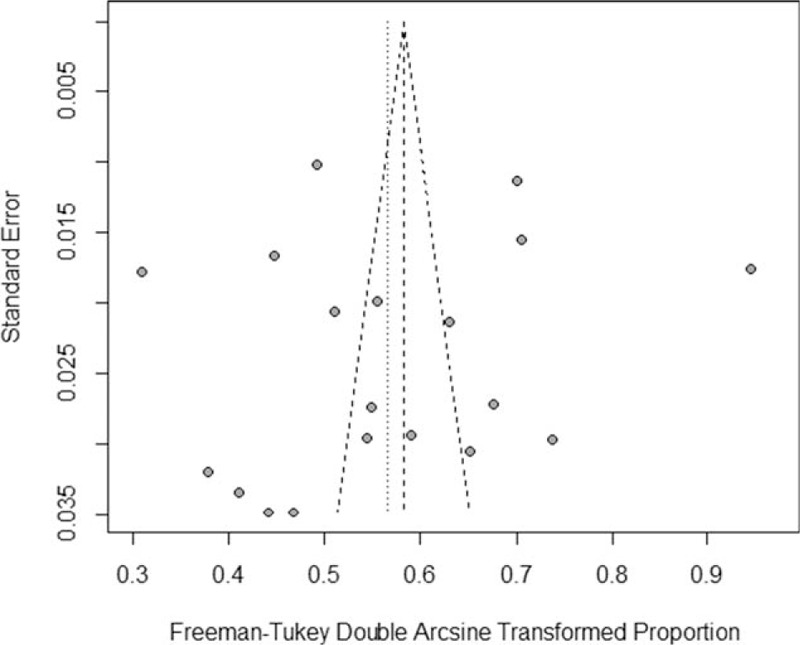
A comprehensive literature search in 3 electronic databases, PubMed, Embase, and PsycINFO, was performed in April 2018. The heterogeneity across studies was examined by the Cochran's Q test and quantified by the I statistic. If significant heterogeneity was observed, meta-regression analyses and subgroup analyses were performed to identify the source of heterogeneity. Publication bias was assessed by a funnel plot and verified by the Egger's and Begg's tests.
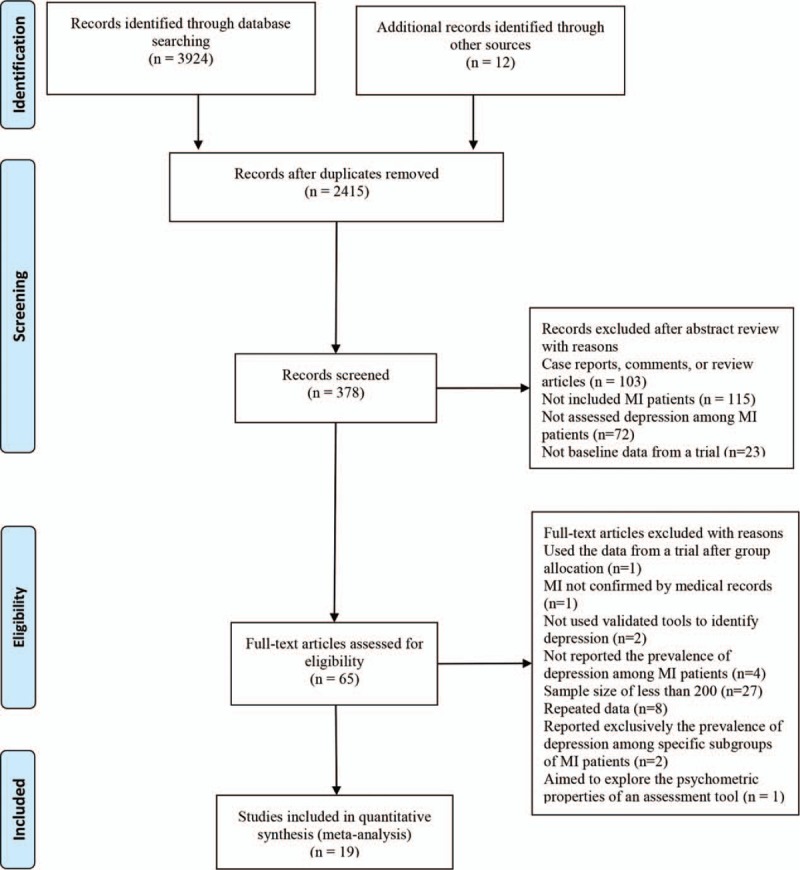
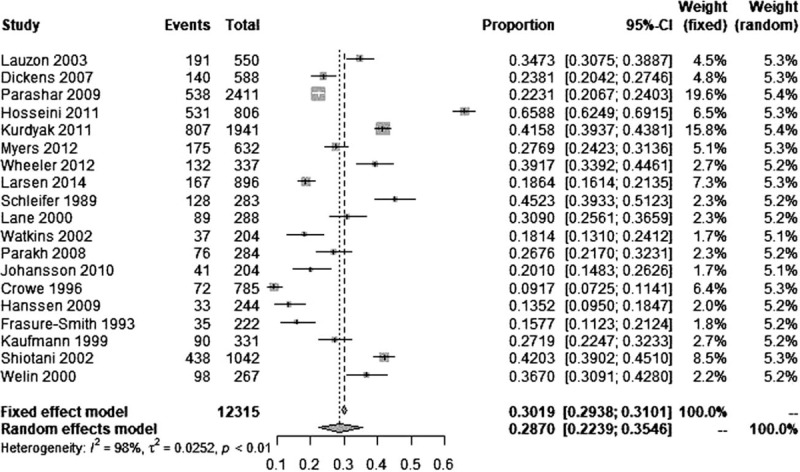
Nineteen eligible studies conducted in 10 countries were included, which consisted of 12,315 patients with MI, among whom 3818 were identified with depression. High heterogeneity was observed across the eligible studies (I = 98.4%), with the reported prevalence of depression ranging from 9.17% to 65.88%. The pooled prevalence of depression among patients with MI was 28.70% (95% CI: 22.39-35.46%) by a random effects model. Subgroup analyses showed that the pooled prevalence differed significantly by region, tool used to identify depression, study quality, sex, race, anterior MI, and diabetes status (P < .05). Meta-regression analyses did not identify any moderators of heterogeneity, and the heterogeneity was high within most subgroups. Nonetheless, for unmarried subjects, the heterogeneity was low (I = 19.5). The Egger's test and the Begg's test indicated no evidence of publication bias (P > .05).
Given the high pooled prevalence of depression found in this study and the association between depression and adverse health outcomes among patients with MI, more psychological resources including early assessment and effective treatment of depression should be allocated to patients with MI.
抑郁症在心肌梗死(MI)后很常见,不仅可能导致长期生活质量受损,还会使MI患者的死亡率增加。各研究报告的MI患者抑郁症患病率差异很大,在2004年3月进行的唯一一项荟萃分析中得出了合并患病率。随后,大量相关研究发表,表明需要更新合并患病率。因此,本研究旨在更新MI患者抑郁症的合并患病率。
2018年4月在3个电子数据库PubMed、Embase和PsycINFO中进行了全面的文献检索。通过Cochran's Q检验检查研究间的异质性,并通过I统计量进行量化。如果观察到显著的异质性,则进行meta回归分析和亚组分析以确定异质性来源。通过漏斗图评估发表偏倚,并通过Egger检验和Begg检验进行验证。
纳入了在10个国家进行的19项符合条件的研究,共12315例MI患者,其中3818例被诊断为抑郁症。在符合条件的研究中观察到高度异质性(I = 98.4%),报告的抑郁症患病率从9.17%到65.88%不等。采用随机效应模型得出MI患者抑郁症的合并患病率为28.70%(95%CI:22.39 - 35.46%)。亚组分析表明,合并患病率在地区、用于识别抑郁症的工具、研究质量、性别、种族、前壁心肌梗死和糖尿病状态方面存在显著差异(P < 0.05)。Meta回归分析未发现任何异质性调节因素,且大多数亚组内异质性较高。然而,对于未婚受试者,异质性较低(I = 19.5)。Egger检验和Begg检验均未显示存在发表偏倚的证据(P > 0.05)。
鉴于本研究中发现的抑郁症合并患病率较高,以及抑郁症与MI患者不良健康结局之间的关联,应向MI患者分配更多的心理资源,包括早期评估和有效的抑郁症治疗。