Division of Human Nutrition, Wageningen University, P.O. Box 17, 6700 AA Wageningen, The Netherlands.
Department of Gynaecology and Obstetrics, Hospital Gelderse Vallei Ede, P.O. Box 9025, 6710 HN Ede, The Netherlands.
Nutrients. 2019 Feb 22;11(2):460. doi: 10.3390/nu11020460.
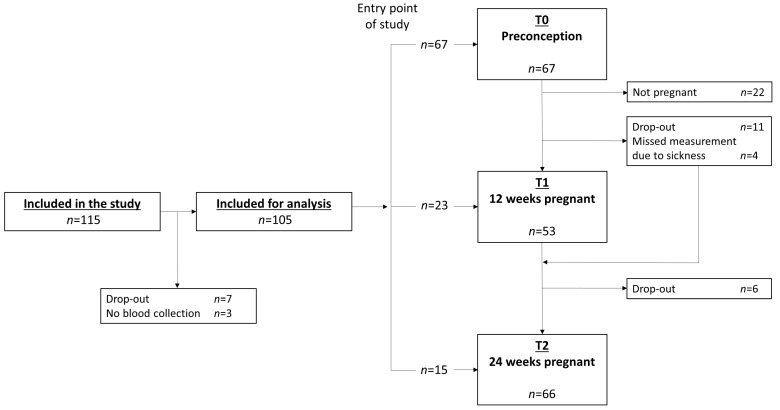
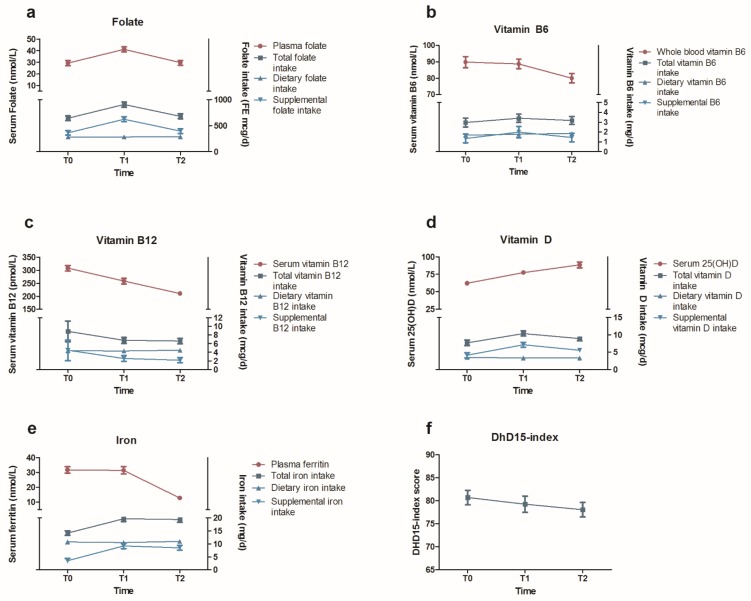
Data on changes in dietary intake and related blood parameters throughout pregnancy are scarce; moreover, few studies have examined their association with glucose homeostasis. Therefore, we monitored intake of folate, vitamin B6, vitamin B12, vitamin D and iron, their status markers, and diet quality from preconception to the second trimester of pregnancy, and we examined whether these dietary factors were associated with glucose homeostasis during pregnancy. We included 105 women aged 18⁻40 years with a desire to get pregnancy or who were already <24 weeks pregnant. Women at increased gestational diabetes (GDM) risk were oversampled. Measurements were scheduled at preconception ( = 67), and 12 ( =53) and 24 weeks of pregnancy ( =66), including a fasting venipuncture, 75-grams oral glucose tolerance test, and completion of a validated food frequency questionnaire. Changes in micronutrient intake and status, and associations between dietary factors and glucose homeostasis, were examined using adjusted repeated measures mixed models. Micronutrient intake of folate, vitamin B6 and vitamin D and related status markers significantly changed throughout pregnancy, which was predominantly due to changes in the intake of supplements. Micronutrient intake or status levels were not associated with glucose homeostasis, except for iron intake (FE µg/day) with fasting glucose (β = -0.069 mmol/L, = 0.013) and HbA1c (β = -0.4843 mmol, = 0.002). Diet quality was inversely associated with fasting glucose (β = -0.006 mmol/L for each DHD15-index point, = 0.017). It was shown that micronutrient intakes and their status markers significantly changed during pregnancy. Only iron intake and diet quality were inversely associated with glucose homeostasis.
关于整个孕期饮食摄入和相关血液参数变化的数据很少;此外,很少有研究检查这些变化与葡萄糖稳态之间的关系。因此,我们从受孕前到孕中期监测了叶酸、维生素 B6、维生素 B12、维生素 D 和铁的摄入量及其状态标志物和饮食质量,并检查了这些饮食因素是否与孕期葡萄糖稳态有关。我们纳入了 105 名年龄在 18⁻40 岁之间、有怀孕意愿或已怀孕 <24 周的女性。对有较高妊娠糖尿病(GDM)风险的女性进行了超采样。测量计划在受孕前(=67)、12 周(=53)和 24 周(=66)进行,包括空腹静脉采血、75 克口服葡萄糖耐量试验和完成经过验证的食物频率问卷。使用调整后的重复测量混合模型检查微量营养素摄入和状态的变化以及饮食因素与葡萄糖稳态之间的关系。叶酸、维生素 B6 和维生素 D 的微量营养素摄入及其相关状态标志物在整个孕期显著变化,这主要是由于补充剂摄入量的变化。除了铁摄入(FE µg/天)与空腹血糖(β = -0.069 mmol/L, = 0.013)和 HbA1c(β = -0.4843 mmol, = 0.002)外,微量营养素摄入或状态水平与葡萄糖稳态无关。饮食质量与空腹血糖呈负相关(DHD15 指数每增加一个点,β = -0.006 mmol/L, = 0.017)。结果表明,孕期微量营养素摄入量及其状态标志物显著变化。只有铁摄入和饮食质量与葡萄糖稳态呈负相关。