Okubo Naoya, Kurata Yohei
Graduate School of Bioresource Sciences, Nihon University, 1866 Kameino, Fujisawa, Kanagawa 252-0880, Japan.
College of Bioresource Sciences, Nihon University, 1866 Kameino, Fujisawa, Kanagawa 252-0880, Japan.
Foods. 2019 Feb 22;8(2):82. doi: 10.3390/foods8020082.
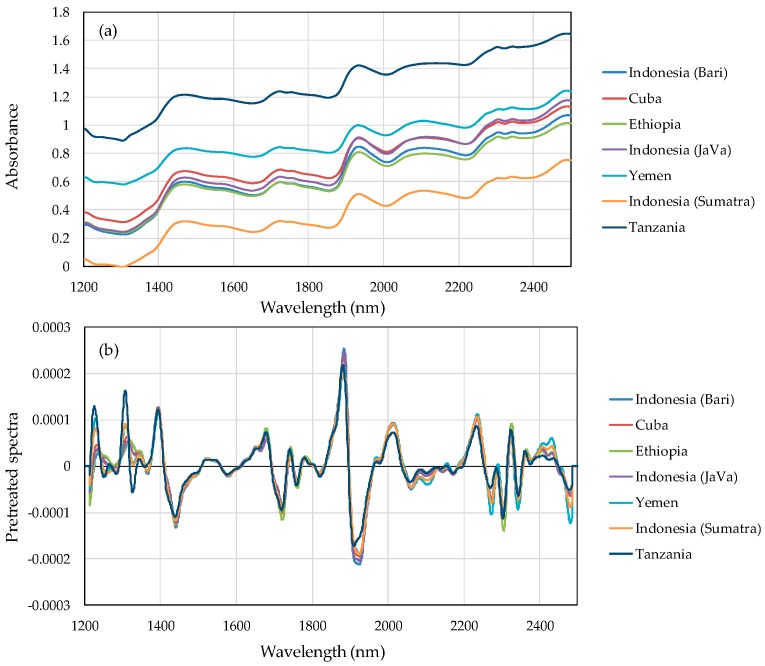
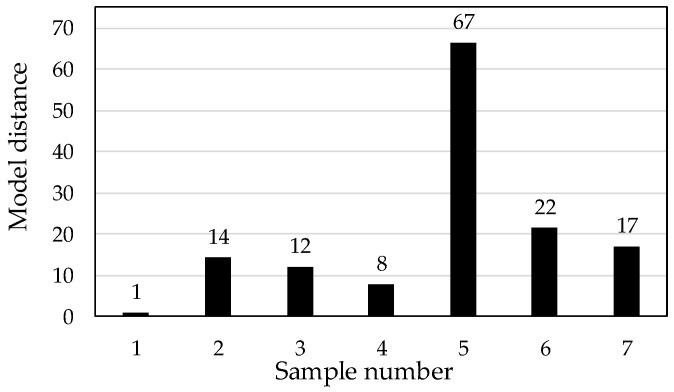
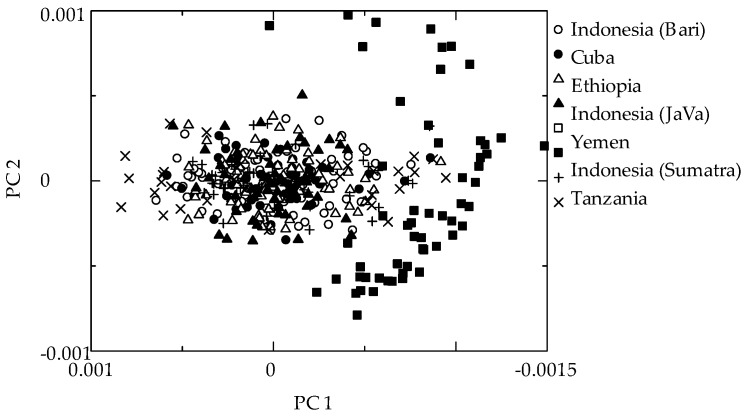
Near-infrared spectroscopy (NIRS) is a powerful tool for the nondestructive evaluation of organic materials, and it has found widespread use in a variety of industries. In the food industry, it is important to know the district in which a particular food was produced. Therefore, in this study, we focused on determining the production area (five areas and three districts) of green coffee beans using classification analysis and NIRS. Soft independent modeling of class analogy (SIMCA) was applied as the classification method. Samples of green coffee beans produced in seven locations-Cuba, Ethiopia, Indonesia (Bari, Java, and Sumatra), Tanzania, and Yemen-were analyzed. These regions were selected since green coffee beans from these locations are commonly sold in Japan supermarkets. A good classification result was obtained with SIMCA for the seven green bean samples, although some samples were partly classified into several categories. Then, the model distance values of SIMCA were calculated and compared. A few model distance values were ~10; such small values may be the reason for misclassification. However, over a 73% correct classification rate could be achieved for the different kinds of green coffee beans using NIRS.
近红外光谱(NIRS)是一种用于有机材料无损评估的强大工具,已在各种行业中广泛应用。在食品行业,了解特定食品的产地很重要。因此,在本研究中,我们专注于使用分类分析和近红外光谱来确定生咖啡豆的产地(五个区域和三个地区)。采用类类比软独立建模(SIMCA)作为分类方法。对在七个地点——古巴、埃塞俄比亚、印度尼西亚(巴里、爪哇和苏门答腊)、坦桑尼亚和也门——生产的生咖啡豆样本进行了分析。选择这些地区是因为来自这些地点的生咖啡豆通常在日本超市销售。使用SIMCA对七个生咖啡豆样本获得了良好的分类结果,尽管一些样本被部分归类到几个类别中。然后,计算并比较了SIMCA的模型距离值。有几个模型距离值约为10;如此小的值可能是分类错误的原因。然而,使用近红外光谱对不同种类的生咖啡豆可以实现超过73%的正确分类率。