Exercise and Performance Nutrition Laboratory, Department of Exercise Science, Lindenwood University, St. Charles, MO 63301, USA.
Sport Medicine Research, Mayo Clinic Health Systems, Onalaska, WI 54650, USA.
Nutrients. 2019 Feb 23;11(2):470. doi: 10.3390/nu11020470.
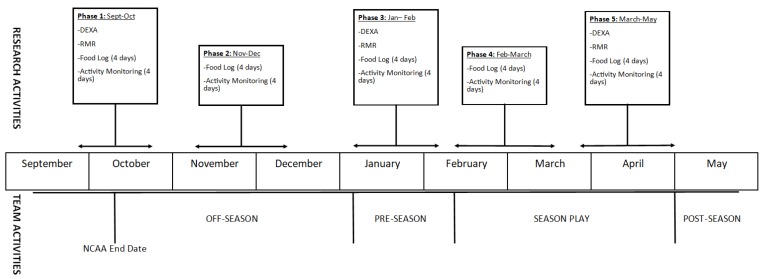
Little data is available regarding the energy and nutritional status of female collegiate team sport athletes. Twenty female NCAA Division II lacrosse athletes (mean ± SD: 20.4 ± 1.8 years; 68.8 ± 8.9 kg; 168.4 ± 6.6 cm; 27.9 ± 3% body fat) recorded dietary intake and wore a physical activity monitor over four consecutive days at five different time points (20 days total) during one academic year. Body composition, bone health, and resting metabolic rate were assessed in conjunction with wearing the monitor during off-season, pre-season, and season-play. Body fat percentage decreased slightly during the course of this study ( = 0.037). Total daily energy expenditure (TDEE) ( < 0.001) and activity energy expenditure (AEE) ( = 0.001) energy were found to change significantly over the course of the year, with pre-season training resulting in the highest energy expenditures (TDEE: 2789 ± 391 kcal/day; AEE: 1001 ± 267 kcal/day). Caloric (2124 ± 448 kcal/day), carbohydrate (3.6 ± 1.1 g/kg), and protein (1.2 ± 0.3 g/kg) intake did not change over the course of the year ( > 0.05). Athletes self-reported a moderate negative energy balance (366⁻719 kcal/day) and low energy availability (22.9⁻30.4 kcal/kg FFM) at each measurement period throughout the study. Reported caloric and macronutrient intake was low given the recorded energy expenditure and macronutrient intake recommendations for athletes. Athletic support staff should provide athletes with appropriate fueling strategies, particularly during pre-season training, to adequately meet energy demands.
关于女性大学生团队运动运动员的能量和营养状况的数据很少。二十名 NCAA 二级联赛长曲棍球运动员(平均±标准差:20.4±1.8 岁;68.8±8.9 公斤;168.4±6.6 厘米;27.9±3%体脂)在一个学术年中,在五个不同时间点(共 20 天)连续四天记录饮食摄入量,并佩戴一个身体活动监测器。在淡季、季前赛和赛季比赛期间,同时评估身体成分、骨骼健康和静息代谢率。在研究过程中,体脂百分比略有下降( = 0.037)。总每日能量消耗(TDEE)(<0.001)和活动能量消耗(AEE)(=0.001)能量在一年中发生了显著变化,季前赛训练导致能量消耗最高(TDEE:2789±391 kcal/天;AEE:1001±267 kcal/天)。热量(2124±448 kcal/天)、碳水化合物(3.6±1.1 g/kg)和蛋白质(1.2±0.3 g/kg)的摄入量在一年中没有变化(>0.05)。运动员在整个研究过程中的每个测量期都报告了中度负能量平衡(366⁻719 kcal/天)和低能量供应(22.9⁻30.4 kcal/kg FFM)。考虑到记录的能量消耗和运动员的宏量营养素摄入建议,报告的热量和宏量营养素摄入较低。运动支持人员应向运动员提供适当的燃料策略,特别是在季前赛训练期间,以充分满足能量需求。