Shrivastwa Nijika, Wagner Abram L, Boulton Matthew L
Department of Epidemiology, University of Michigan, Ann Arbor, MI 48109, USA.
Department of Internal Medicine, Division of Infectious Disease, Michigan Medicine, University of Michigan, Ann Arbor, MI 48109, USA.
Vaccines (Basel). 2019 Feb 24;7(1):24. doi: 10.3390/vaccines7010024.
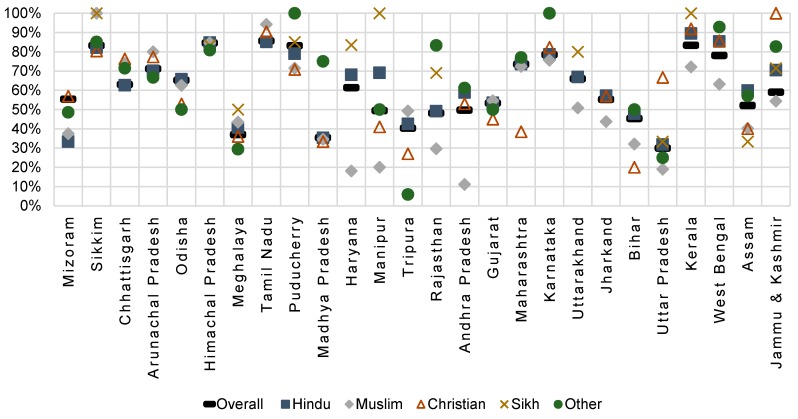
There is little research on state-level differences in child health outcomes in India. The aim of this study was to identify state-level characteristics that relate to childhood immunizations. Most state-level characteristics came from the 2011 Indian Census. Individual-level data and other state-level characteristics were obtained from the 2007⁻2008 District Level Household and Facility Survey. Predictors of full vaccination were assessed with logistic regression models. Among 86,882 children 12⁻36 months, 53.2% were fully vaccinated. Children living in bigger households (≥7 members), born in non-institutional settings, and female had lower odds of complete vaccination. Individuals living in states in the mid-range of poverty had lower odds of full vaccination compared to those in lower or higher poverty states (3rd vs. 1st quintile: odds ratio [OR]: 0.36, 95% confidence interval [CI]: 0.30, 0.42). Greater average population per primary health center was associated with decreased odds of full vaccination (5th vs. 1st quintile: OR: 0.37, 95% CI: 0.30, 0.47). Vaccination coverage in India can be explained by a complex interplay of individual- and state-level factors. Solutions to increasing vaccination must be multisectoral and acknowledge the cultural and socio-economic diversity that influences an individual child's vaccination coverage along with within-state disparities.
关于印度各邦儿童健康结果差异的研究很少。本研究的目的是确定与儿童免疫接种相关的邦级特征。大多数邦级特征来自2011年印度人口普查。个人层面的数据和其他邦级特征来自2007 - 2008年地区家庭和设施调查。通过逻辑回归模型评估全程接种疫苗的预测因素。在86,882名12至36个月大的儿童中,53.2%的儿童完成了全程接种。生活在大家庭(≥7名成员)、非医疗机构出生的儿童以及女孩完成接种的几率较低。与贫困程度较低或较高的邦相比,生活在贫困程度中等邦的个人完成全程接种的几率较低(第三五分位数与第一五分位数相比:优势比[OR]:0.36,95%置信区间[CI]:0.30,0.42)。每个初级卫生中心的平均人口较多与全程接种几率降低相关(第五五分位数与第一五分位数相比:OR:0.37,95%CI:0.30,0.47)。印度的疫苗接种覆盖率可由个人层面和邦级层面因素的复杂相互作用来解释。提高疫苗接种率的解决方案必须是多部门的,并承认文化和社会经济多样性,这种多样性会影响个体儿童的疫苗接种覆盖率以及邦内差异。