Genchi Shingo, Yamamoto Mahito, Shigematsu Koji, Aritomi Shodai, Nouchi Ryo, Kanki Teruo, Watanabe Kenji, Taniguchi Takashi, Murakami Yasukazu, Tanaka Hidekazu
Institute of Scientific and Industrial Research, Osaka University, Ibaraki, Osaka, 567-0047, Japan.
The Ultramicroscopy Research Center, Kyushu University, Fukuoka, 819-0395, Japan.
Sci Rep. 2019 Feb 27;9(1):2857. doi: 10.1038/s41598-019-39091-8.
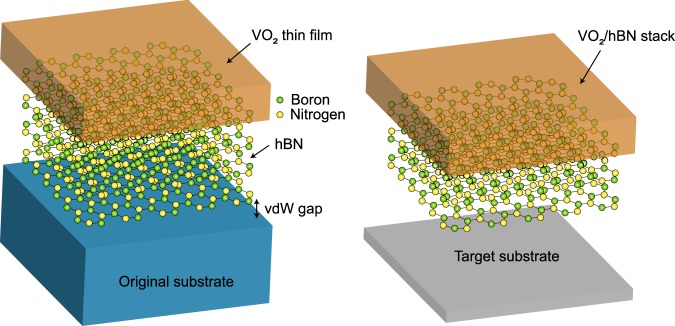
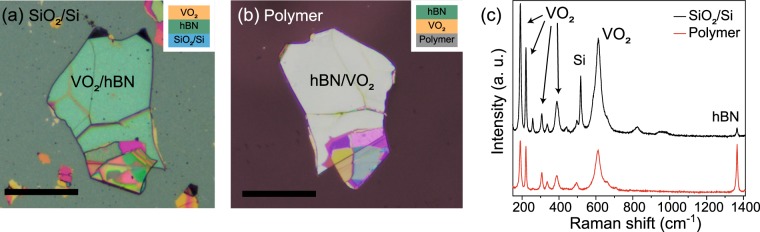
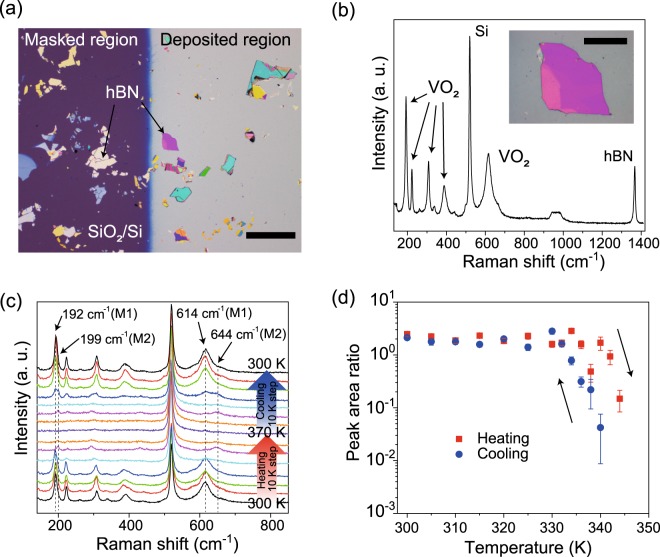
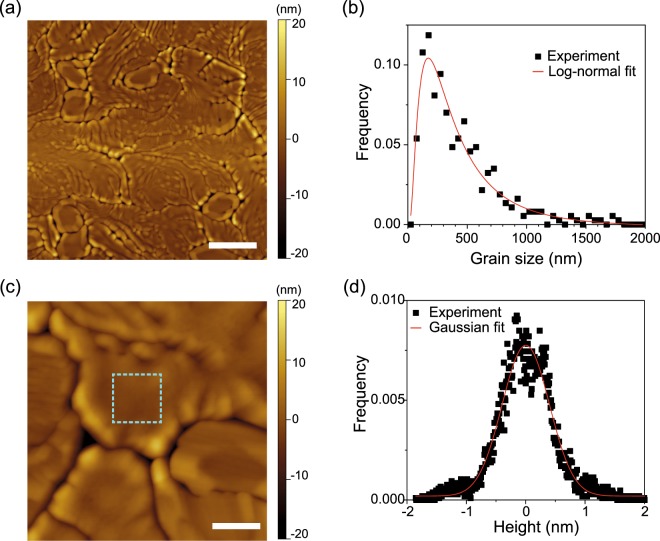
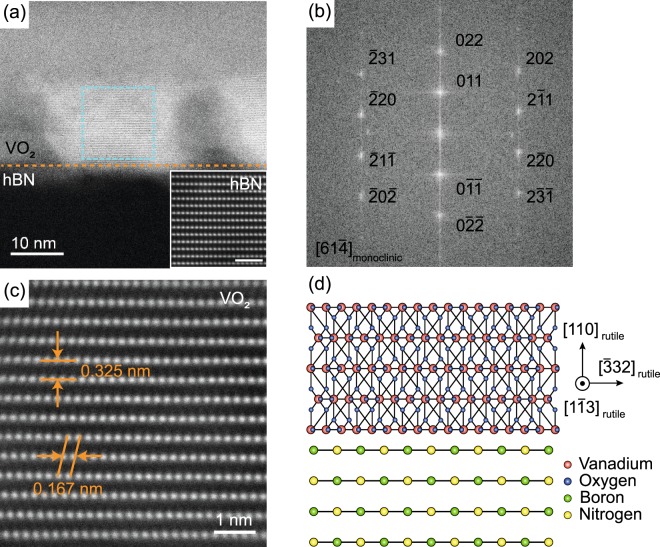
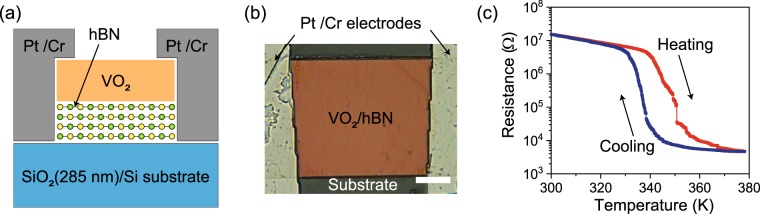
Vanadium dioxide (VO) is an archetypal metal-insulator transition (MIT) material, which has been known for decades to show an orders-of-magnitude change in resistivity across the critical temperature of approximately 340 K. In recent years, VO has attracted increasing interest for electronic and photonic applications, along with advancement in thin film growth techniques. Previously, thin films of VO were commonly grown on rigid substrates such as crystalline oxides and bulk semiconductors, but the use of transferrable materials as the growth substrates can provide versatility in applications, including transparent and flexible devices. Here, we employ single-crystalline hexagonal boron nitride (hBN), which is an insulating layered material, as a substrate for VO thin film growth. VO thin films in the polycrystalline form are grown onto hBN thin flakes exfoliated onto silicon (Si) with a thermal oxide, with grains reaching up-to a micrometer in size. The VO grains on hBN are orientated preferentially with the (110) surface of the rutile structure, which is the most energetically favorable. The VO film on hBN shows a MIT at approximately 340 K, across which the resistivity changes by nearly three orders of magnitude, comparable to VO films grown on common substrates such as sapphire and titanium dioxide. The VO/hBN stack can be picked up from the supporting Si and transferred onto arbitrary substrates, onto which VO thin films cannot be grown directly. Our results pave the way for new possibilities for practical and versatile applications of VO thin films in electronics and photonics.
二氧化钒(VO)是一种典型的金属-绝缘体转变(MIT)材料,几十年来人们一直知道它在约340K的临界温度下电阻率会发生几个数量级的变化。近年来,随着薄膜生长技术的进步,VO在电子和光子应用方面引起了越来越多的关注。以前,VO薄膜通常生长在刚性衬底上,如晶体氧化物和块状半导体,但使用可转移材料作为生长衬底可以在包括透明和柔性器件在内的应用中提供多功能性。在这里,我们采用单晶六方氮化硼(hBN),一种绝缘层状材料,作为VO薄膜生长的衬底。多晶形式的VO薄膜生长在剥离到带有热氧化物的硅(Si)上的hBN薄片上,晶粒尺寸可达微米级。hBN上的VO晶粒优先以金红石结构的(110)面取向,这是能量上最有利的。hBN上的VO薄膜在约340K时显示出MIT,在此温度范围内电阻率变化近三个数量级,与生长在蓝宝石和二氧化钛等常见衬底上的VO薄膜相当。VO/hBN堆叠可以从支撑硅上取下并转移到任意衬底上,而VO薄膜不能直接生长在这些衬底上。我们的结果为VO薄膜在电子和光子学中的实际和多功能应用开辟了新的可能性。