Department of Neurology, ALS Center, Lille University, INSERM UMRS_1171, University Hospital Center, LICEND COEN Center, Lille, France.
Department of Medical Pharmacology, Lille University, INSERM UMRS_1171, University Hospital Center, LICEND COEN Center, Lille, France.
Sci Rep. 2019 Feb 27;9(1):2918. doi: 10.1038/s41598-019-39739-5.
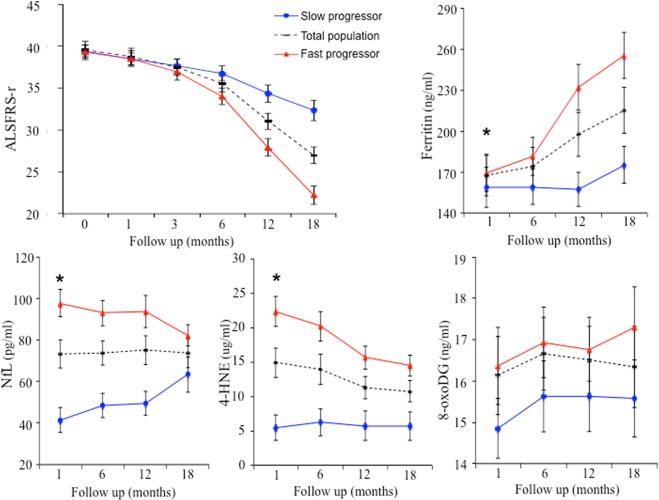
Accurate patient stratification into prognostic categories and targeting Amyotrophic Lateral Sclerosis (ALS)-associated pathways may pave the way for promising trials. We evaluated blood-based prognostic indicators using an array of pathological markers. Plasma samples were collected as part of a large, phase III clinical trial (Mitotarget/TRO19622) at months 1, 6, 12 and 18. The ALSFRS-r score was used as a proxy of disease progression to assess the predictive value of candidate biological indicators. First, established clinical predictors were evaluated in all 512 patients. Subsequently, pathologic markers, such as proxies of neuronal integrity (Neurofilament light chain and phosphorylated heavy chain), DNA oxidation (8-oxo-2'-desoxyguanosine), lipid peroxidation (4-hydroxy-2-nonenal, isoprostane), inflammation (interleukin-6) and iron status (ferritin, hepcidin, transferrin) were assessed in a subset of 109 patients that represented the whole cohort. Markers of neuronal integrity, DNA and lipid oxidation, as well as iron status at baseline are accurate predictors of disability at 18-month follow-up. The composite scores of these markers in association with established clinical predictors enable the accurate forecasting of functional decline. The identified four biomarkers are all closely associated with 'ferroptosis', a recently discovered form of programmed cell death with promising therapeutic targets. The predictive potential of these pathophysiology-based indicators may offer superior patient stratification for future trials, individualised patient care and resource allocation.
准确地将患者分层为预后类别,并针对肌萎缩侧索硬化症(ALS)相关途径进行靶向治疗,可能为有前途的试验铺平道路。我们使用一系列病理标志物评估基于血液的预后指标。作为大型三期临床试验(Mitotarget/TRO19622)的一部分,在第 1、6、12 和 18 个月采集血浆样本。ALS 功能评定量表(ALSFRS-r)得分被用作疾病进展的替代指标,以评估候选生物标志物的预测价值。首先,我们评估了所有 512 名患者中的既定临床预测因素。随后,在代表整个队列的 109 名患者亚组中评估了神经元完整性(神经丝轻链和磷酸化重链)、DNA 氧化(8-氧-2'-脱氧鸟苷)、脂质过氧化(4-羟基-2-壬烯醛、异前列烷)、炎症(白细胞介素-6)和铁状态(铁蛋白、hepcidin、转铁蛋白)等病理标志物。基线时神经元完整性、DNA 和脂质氧化以及铁状态标志物是 18 个月随访时残疾的准确预测因素。这些标志物与既定临床预测因素的综合评分可准确预测功能下降。确定的四个生物标志物均与“铁死亡”密切相关,铁死亡是一种最近发现的程序性细胞死亡形式,具有有前途的治疗靶点。这些基于病理生理学的指标的预测潜力可能为未来的试验、个体化患者护理和资源分配提供更好的患者分层。