Selli Cigdem, Sims Andrew H
Applied Bioinformatics of Cancer, University of Edinburgh Cancer Research UK Centre, MRC Institute of Genetics & Molecular Medicine, Edinburgh, UK.
Department of Pharmacology, Faculty of Pharmacy, Ege University, Izmir, Turkey.
Breast Cancer (Auckl). 2019 Feb 19;13:1178223419829072. doi: 10.1177/1178223419829072. eCollection 2019.
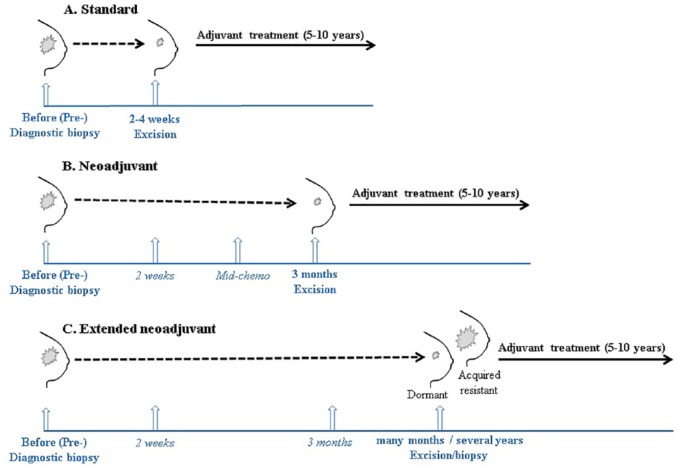
Neoadjuvant therapy, where patients receive systemic therapy before surgical removal of the tumour, can downstage tumours allowing breast-conserving surgery, rather than mastectomy. In addition to its impact on surgery, the neoadjuvant setting offers a valuable opportunity to monitor individual tumour response. The effectiveness of standard and/or potential new therapies can be tested in the neoadjuvant pre-surgical setting. It can potentially help to identify markers differentiating patients that will potentially benefit from continuing with the same or a different adjuvant treatment enabling personalised treatment. Characterising the molecular response to treatment over time can more accurately identify the significant differences between baseline samples that would not be identified without post-treatment samples. In this review, we discuss the potential and challenges of using the neoadjuvant setting in translational breast cancer research, considering the implications for improving our understanding of response to treatment, predicting therapy benefit, modelling breast cancer dormancy, and the development of drug resistance.
新辅助治疗是指患者在手术切除肿瘤之前接受全身治疗,它可以降低肿瘤分期,从而使保乳手术成为可能,而非乳房切除术。除了对手术有影响外,新辅助治疗还提供了一个监测个体肿瘤反应的宝贵机会。标准治疗和/或潜在新疗法的有效性可以在新辅助手术前环境中进行测试。它有可能帮助识别能够区分哪些患者可能从继续采用相同或不同辅助治疗中获益的标志物,从而实现个性化治疗。随着时间推移对治疗的分子反应进行表征,可以更准确地识别基线样本之间的显著差异,而这些差异在没有治疗后样本的情况下是无法识别的。在本综述中,我们讨论了在转化性乳腺癌研究中使用新辅助治疗环境的潜力和挑战,同时考虑其对增进我们对治疗反应的理解、预测治疗获益、模拟乳腺癌休眠以及耐药性发展的影响。