Gallo Mariagrazia, Licata Emanuele, Meneghini Caterina, Dal Lago Alessandro, Fabiani Cristina, Amodei Marcello, Antonaci Domenico, Miriello Donatella, Corno Roberta, Liberanome Carmelina, Bisogni Francescantonio, Paciotti Gemma, Meneghini Carlo, Rago Rocco
Physiopathology of Reproduction and Andrology Unit, Sandro Pertini Hospital, Rome, Italy.
Science Department, Roma Tre University, Rome, Italy.
Front Endocrinol (Lausanne). 2019 Feb 13;10:35. doi: 10.3389/fendo.2019.00035. eCollection 2019.
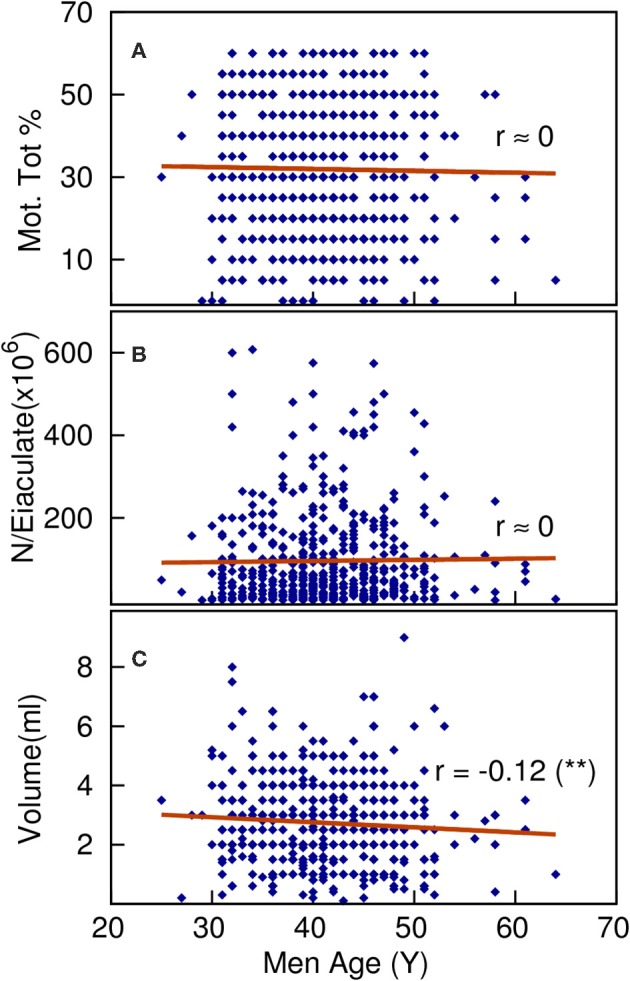
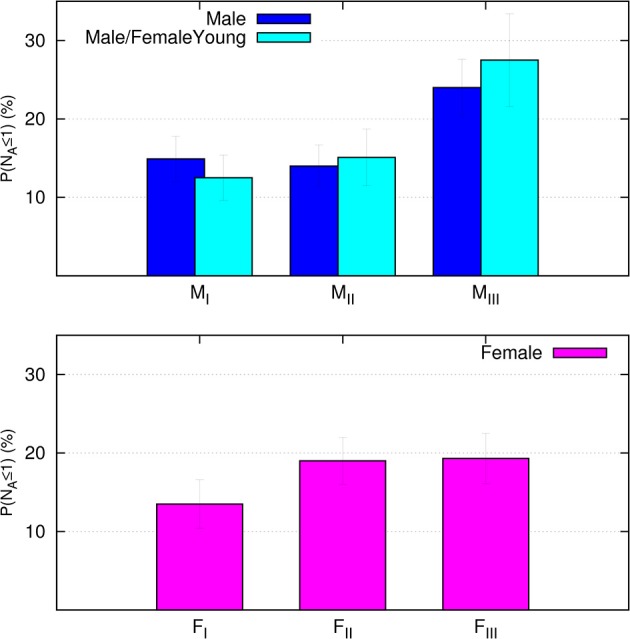
We conducted a retrospective study on a cohort of couples attending the Department of Andrology and Reproductive Physiopathology at Sandro Pertini Hospital in Rome for Intracytoplasmatic Sperm Injection (ICSI)-assisted reproduction programs. Some of the couples included in the study underwent more than one ICSI cycle. Between January 2015 and April 2017. To evaluate whether the advancing of the paternal age may have effect on the seminal parameters, thus negatively affecting the embryo formation, development and quality, as well as the pregnancy rate. Five hundred and forty three ICSI cycles were performed on 439 couples undergoing Assisted Reproductive Technologies (ART). Patients were subdivided into three male and three female age groups having similar size: Men: ≤38 years (M), 39-43 years (M), ≥44 years (M). Women: ≤35 years (F), 36-40 years (F),≥41 years (F). Male age groups did not reveal any statistical significant differences in any age-related semen parameters. We also confirmed a statistical significant increase in the pregnancy rate of couples with older partner age difference and younger female. We found that the advanced male age increases the probability of obtaining one or no type A embryo (N≤1), which was almost doubled in the M group in comparison with M, suggesting a negative effect of male age on the efficacy of the reproductive outcome in terms of a reduced number of type A embryos. Such an effect does not seem related to semen parameters and may deserve further investigations.
我们对罗马桑德罗·佩尔蒂尼医院男科与生殖病理生理学部门接受卵胞浆内单精子注射(ICSI)辅助生殖项目的一组夫妇进行了回顾性研究。纳入研究的部分夫妇接受了不止一个ICSI周期。研究时间为2015年1月至2017年4月。目的是评估父亲年龄的增长是否会对精液参数产生影响,进而对胚胎形成、发育和质量以及妊娠率产生负面影响。对439对接受辅助生殖技术(ART)的夫妇进行了543个ICSI周期。患者被分为三个男性年龄组和三个女性年龄组,每组人数相近:男性:≤38岁(M₁)、39 - 43岁(M₂)、≥44岁(M₃)。女性:≤35岁(F₁)、36 - 40岁(F₂)、≥41岁(F₃)。男性年龄组在任何与年龄相关的精液参数方面均未显示出任何统计学上的显著差异。我们还证实,伴侣年龄差较大且女性年龄较小的夫妇妊娠率有统计学上的显著增加。我们发现,男性年龄的增长会增加获得一个或没有A型胚胎(N≤1)的概率,与M₁组相比,M₃组几乎翻倍,这表明男性年龄对生殖结局的有效性有负面影响,即A型胚胎数量减少。这种影响似乎与精液参数无关,可能值得进一步研究。