College of Medicine, Alfaisal University, Riyadh 11533, Saudi Arabia.
Department of Comparative Medicine, King Faisal Specialist Hospital and Research Centre, Riyadh 11211, Saudi Arabia.
Asian J Androl. 2021 Mar-Apr;23(2):178-187. doi: 10.4103/aja.aja_67_20.
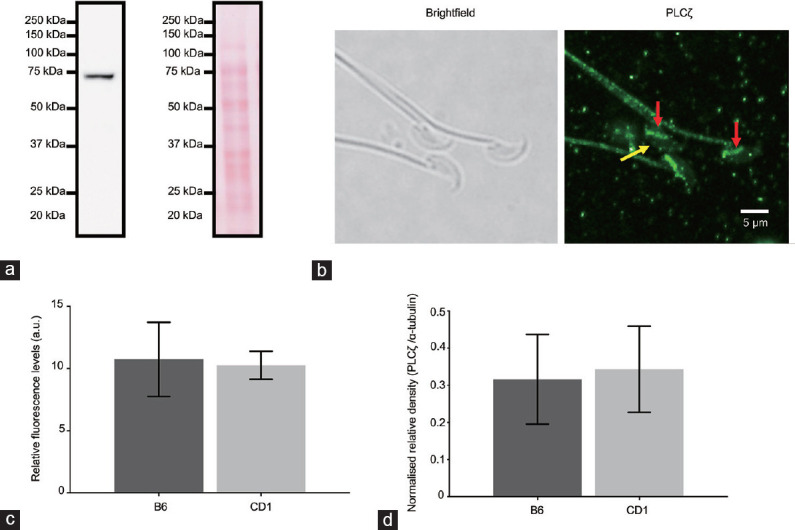
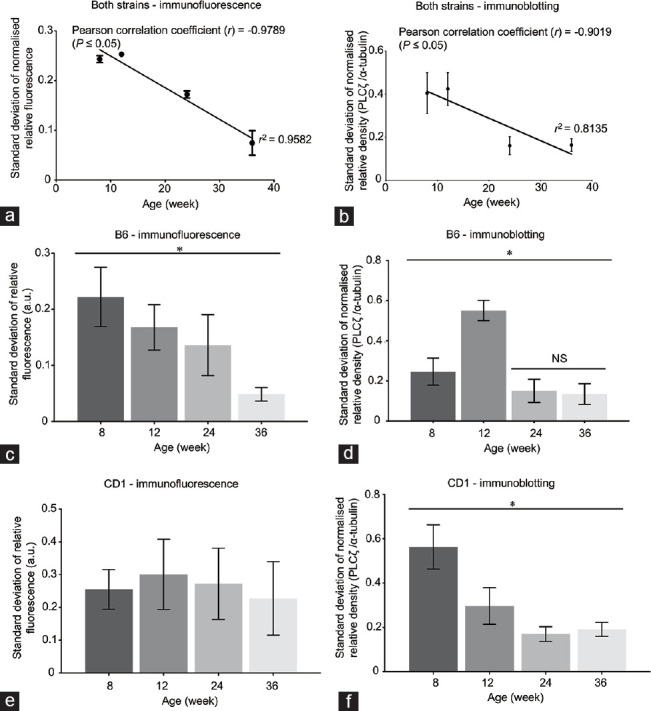
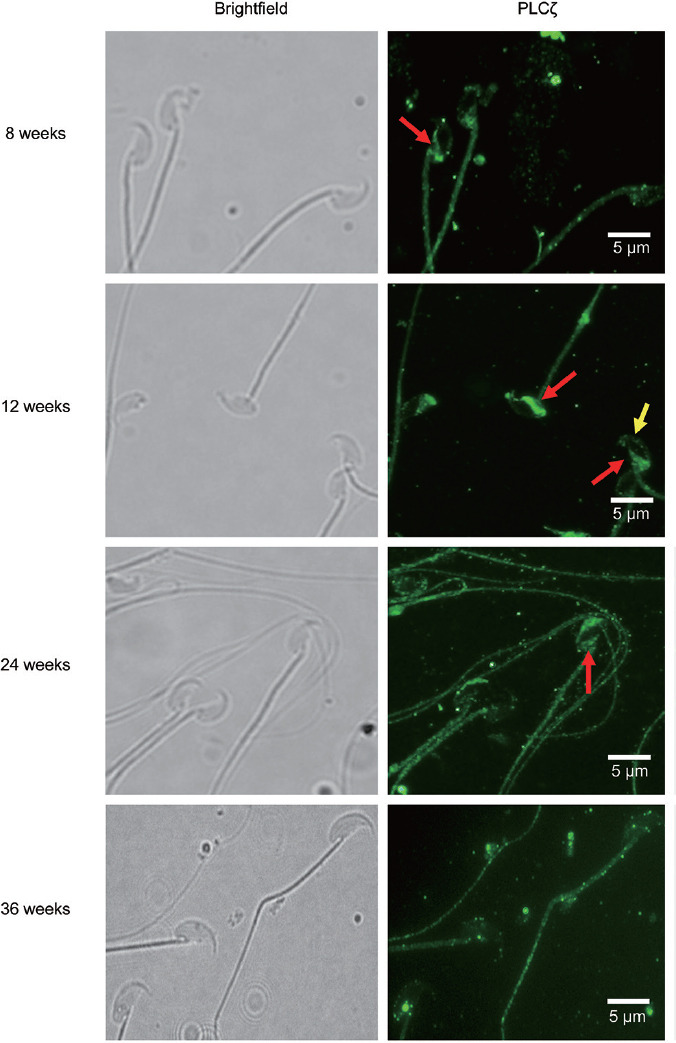
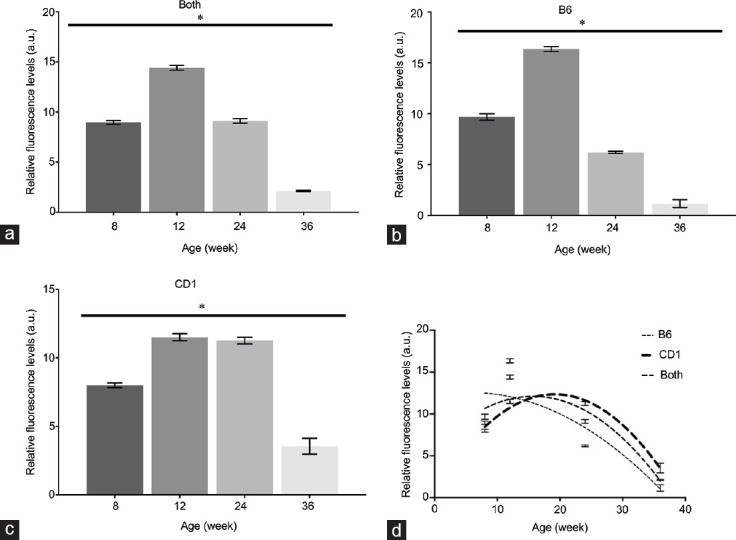
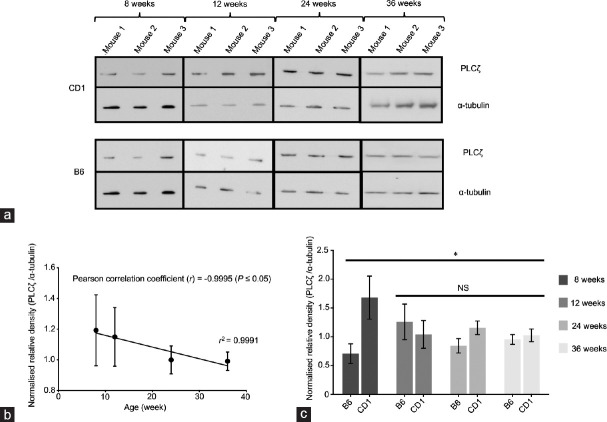
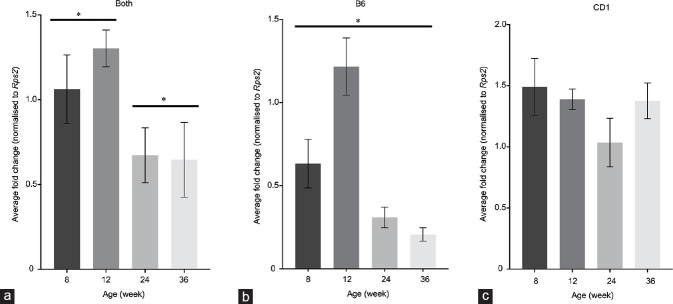
Sperm-specific phospholipase C zeta (PLCζ) initiates intracellular calcium (Ca) transients which drive a series of concurrent events collectively termed oocyte activation. Numerous investigations have linked abrogation and absence/reduction of PLCζ with forms of male infertility in humans where oocyte activation fails. However, very few studies have examined potential relationships between PLCζ and advancing male age, both of which are increasingly considered to be major effectors of male fertility. Initial efforts in humans may be hindered by inherent PLCζ variability within the human population, alongside a lack of sufficient controllable repeats. Herein, utilizing immunoblotting, immunofluorescence, and quantitative reverse transcription PCR (qRT-PCR) we examined for the first time PLCζ protein levels and localization patterns in sperm, and PLCζ mRNA levels within testes, from mice at 8 weeks, 12 weeks, 24 weeks, and 36 weeks of age, from two separate strains of mice, C57BL/6 (B6; inbred) and CD1 (outbred). Collectively, advancing male age generally diminished levels and variability of PLCζ protein and mRNA in sperm and testes, respectively, when both strains were examined. Furthermore, advancing male age altered the predominant pattern of PLCζ localization in mouse sperm, with younger mice exhibiting predominantly post-acrosomal, and older mice exhibiting both post-acrosomal and acrosomal populations of PLCζ. However, the specific pattern of such decline in levels of protein and mRNA was strain-specific. Collectively, our results demonstrate a negative relationship between advancing male age and PLCζ levels and localization patterns, indicating that aging male mice from different strains may serve as useful models to investigate PLCζ in cases of male infertility and subfertility in humans.
精子特异性磷酯酶 C ζ(PLCζ)引发细胞内钙(Ca)瞬变,驱动一系列称为卵母细胞激活的并发事件。许多研究将 PLCζ 的缺失与人类男性不育症联系起来,其中卵母细胞激活失败。然而,很少有研究检查 PLCζ 与男性年龄增长之间的潜在关系,而这两者都被认为是男性生育能力的主要影响因素。在人类中,最初的努力可能会受到人类群体中固有 PLCζ 变异性的阻碍,同时缺乏足够的可控重复次数。在这里,我们首次利用免疫印迹、免疫荧光和定量逆转录 PCR(qRT-PCR)检查了来自 8 周、12 周、24 周和 36 周龄的两种不同品系(C57BL/6(B6;近交系)和 CD1(远交系))的精子中 PLCζ 蛋白水平和定位模式,以及睾丸中的 PLCζ mRNA 水平。总的来说,当检查两种品系时,男性年龄的增长通常会降低精子和睾丸中 PLCζ 蛋白和 mRNA 的水平和变异性。此外,男性年龄的增长改变了 PLCζ 在小鼠精子中的主要定位模式,年轻的老鼠表现出主要的顶体后,而年老的老鼠表现出顶体后和顶体的 PLCζ 种群。然而,这种蛋白和 mRNA 水平下降的具体模式是品系特异性的。总的来说,我们的结果表明,男性年龄的增长与 PLCζ 水平和定位模式之间存在负相关关系,这表明来自不同品系的衰老雄性小鼠可能成为研究人类男性不育和生育力低下中 PLCζ 的有用模型。