Simonsen Jens B
Department of Health Technology (DTU Health Tech) and Department of Micro- and Nanotechnology (DTU Nanotech), Technical University of Denmark, Lyngby, Denmark.
J Extracell Vesicles. 2019 Feb 20;8(1):1582237. doi: 10.1080/20013078.2019.1582237. eCollection 2019.
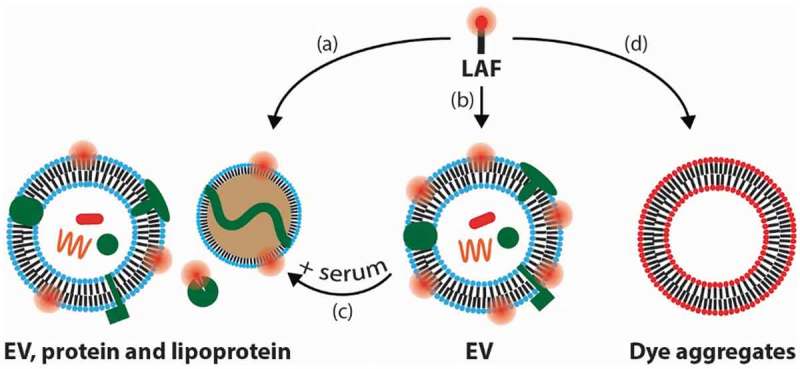
Post-staining of extracellular vesicles (EVs) with lipid-anchored fluorophores (LAFs) such as PKH67 is a widely used strategy for studying EVs but it is associated with several pitfalls. The pitfalls discussed in this commentary are related to LAF labelling of non-EV species due to (1) lipoprotein contamination in EV samples, (2) desorption of the LAF reporters from vesicles into proteins and lipoproteins in blood and serum, and (3) the capability of the amphiphilic LAF compounds to form EV-like particles. Awareness of these challenges and developing solutions to overcome these are important to ensure that we make relevant interpretations when using LAFs to track EVs.
使用脂质锚定荧光团(LAF)(如PKH67)对细胞外囊泡(EV)进行染色后处理是研究EV的一种广泛使用的策略,但它存在几个缺陷。本评论中讨论的缺陷与非EV物种的LAF标记有关,原因如下:(1)EV样本中的脂蛋白污染;(2)LAF报告分子从囊泡解吸到血液和血清中的蛋白质和脂蛋白中;(3)两亲性LAF化合物形成类似EV颗粒的能力。认识到这些挑战并开发克服这些挑战的解决方案,对于确保我们在使用LAF追踪EV时做出相关解释非常重要。