1Department of Clinical Bacteriology and Mycology National Reference Laboratory, Ethiopian Public Health Institute, Addis Ababa, Ethiopia.
3Department of Clinical Bacteriology and Mycology National Reference Laboratory, Ethiopian Public Health Institute, Addis Ababa, Ethiopia.
Antimicrob Resist Infect Control. 2019 Feb 15;8:39. doi: 10.1186/s13756-019-0488-4. eCollection 2019.
The global emergence and spread of extended-spectrum beta-lactamases (ESBLs) producing have been threatening the ability to treat an infection. Hence, this study aimed to determine the prevalence of ESBL-producing and multi-drug resistance (MDR) (ESBLs-E) from different clinical specimens in Addis Ababa, Ethiopia.
A cross-sectional study was conducted from January 1 to May 30, 2017. A total of 426 isolates were identified from clinical specimens. The isolates were collected from four laboratories. Antimicrobial susceptibility testing was performed using the Kirby-Bauer disk diffusion method on Muller Hinton agar (MHA). All were screened for ESBLs production using cefotaxime and ceftazidime as per CLSI guideline. Each ESBL screening positive were confirmed by a combination disk test (CDT). Data were entered and analyzed by using SPSS version-20.
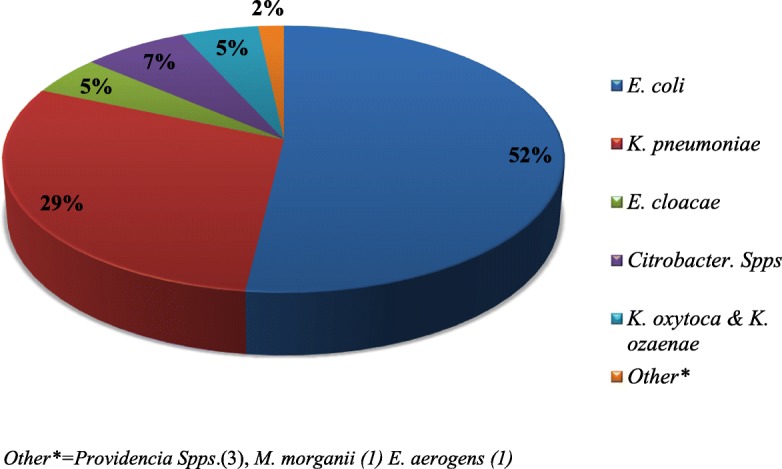
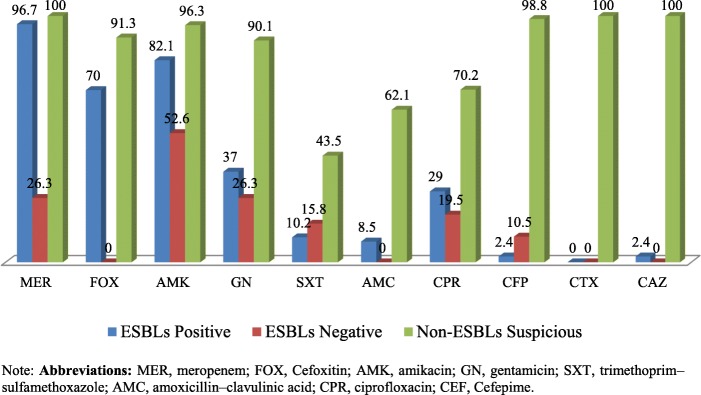
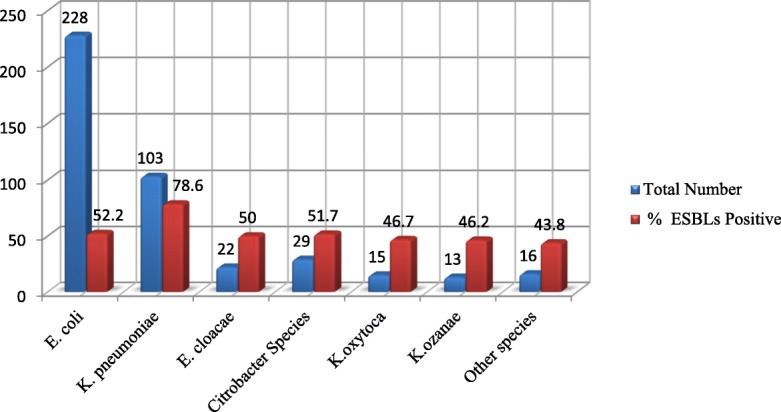
The most frequent were 228 (53.5%) and 103 (24.1%). The magnitude of ESBLs-E was 57.7% (246/426). The highest frequencies of ESBLs-E were observed in blood specimesns (84.4%) and the highest ESBLs production was observed in (85.4%). The highest resistance level was seen to sulfamethoxazole-trimethoprim (77.0%), amoxicillin with clavulanic acid (71.6%), cefotaxime (62.2%), cefepime (60.3%) and ceftazidime (60.8%). The overall magnitude of multi-drug resistance (MDR) level was 68.3%. Of ESBLs-E, 96.3% of them were MDR ( < 0.001).
There was a high prevalence of ESBLs-E and MDR isolate in Addis Ababa. Most of ESBLs-E was isolated primarily in blood and urine. The highest ESBLs production was observed among . Hence, strong infection control strategies must be implemented in hospital settings of the country.
产Extended-spectrum beta-lactamases(ESBLs)的在全球范围内的出现和传播威胁到了感染的治疗能力。因此,本研究旨在确定埃塞俄比亚亚的斯亚贝巴不同临床标本中产 ESBL 且具有多重耐药性(ESBLs-E)的发生率。
这是一项于 2017 年 1 月 1 日至 5 月 30 日进行的横断面研究。从四个实验室共收集了 426 株临床分离株。药敏试验采用 Kirby-Bauer 纸片扩散法在 Muller Hinton 琼脂(MHA)上进行。所有均按照 CLSI 指南用头孢噻肟和头孢他啶进行 ESBLs 产筛选。对所有 ESBL 筛选阳性的进行了组合纸片试验(CDT)确认。数据由 SPSS 版本 20 输入和分析。
最常见的分离株是 228 株(53.5%)和 103 株(24.1%)。ESBLs-E 的发生率为 57.7%(246/426)。在血液标本中观察到 ESBLs-E 的频率最高(84.4%),而在 中观察到的 ESBLs 产率最高(85.4%)。对磺胺甲恶唑-甲氧苄啶(77.0%)、阿莫西林-克拉维酸(71.6%)、头孢噻肟(62.2%)、头孢吡肟(60.3%)和头孢他啶(60.8%)的耐药率最高。总的多药耐药(MDR)水平为 68.3%。在 ESBLs-E 中,96.3%的为 MDR( < 0.001)。
在亚的斯亚贝巴,ESBLs-E 和 MDR 分离株的发生率很高。大多数 ESBLs-E 主要从血液和尿液中分离出来。在 中观察到的 ESBLs 产率最高。因此,必须在该国医院环境中实施强有力的感染控制策略。