Laverdure Rose, Mezouari Ania, Carson Michael A, Basiliko Nathan, Gagnon Jeffrey
Department of Biology Laurentian University Sudbury ON Canada.
Vale Living with Lakes Centre Laurentian University Sudbury ON Canada.
Endocrinol Diabetes Metab. 2017 Dec 1;1(1):e00006. doi: 10.1002/edm2.6. eCollection 2018 Jan.
The gastrointestinal (GI) microbiome has emerged as a potential regulator of metabolism. However, the precise mechanisms of how microorganisms may influence physiology remain largely unknown. Interestingly, GI microorganisms, including methanogens, are localized within the same regions as the glucagon-like peptide-1 (GLP-1) secreting L cells. GLP-1 plays key roles appetite and glucose regulation. Furthermore, both methane and GLP-1 levels are altered in obese humans with metabolic disease. We predict that high-fat diet-induced obesity alters the abundance of GI methanogens and that methane may play a role in the GLP-1 secretory response from the L cell.
To demonstrate this, GLP-1 secretion response and faecal methanogens were examined in mice given a high-fat diet for 14 weeks. In addition, the direct effect of methane on GLP-1 secretion was assessed in two L-cell models (NCI-H716 and GLUTag).
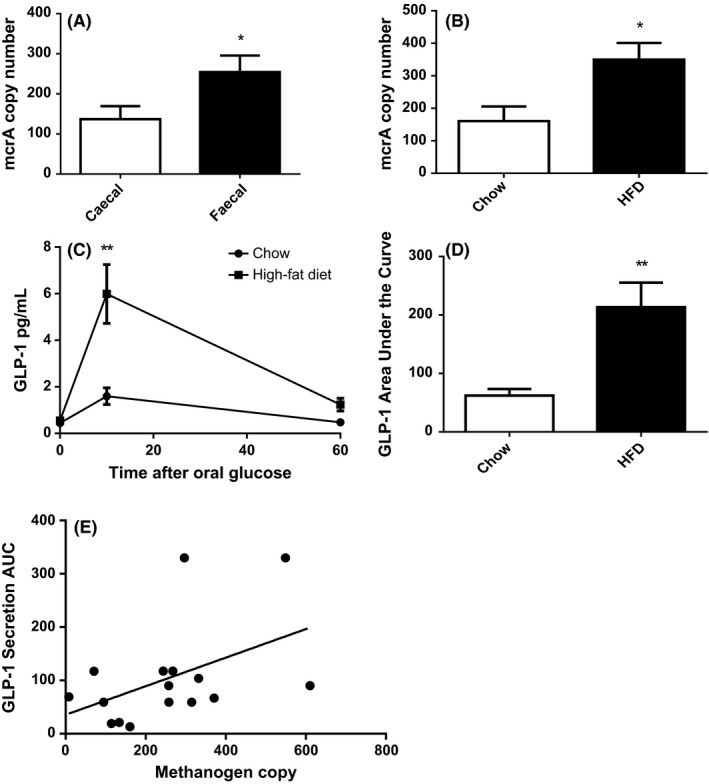
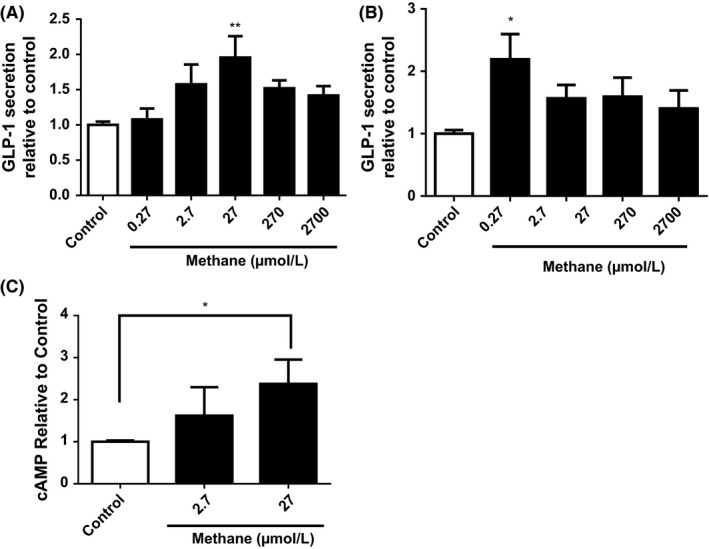
High-fat diet caused a significant increase in both GLP-1 secretion and faecal methanogen content. There was a direct correlation between GLP-1 secretion response and faecal methanogen levels. In L cells, methane stimulated GLP-1 secretion and enhanced intracellular cAMP content.
These results indicate that alterations in the methanogen communities occurring in obesity may play a vital role in directly enhancing GLP-1 secretion, and that methane can directly stimulate the secretion of GLP-1.
胃肠道微生物群已成为新陈代谢的潜在调节因子。然而,微生物影响生理机能的具体机制仍 largely 未知。有趣的是,包括产甲烷菌在内的胃肠道微生物与分泌胰高血糖素样肽 -1(GLP-1)的 L 细胞位于同一区域。GLP-1 在食欲和血糖调节中起关键作用。此外,肥胖且患有代谢疾病的人体内甲烷和 GLP-1 水平均发生改变。我们预测,高脂饮食诱导的肥胖会改变胃肠道产甲烷菌的丰度,且甲烷可能在 L 细胞的 GLP-1 分泌反应中发挥作用。
为证明这一点,对给予高脂饮食 14 周的小鼠的 GLP-1 分泌反应和粪便产甲烷菌进行了检测。此外,在两种 L 细胞模型(NCI-H716 和 GLUTag)中评估了甲烷对 GLP-1 分泌的直接影响。
高脂饮食导致 GLP-1 分泌和粪便产甲烷菌含量均显著增加。GLP-1 分泌反应与粪便产甲烷菌水平之间存在直接相关性。在 L 细胞中,甲烷刺激 GLP-1 分泌并提高细胞内 cAMP 含量。
这些结果表明,肥胖中发生的产甲烷菌群落变化可能在直接增强 GLP-1 分泌中起关键作用,且甲烷可直接刺激 GLP-1 的分泌。