Marryat Louise, Frank John
Farr Institute/Scottish Collaboration for Public Health Research and Policy, University of Edinburgh, Edinburgh, UK.
BMJ Paediatr Open. 2019 Jan 31;3(1):e000340. doi: 10.1136/bmjpo-2018-000340. eCollection 2019.
Adverse childhood experiences (ACEs) have been associated with a range of poorer health and social outcomes throughout the life course; however, to date they have primarily been conducted retrospectively in adulthood. This paper sets out to determine the prevalence of ACEs at age 8 in a recent prospective birth cohort and examine associations between risk factors in the first year and cumulative ACEs.
This study uses the Growing Up in Scotland Birth Cohort 1, in which children born in Scotland in 2004/5 were identified using Child Benefit Records and followed up for 7 years (n.3119). ACE scores and sample characteristics were calculated and described. Logistic regression models were fitted to explore associations between risk factors (sex, mother's age and education, household income, area level deprivation and urban/rural indicator) and ACE scores.
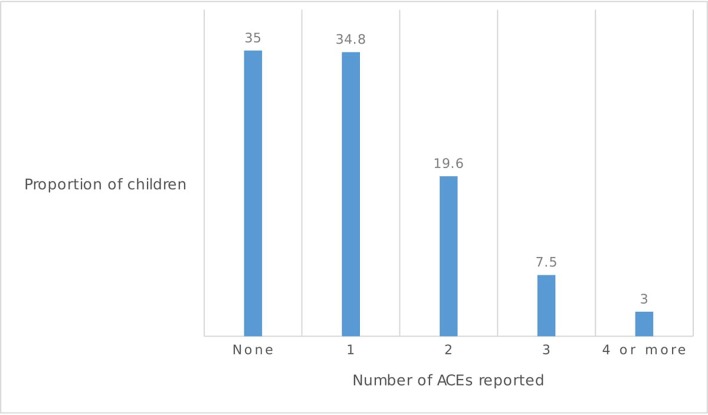
Seven ACEs (or proxies) were assessed: physical abuse, domestic violence, substance abuse, mental illness, parental separation, parental incarceration and emotional neglect. Instances of sexual abuse were too few to be reported. Emotional abuse and physical neglect could not be gathered. Around two-thirds of children had experienced one or more ACE, with 10% experiencing three or more in their lifetime. Higher ACE scores were associated with being male, having a young mother, low income and urban areas.
Using prospective data, the majority of children born in 2004/2005 in Scotland experienced at least one ACE by age 8, although three ACEs could not be assessed in this cohort. ACEs were highly correlated with socioeconomic disadvantage in the first year of life.
童年不良经历(ACEs)与一生中一系列较差的健康和社会结果相关;然而,迄今为止,这些研究主要是在成年后进行的回顾性研究。本文旨在确定最近一个前瞻性出生队列中8岁儿童ACEs的患病率,并研究出生第一年的风险因素与累积ACEs之间的关联。
本研究使用了苏格兰成长队列1,通过儿童福利记录识别出2004/2005年在苏格兰出生的儿童,并对其进行了7年的随访(n = 3119)。计算并描述了ACEs得分和样本特征。采用逻辑回归模型探讨风险因素(性别、母亲年龄和教育程度、家庭收入、地区贫困水平和城乡指标)与ACEs得分之间的关联。
评估了七种ACEs(或替代指标):身体虐待、家庭暴力、药物滥用、精神疾病、父母分居、父母监禁和情感忽视。性虐待案例太少,无法报告。情感虐待和身体忽视无法收集。约三分之二的儿童经历过一种或多种ACEs,10%的儿童一生中经历过三种或更多。较高的ACEs得分与男性、母亲年轻、低收入和城市地区相关。
使用前瞻性数据,2004/2005年在苏格兰出生的大多数儿童在8岁时至少经历过一次ACEs,尽管该队列中无法评估三种ACEs。ACEs与生命第一年的社会经济劣势高度相关。