Department of Endocrinology, Shanghai East Hospital, Tongji University School of Medicine, Shanghai, China.
J Diabetes Investig. 2019 Sep;10(5):1365-1371. doi: 10.1111/jdi.13031. Epub 2019 Mar 19.
AIMS/INTRODUCTION: There is potential for mobile applications to deliver new self-management interventions for chronic disease, especially in diabetes. The aim of the present study was to evaluate the effects of a mobile phone application (MPA) combined with or without self-monitoring of blood glucose (SMBG) on glycemic control in patients with diabetes.
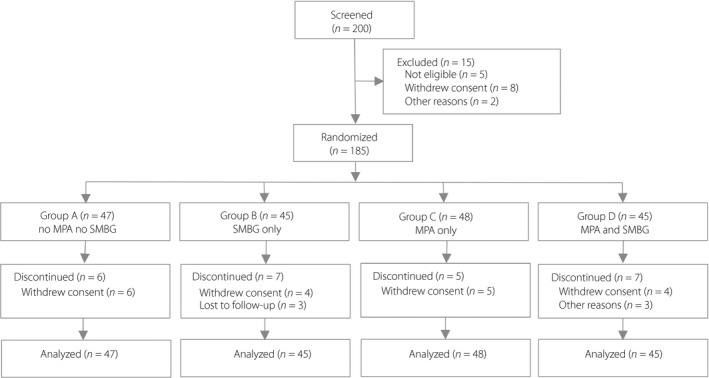
The study was a 24-week period, four-arm parallel group, non-blinded, randomized trial. A total of 185 patients with mean age of 52 years were randomized to group A (no MPA and no SMBG), group B (SMBG only), group C (MPA only) and group D (both MPA and SMBG were used). Changes in glycated hemoglobin (HbA1c), fasting plasma glucose and 1,5-anhydroglucitol from baseline to week 24 were analyzed.
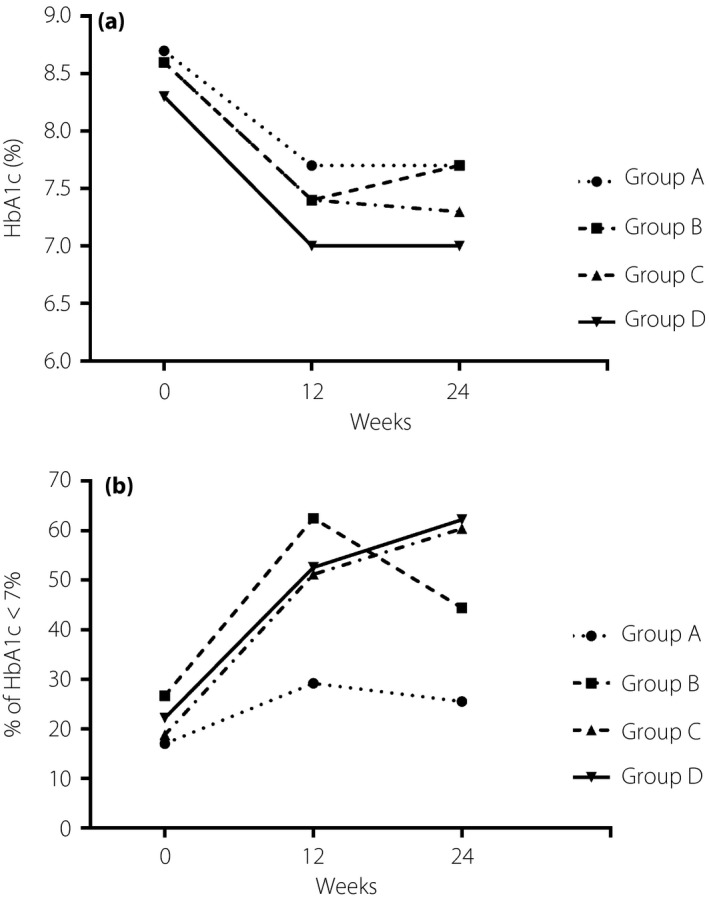
At 24 weeks, the HbA1c levels in patients of all groups decreased significantly from baseline. There were significant differences in the proportions of patients that achieved HbA1c <7% between groups, especially in group C and group D, compared with group A at week 24 (60.4%, 62.2% vs 25.5%, all P < 0.05). 1,5-Anhydroglucitol changes were obvious in group A and group C at week 24 from baseline (all P < 0.05 within groups). Factorial analysis of anova showed that MPA intervention was the main effective factor for HbA1c change (F = 4.59, P = 0.034), and there was no effect on HbA1c change for SMBG intervention (P = 0.975).
Implementation of the MPA, Diabetes-Carer, is effective in improving the proportion of HbA1c <7% in patients with type 2 diabetes.
目的/引言:移动应用程序有可能为慢性病,尤其是糖尿病患者提供新的自我管理干预措施。本研究的目的是评估手机应用程序(MPA)与或不与自我血糖监测(SMBG)联合应用对糖尿病患者血糖控制的影响。
该研究是一项为期 24 周的四臂平行组、非盲、随机试验。共纳入 185 名平均年龄为 52 岁的患者,随机分为 A 组(无 MPA 且无 SMBG)、B 组(仅 SMBG)、C 组(仅 MPA)和 D 组(同时使用 MPA 和 SMBG)。分析从基线到第 24 周糖化血红蛋白(HbA1c)、空腹血浆葡萄糖和 1,5-脱水葡萄糖醇的变化。
在第 24 周,所有组的患者 HbA1c 水平均较基线显著下降。与 A 组相比,第 24 周时 C 组和 D 组 HbA1c<7%的患者比例有显著差异(60.4%、62.2% vs 25.5%,均 P<0.05)。与基线相比,第 24 周 A 组和 C 组的 1,5-脱水葡萄糖醇变化明显(两组内均 P<0.05)。方差分析的析因分析显示,MPA 干预是 HbA1c 变化的主要有效因素(F=4.59,P=0.034),而 SMBG 干预对 HbA1c 变化无影响(P=0.975)。
实施 MPA,即“糖尿病护理者”,可有效提高 2 型糖尿病患者 HbA1c<7%的比例。