Laboratório de Infectologia Molecular Animal, Instituto de Biotecnologia Aplicada à Agropecuária, Universidade Federal de Viçosa (UFV), Viçosa, Minas Gerais 36570-900, Brazil.
Núcleo de Análise de Biomoléculas (NuBioMol), Centro de Ciências Biológicas (CCB), Universidade Federal de Viçosa (UFV), Viçosa, Minas Gerais 36570-900, Brazil.
Viruses. 2019 Feb 27;11(3):201. doi: 10.3390/v11030201.
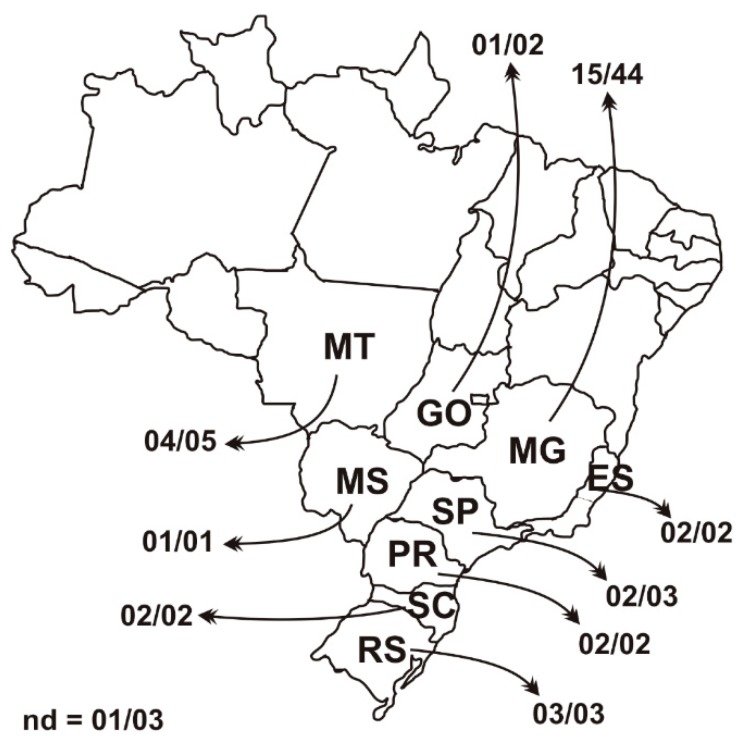
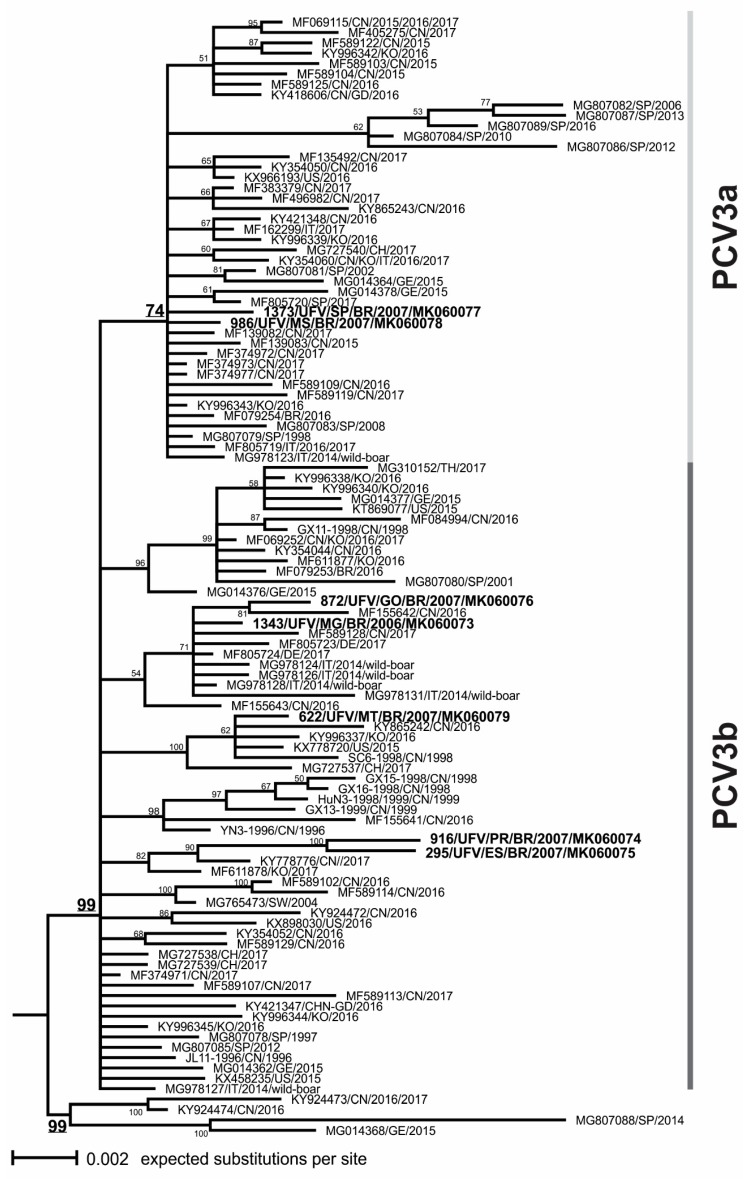
3 (PCV3) is an emerging virus that was first identified in the United States in 2016. Since its first detection, PCV3 has already been found in America, Asia, and Europe. Although PCV3 has already been described in Brazil, knowledge of its detection and sequence variation before 2016 is limited, as well as its distribution in the main swine producing regions of Brazil. In this study, 67 porcine clinical samples collected from nine states in Brazil between 2006 and 2007 were analyzed for PCV3 infection by PCR. Results showed that 47.8% of the samples were PCV3 positive, across all nine states. Of the PCV3-positive samples, 37.5% were also positive for PCV2. Interestingly, no clinical signs were associated with samples that were detected singularly with PCV3 infection. Moreover, the positive PCV3 rate in healthy pigs was higher (29.8%) than that found in unhealthy pigs (17.9%), suggesting that most pigs could live with PCV3 infection without any clinical sign in the analyzed samples. Nucleotide sequence analysis showed that PCV3 strains obtained in this study shared 94.44% to 99.83% sequence identity at the open reading frame 2 (ORF2) gene level with available strains from different countries. PCV3 Brazilian sequences collected in 2006 and 2007 shared 97.94% to 99.62% identity with the strains obtained in 2016. The results of neutrality and selective pressure tests indicated that the PCV3 Cap protein seems unable to tolerate high levels of variation on its sequence. Phylogenetic analysis grouped the Brazilian strains in PCV3a and PCV3b genotypes clusters, both including strains collected in America, Asia, and Europe. Taking the results together, multiple events of introduction of PCV3 may have occurred in Brazil, and Brazilian PCV3 strains may show genetic stability over the past 10 years.
3(PCV3)是一种新兴病毒,于 2016 年在美国首次发现。自首次发现以来,PCV3 已在美国、亚洲和欧洲发现。尽管 PCV3 已在巴西被描述,但 2016 年前对其检测和序列变异的了解有限,以及其在巴西主要养猪地区的分布情况。在这项研究中,通过 PCR 分析了 2006 年至 2007 年间从巴西 9 个州采集的 67 份猪临床样本,以检测 PCV3 感染。结果显示,在所有 9 个州中,有 47.8%的样本呈 PCV3 阳性。在 PCV3 阳性样本中,有 37.5%也同时呈 PCV2 阳性。有趣的是,与单独检测到的 PCV3 感染样本相关的临床症状并不明显。此外,在健康猪中,PCV3 的阳性率(29.8%)高于不健康猪(17.9%),这表明在分析样本中,大多数猪可以在没有任何临床症状的情况下感染 PCV3。核苷酸序列分析显示,本研究获得的 PCV3 株在开放阅读框 2(ORF2)基因水平上与不同国家的现有株具有 94.44%至 99.83%的序列同一性。2006 年和 2007 年收集的 PCV3 巴西序列与 2016 年获得的序列具有 97.94%至 99.62%的同一性。中性和选择压力测试的结果表明,PCV3 Cap 蛋白似乎无法容忍其序列的高水平变异。系统进化分析将巴西株分为 PCV3a 和 PCV3b 基因型簇,均包括在美国、亚洲和欧洲收集的菌株。综合结果表明,PCV3 可能在巴西多次传入,巴西 PCV3 株在过去 10 年中可能表现出遗传稳定性。