Arbor Research Collaborative for Health, Ann Arbor, Michigan.
College of Pharmacy, University of Michigan, Ann Arbor, Michigan.
Clin J Am Soc Nephrol. 2019 Mar 7;14(3):421-430. doi: 10.2215/CJN.10590918. Epub 2019 Feb 28.
Immunosuppressive medications are critical for maintenance of graft function in transplant recipients but can represent a substantial financial burden to patients and their insurance carriers.
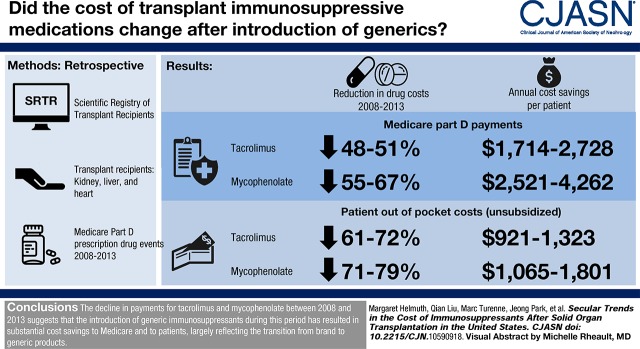
DESIGN, SETTING, PARTICIPANTS, & MEASUREMENTS: To determine whether availability of generic immunosuppressive medications starting in 2009 may have alleviated some of that burden, we used Medicare Part D prescription drug events between 2008 and 2013 to estimate the average annualized per-patient payments made by patients and Medicare in a large national sample of kidney, liver, and heart transplant recipients. Repeated measures linear regression was used to determine changes in payments over the study period.
Medicare Part D payments for two commonly used immunosuppressive medications, tacrolimus and mycophenolic acid (including mycophenolate mofetil and mycophenolate sodium), decreased overall by 48%-67% across organs and drugs from 2008 to 2013, reflecting decreasing payments for brand and generic tacrolimus (21%-54%), and generic mycophenolate (72%-74%). Low-income subsidy payments, which are additional payments made under Medicare Part D, also decreased during the study period. Out-of-pocket payments by patients who did not receive the low-income subsidy decreased by more than those who did receive the low-income subsidy (63%-79% versus 24%-44%).
The decline in payments by Medicare Part D and by transplant recipients for tacrolimus and mycophenolate between 2008 and 2013 suggests that the introduction of generic immunosuppressants during this period has resulted in substantial cost savings to Medicare and to patients, largely reflecting the transition from brand to generic products.
免疫抑制药物对于移植受者的移植物功能维持至关重要,但对患者及其保险承担者来说,这可能构成重大的经济负担。
设计、设置、参与者和测量方法:为了确定 2009 年开始提供的通用免疫抑制剂是否可能减轻了部分负担,我们使用 2008 年至 2013 年期间的医疗保险处方药物事件,估计了大型全国性肾、肝和心脏移植受者样本中患者和医疗保险的平均年度人均支付额。重复测量线性回归用于确定研究期间支付额的变化。
2008 年至 2013 年,在所有器官和药物中,两种常用免疫抑制剂(他克莫司和霉酚酸(包括霉酚酸酯和霉酚酸钠))的医疗保险部分 D 支付额总体下降了 48%-67%,反映了品牌和通用他克莫司(21%-54%)和通用霉酚酸(72%-74%)的支付额下降。在研究期间,医疗保险部分 D 下的低收入补贴支付额也有所下降。在未接受低收入补贴的患者中,自付额的降幅超过了接受低收入补贴的患者(63%-79%对 24%-44%)。
2008 年至 2013 年间,医疗保险部分 D 和接受肾、肝和心脏移植的患者支付的他克莫司和霉酚酸费用下降表明,在此期间通用免疫抑制剂的引入为医疗保险和患者带来了大量成本节约,主要反映了从品牌到通用产品的转变。