Goswami Sourav, Gupta Subodh Saran
Department of Community Medicine, Mahatma Gandhi Institute of Medical Sciences, Wardha, Maharashtra, India.
Indian J Palliat Care. 2019 Jan-Mar;25(1):103-109. doi: 10.4103/IJPC.IJPC_118_18.
Oral cancer is an important cause of mortality and morbidity in India. The disease and side effects of different treatment modalities impart a negative physical and psychosocial impact on the patients. This study was designed to have a better understanding of patients concerns.
This is a qualitative study using in-depth interviews on 24 purposively selected oral cancer patients who have completed their treatment. The study was conducted from January 2016 to September 2017 in both urban and rural community development block in a district in Central India. Participants were selected irrespective of age, sex, occupation, education, stage of disease, and treatments received. The recorded interviews were transcribed for analysis, done using ATLAS ti. The study was conducted after ethical approval.
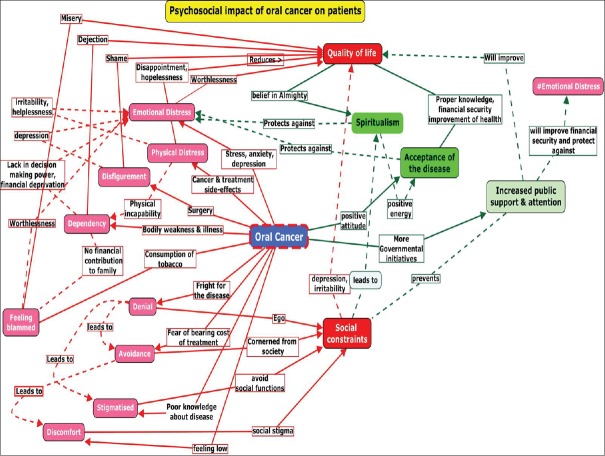
Concerns regarding quality of life, social constraints, financial security, and eating problems were the four major themes, which evolved from the analysis. Emotional and physical distress, disfigurement, dependency, feeling blamed, and avoidance are the evolved subthemes that had a negative psychosocial impact. Spiritualism, acceptance of the disease and increased public attention and support are the factors that increase the confidence among the cancer patients.
Quality of life of oral cancer patients should be given prime focus along with continuum of care starting from early means of diagnosis by screening to treatment completion. Nevertheless, it is the family support that seems to play the most vital role in helping cancer patients cope up with the problems.
口腔癌是印度导致死亡和发病的一个重要原因。该疾病以及不同治疗方式的副作用对患者的身体和心理社会状况产生了负面影响。本研究旨在更好地了解患者的担忧。
这是一项定性研究,对24名经过 purposively 挑选、已完成治疗的口腔癌患者进行了深入访谈。该研究于2016年1月至2017年9月在印度中部一个地区的城乡社区发展街区开展。入选参与者时不考虑年龄、性别、职业、教育程度、疾病阶段和所接受的治疗。对记录的访谈内容进行转录以便分析,使用 ATLAS ti 软件完成。该研究在获得伦理批准后进行。
对生活质量、社会限制、经济保障和饮食问题的担忧是分析得出的四个主要主题。情绪和身体困扰、毁容、依赖、感到被指责以及回避是产生负面心理社会影响的衍生子主题。灵性、对疾病的接受以及公众关注度和支持度的提高是增强癌症患者信心的因素。
应将口腔癌患者的生活质量作为首要关注点,并提供从早期筛查诊断到治疗完成的持续护理。然而,家庭支持在帮助癌症患者应对问题方面似乎起着最为关键的作用。