Tayebi Naeimeh, Akinrinade Oyediran, Khan Muhammad Imran, Hejazifar Arash, Dehghani Alireza, Cremers Frans P M, Akhlaghi Mohammadreza
Program in Genetics and Genome Biology, The Hospital for Sick Children, Toronto, ON, Canada.
Department of Human Genetics, Radboud University Medical Center, Nijmegen, The Netherlands.
Mol Vis. 2019 Feb 8;25:106-117. eCollection 2019.
Inherited retinal diseases (IRDs) are clinically and genetically heterogeneous showing progressive retinal cell death which results in vision loss. IRDs include a wide spectrum of disorders, such as retinitis pigmentosa (RP), Leber congenital amaurosis (LCA), cone-rod dystrophy (CRD), and Stargardt disease (STGD1).
In this study, we performed targeted next-generation sequencing based on molecular inversion probes (MIPs) that allowed the sequence analysis of 108 IRD-associated genes in 50 Iranian IRD probands.
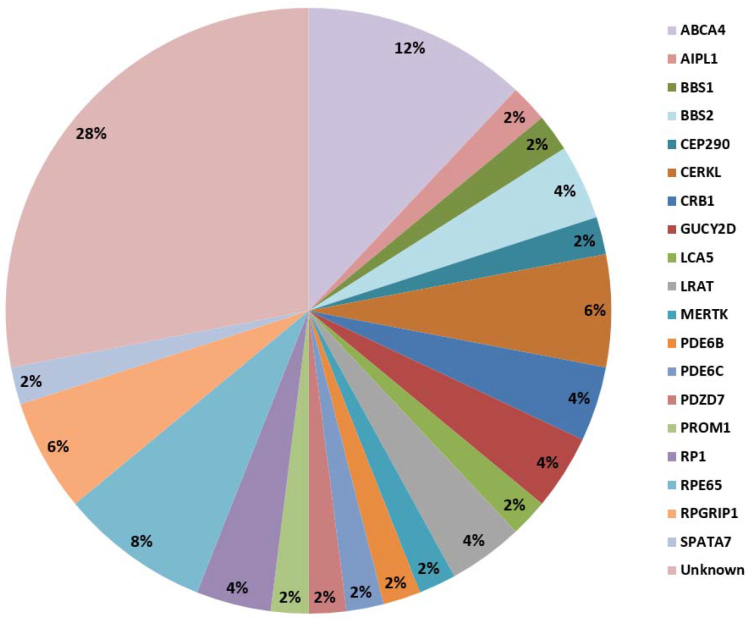
The sequencing and variant filtering led to the identification of putative pathogenic variants in 36 out of 50 (72%) probands. Among 36 unique variants, we identified 20 novel variants in 15 genes. Four out of 36 probands carry compound heterozygous variants, and 32 probands carry homozygous variants.
Employing a cost-effective targeted next-generation sequencing procedure, we identified the genetic causes of different retinal disorders in the majority of Iranian families in this study.
遗传性视网膜疾病(IRD)在临床和遗传上具有异质性,表现为视网膜细胞进行性死亡,最终导致视力丧失。IRD包括多种疾病,如色素性视网膜炎(RP)、莱伯先天性黑蒙(LCA)、锥杆营养不良(CRD)和斯塔加特病(STGD1)。
在本研究中,我们基于分子倒置探针(MIP)进行了靶向二代测序,该方法能够对50名伊朗IRD先证者的108个IRD相关基因进行序列分析。
测序和变异筛选在50名(72%)先证者中鉴定出了可能的致病变异。在36个独特的变异中,我们在15个基因中鉴定出20个新变异。36名先证者中有4名携带复合杂合变异,32名先证者携带纯合变异。
通过采用具有成本效益的靶向二代测序程序,我们在本研究中的大多数伊朗家庭中确定了不同视网膜疾病的遗传病因。