Maria Maleeha, Ajmal Muhammad, Azam Maleeha, Waheed Nadia Khalida, Siddiqui Sorath Noorani, Mustafa Bilal, Ayub Humaira, Ali Liaqat, Ahmad Shakeel, Micheal Shazia, Hussain Alamdar, Shah Syed Tahir Abbas, Ali Syeda Hafiza Benish, Ahmed Waqas, Khan Yar Muhammad, den Hollander Anneke I, Haer-Wigman Lonneke, Collin Rob W J, Khan Muhammad Imran, Qamar Raheel, Cremers Frans P M
Department of Biosciences, Commission on Science and Technology for Sustainable Development in the South Institute of Information Technology, Islamabad, Pakistan; Department of Human Genetics, Radboud University Medical Center, Nijmegen, the Netherlands.
Tufts University Medical School, Boston, Massachusetts, United States of America.
PLoS One. 2015 Mar 16;10(3):e0119806. doi: 10.1371/journal.pone.0119806. eCollection 2015.
Homozygosity mapping has facilitated the identification of the genetic causes underlying inherited diseases, particularly in consanguineous families with multiple affected individuals. This knowledge has also resulted in a mutation dataset that can be used in a cost and time effective manner to screen frequent population-specific genetic variations associated with diseases such as inherited retinal disease (IRD).
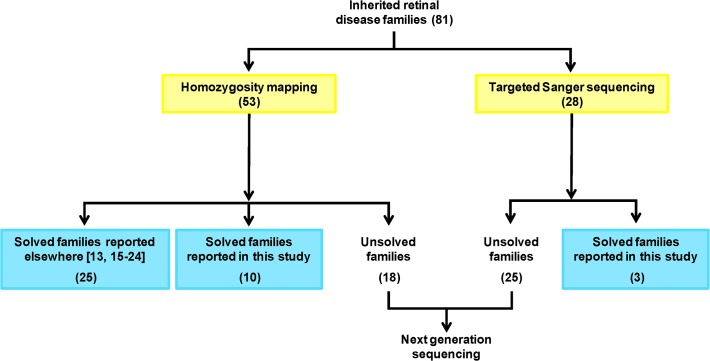
We genetically screened 13 families from a cohort of 81 Pakistani IRD families diagnosed with Leber congenital amaurosis (LCA), retinitis pigmentosa (RP), congenital stationary night blindness (CSNB), or cone dystrophy (CD). We employed genome-wide single nucleotide polymorphism (SNP) array analysis to identify homozygous regions shared by affected individuals and performed Sanger sequencing of IRD-associated genes located in the sizeable homozygous regions. In addition, based on population specific mutation data we performed targeted Sanger sequencing (TSS) of frequent variants in AIPL1, CEP290, CRB1, GUCY2D, LCA5, RPGRIP1 and TULP1, in probands from 28 LCA families.
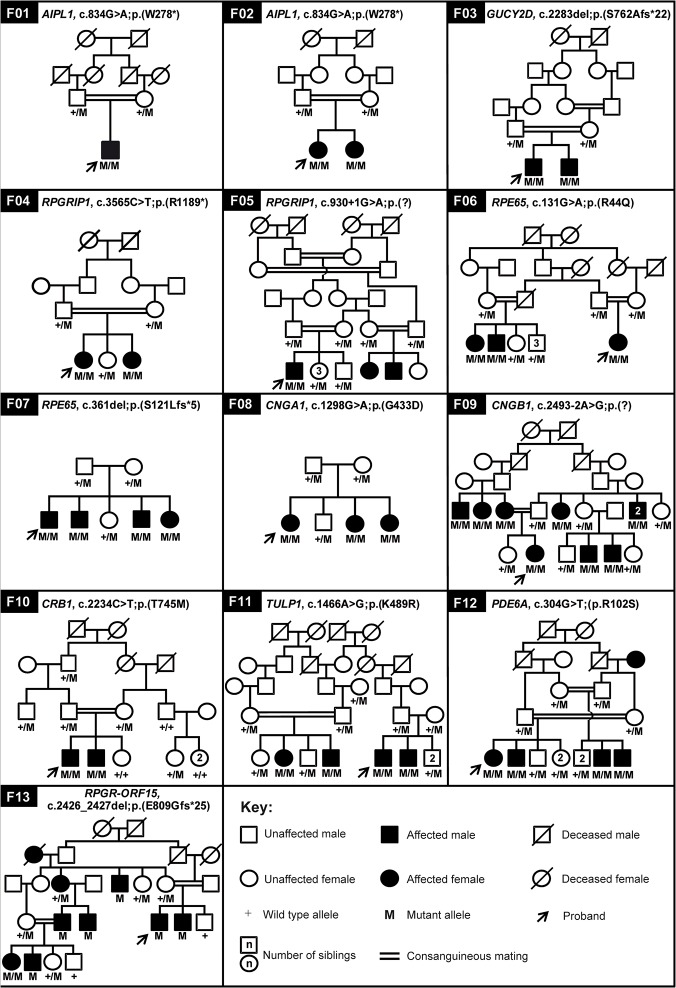
Homozygosity mapping and Sanger sequencing of IRD-associated genes revealed the underlying mutations in 10 families. TSS revealed causative variants in three families. In these 13 families four novel mutations were identified in CNGA1, CNGB1, GUCY2D, and RPGRIP1.
Homozygosity mapping and TSS revealed the underlying genetic cause in 13 IRD families, which is useful for genetic counseling as well as therapeutic interventions that are likely to become available in the near future.
纯合性定位有助于确定遗传性疾病的潜在遗传病因,尤其是在有多个患病个体的近亲家庭中。这一知识还产生了一个突变数据集,可用于以具有成本效益和时间效益的方式筛选与遗传性视网膜疾病(IRD)等疾病相关的常见人群特异性遗传变异。
我们对来自81个巴基斯坦IRD家庭队列中的13个家庭进行了基因筛查,这些家庭被诊断患有莱伯先天性黑蒙(LCA)、视网膜色素变性(RP)、先天性静止性夜盲(CSNB)或视锥细胞营养不良(CD)。我们采用全基因组单核苷酸多态性(SNP)阵列分析来确定患病个体共有的纯合区域,并对位于相当大的纯合区域内的IRD相关基因进行桑格测序。此外,基于人群特异性突变数据,我们对28个LCA家庭的先证者中AIPL1、CEP290、CRB1、GUCY2D、LCA5、RPGRIP1和TULP1中的常见变异进行了靶向桑格测序(TSS)。
IRD相关基因的纯合性定位和桑格测序揭示了10个家庭中的潜在突变。TSS在3个家庭中发现了致病变异。在这13个家庭中,在CNGA1、CNGB1、GUCY2D和RPGRIP1中鉴定出4个新突变。
纯合性定位和TSS揭示了13个IRD家庭的潜在遗传病因,这对于遗传咨询以及在不久的将来可能会有的治疗干预都很有用。