Popovic Bojana, Popovic Dejana, Macut Djuro, Antic Ivana Bozic, Isailovic Tatjana, Ognjanovic Sanja, Bogavac Tamara, Kovacevic Valentina Elezovic, Ilic Dusan, Petrovic Mirjana, Damjanovic Svetozar
Clinic for Endocrinology, Diabetes and Metabolic Diseases, Clinical Centre of Serbia, Belgrade, Serbia.
Clinic for Cardiology, Clinical Centre of Serbia, Belgrade, Serbia.
J Med Biochem. 2019 Mar 1;38(1):6-12. doi: 10.2478/jomb-2018-0016. eCollection 2019 Mar.
Endocrine system plays a major role in both permissive and regulatory activities in order to adequately respond to physical stress of exercise. But level and direction of activation depend on many factors and are not easily interpreted.
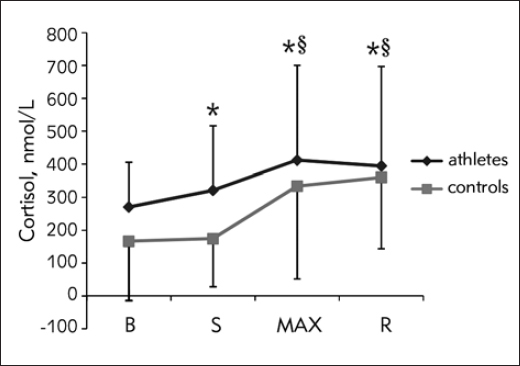
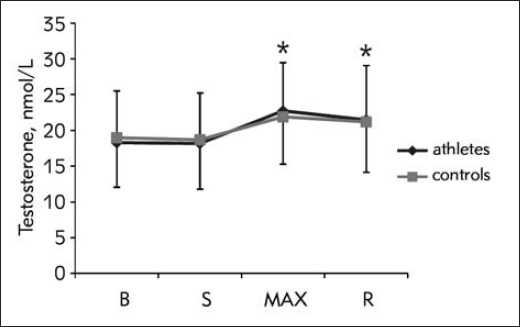
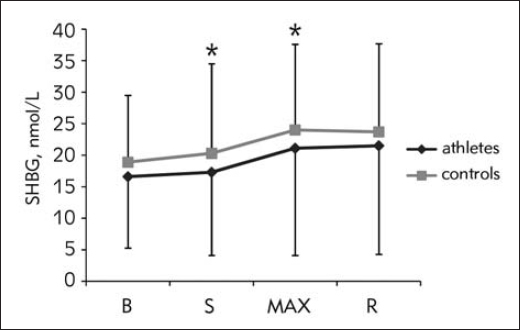
We tested a group of male professional athletes (21 water polo players and 15 wrestlers), together with 20 sedentary controls matched by age. All participants took a continuous progressive exercise stress test on a treadmill until exhaustion and plateau of oxygen consumption (VO). Blood samples for cortisol, sex hormone binding globulin (SHBG) and testosterone were drawn in four time points: baseline (B), start of the test (S), point of maximal strain (MAX) and in the 3 minute of recovery period (R).
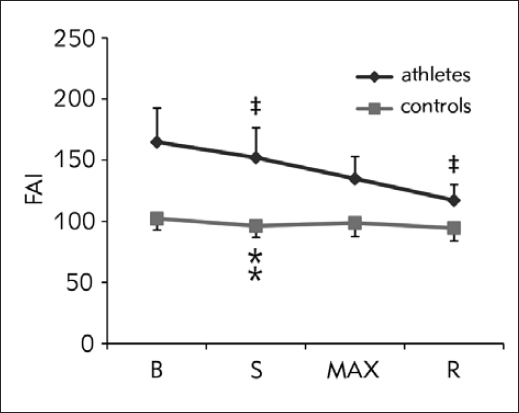
Cortisol levels significantly increased in both groups, but the response between S and MAX was more pronounced in controls (p=0.036). The athletes had significantly higher levels of cortisol in all points in test, except during R (p=0.118), when their cortisol levels gradually started to decline. Significant increase in total testosterone was in great deal a consequence of increase in SHBG level (p<0.01 for both). Consequently, calculated free testosterone significantly decreased during test (p=0.008), and the drop was more pronounced in athletes. This was in concordance with significant correlation between SHBG and cortisol level demonstrated in athletes, but not in controls.
It seems that high intensity endurance exercise favors catabolic response, but the level of response highly depends on a previous level of training.
内分泌系统在允许和调节活动中发挥着重要作用,以便充分应对运动带来的身体压力。但其激活水平和方向取决于多种因素,且不易解读。
我们测试了一组男性职业运动员(21名水球运动员和15名摔跤运动员),以及20名年龄匹配的久坐不动的对照组人员。所有参与者在跑步机上进行持续渐进性运动压力测试,直至耗竭和耗氧量(VO)达到平稳状态。在四个时间点采集血液样本,检测皮质醇、性激素结合球蛋白(SHBG)和睾酮:基线(B)、测试开始时(S)、最大应变点(MAX)以及恢复期3分钟时(R)。
两组的皮质醇水平均显著升高,但对照组在S和MAX之间的反应更为明显(p = 0.036)。运动员在测试的所有时间点皮质醇水平均显著高于对照组,除了在R点(p = 0.118),此时他们的皮质醇水平开始逐渐下降。总睾酮的显著增加在很大程度上是SHBG水平升高的结果(两者p均<0.01)。因此,计算得出的游离睾酮在测试期间显著下降(p = 0.008),且在运动员中下降更为明显。这与运动员中SHBG和皮质醇水平之间存在显著相关性一致,但对照组中未发现这种相关性。
高强度耐力运动似乎有利于分解代谢反应,但反应水平高度依赖于先前的训练水平。