Desmedt Christine, Pingitore Julien, Rothé Françoise, Marchio Caterina, Clatot Florian, Rouas Ghizlane, Richard François, Bertucci François, Mariani Odette, Galant Christine, Fribbens Charlotte, O'Leary Ben, van den Eynden Gert, Salgado Roberto, Turner Nicholas C, Piccart Martine, Vincent-Salomon Anne, Pruneri Giancarlo, Larsimont Denis, Sotiriou Christos
1Breast Cancer Translational Research Laboratory, Institut Jules Bordet, U-CRC, Université Libre de Bruxelles, 1000 Brussels, Belgium.
2Laboratory for Translational Breast Cancer Research, KU Leuven, Herestraat 49, 3000 Leuven, Belgium.
NPJ Breast Cancer. 2019 Feb 22;5:9. doi: 10.1038/s41523-019-0104-z. eCollection 2019.
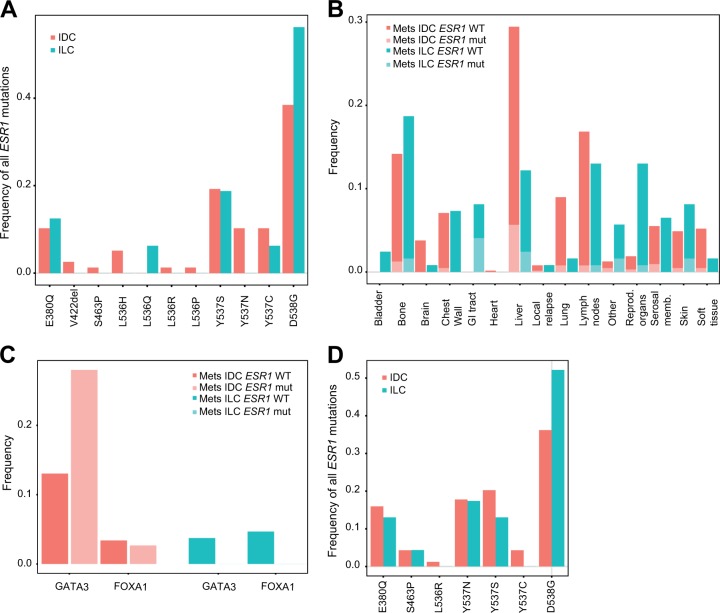
Invasive lobular breast cancer (ILC) represents the second most common histology of breast cancer after invasive ductal breast cancer (IDC), accounts for up to 15% of all invasive cases and generally express the estrogen receptor (ER, coded by the gene). mutations have been associated with resistance to endocrine therapy, however these have not been specifically evaluated in ILC. We assessed the frequency of mutations by droplet digital PCR in a retrospective multi-centric series of matched primary tumor and recurrence samples ( = 279) from 80 metastatic ER-positive ILC patients. We further compared mutations between IDC and ILC patients in metastatic samples from MSKCC-IMPACT ( = 595 IDC and 116 ILC) and in ctDNA from the SoFEA and PALOMA-3 trials ( = 416 IDC and 76 ILC). In the retrospective series, the metastases from seven patients (9%) harbored mutations, which were absent from the interrogated primary samples. Five patients (6%) had a mutation in the primary tumor or axillary metastasis, which could not be detected in the matched distant metastasis. In the MSKCC-IMPACT cohort, as well as in the SoFEA and PALOMA-3 trials, there were no differences in prevalence and distribution of the mutations between IDC and ILC, with D538G being the most frequent mutation in both histological subtypes. To conclude, no patient had an identical mutation in the early and metastatic disease in the retrospective ILC series. In the external series, there was no difference in terms of prevalence and type of ESR1 mutations between ILC and IDC.
浸润性小叶乳腺癌(ILC)是继浸润性导管癌(IDC)之后第二常见的乳腺癌组织学类型,占所有浸润性病例的15%,通常表达雌激素受体(ER,由该基因编码)。突变与内分泌治疗耐药有关,然而这些突变在ILC中尚未得到专门评估。我们通过液滴数字PCR评估了80例转移性ER阳性ILC患者的回顾性多中心系列匹配原发性肿瘤和复发样本(n = 279)中突变的频率。我们还比较了MSKCC-IMPACT转移性样本(n = 595例IDC和116例ILC)以及SoFEA和PALOMA-3试验的ctDNA(n = 416例IDC和76例ILC)中IDC和ILC患者之间的突变情况。在回顾性系列中,7例患者(9%)的转移灶存在突变,而在检测的原发性样本中未发现这些突变。5例患者(6%)的原发性肿瘤或腋窝转移灶存在突变,而在匹配的远处转移灶中未检测到。在MSKCC-IMPACT队列以及SoFEA和PALOMA-3试验中,IDC和ILC之间突变的患病率和分布没有差异,D538G是两种组织学亚型中最常见的突变。总之,在回顾性ILC系列中,没有患者在早期和转移性疾病中具有相同的突变。在外部系列中,ILC和IDC之间在ESR1突变的患病率和类型方面没有差异。