Department of Freshwater and Marine Ecology, Institute for Biodiversity and Ecosystem Dynamics, University of Amsterdam, PO Box 94240, 1090 GE, Amsterdam, The Netherlands.
Wetsus, European Centre of Excellence for Sustainable Water Technology, Oostergoweg 9, 8911 MA, Leeuwarden, The Netherlands.
Photosynth Res. 2019 Sep;141(3):291-301. doi: 10.1007/s11120-019-00630-z. Epub 2019 Feb 28.
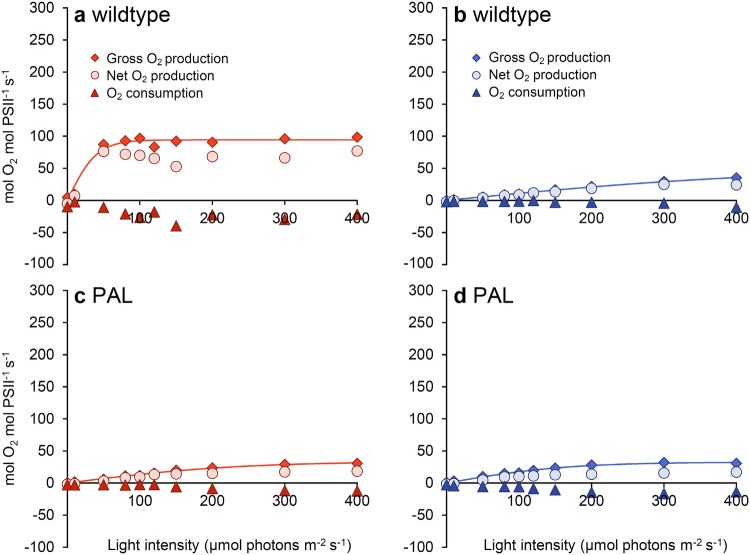
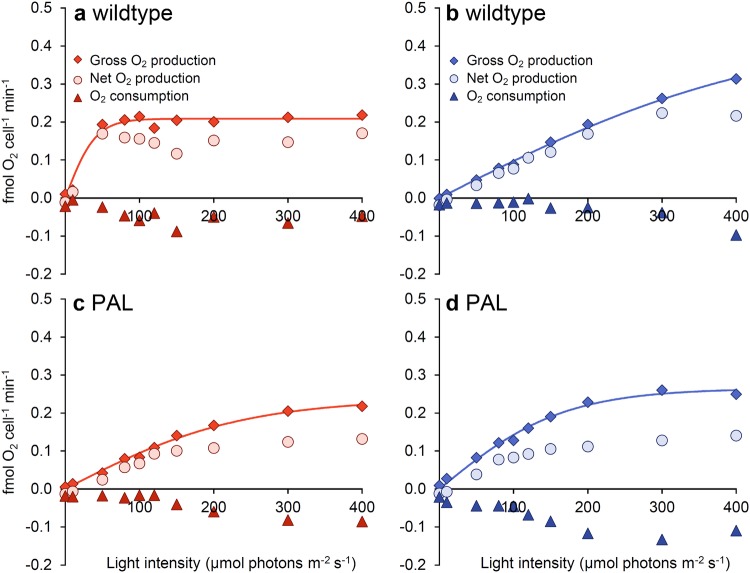
The ubiquitous chlorophyll a (Chl a) pigment absorbs both blue and red light. Yet, in contrast to green algae and higher plants, most cyanobacteria have much lower photosynthetic rates in blue than in red light. A plausible but not yet well-supported hypothesis is that blue light results in limited energy transfer to photosystem II (PSII), because cyanobacteria invest most Chl a in photosystem I (PSI), whereas their phycobilisomes (PBS) are mostly associated with PSII but do not absorb blue photons. In this paper, we compare the photosynthetic performance in blue and orange-red light of wildtype Synechocystis sp. PCC 6803 and a PBS-deficient mutant. Our results show that the wildtype had much lower biomass, Chl a content, PSI:PSII ratio and O production rate per PSII in blue light than in orange-red light, whereas the PBS-deficient mutant had a low biomass, Chl a content, PSI:PSII ratio, and O production rate per PSII in both light colors. More specifically, the wildtype displayed a similar low photosynthetic efficiency in blue light as the PBS-deficient mutant in both light colors. Our results demonstrate that the absorption of light energy by PBS and subsequent transfer to PSII are crucial for efficient photosynthesis in cyanobacteria, which may explain both the low photosynthetic efficiency of PBS-containing cyanobacteria and the evolutionary success of chlorophyll-based light-harvesting antennae in environments dominated by blue light.
普遍存在的叶绿素 a (Chl a) 色素吸收蓝光和红光。然而,与绿藻和高等植物不同,大多数蓝藻在蓝光下的光合速率比在红光下低得多。一个合理但尚未得到充分支持的假设是,蓝光导致能量向光系统 II (PSII) 的传递受限,因为蓝藻将大部分 Chl a 投资于光系统 I (PSI),而它们的藻胆体 (PBS) 主要与 PSII 相关联,但不吸收蓝光光子。在本文中,我们比较了野生型集胞藻 PCC 6803 和 PBS 缺陷突变体在蓝光和橙红光下的光合作用性能。我们的结果表明,野生型在蓝光下的生物量、Chl a 含量、PSI:PSII 比和 PSII 每单位产生的 O2 速率均远低于橙红光,而 PBS 缺陷突变体在两种光色下的生物量、Chl a 含量、PSI:PSII 比和 PSII 每单位产生的 O2 速率均较低。更具体地说,野生型在两种光色下的蓝光光合效率与 PBS 缺陷突变体相似。我们的结果表明,PBS 吸收光能并随后向 PSII 传递对于蓝藻的高效光合作用至关重要,这可能解释了含 PBS 的蓝藻光合效率低以及基于叶绿素的光捕获天线在以蓝光为主的环境中进化成功的原因。