Department of Biological Sciences, University of Maryland Baltimore County, Baltimore, MD 21250, USA.
Cells. 2019 Feb 25;8(2):199. doi: 10.3390/cells8020199.
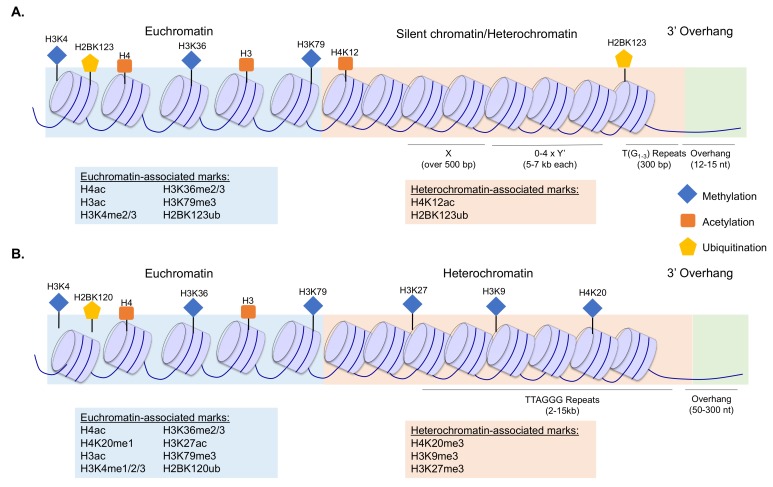
Telomeres, the nucleoprotein structures at the ends of eukaryotic chromosomes, play an integral role in protecting linear DNA from degradation. Dysregulation of telomeres can result in genomic instability and has been implicated in increased rates of cellular senescence and many diseases, including cancer. The integrity of telomeres is maintained by a coordinated network of proteins and RNAs, such as the telomerase holoenzyme and protective proteins that prevent the recognition of the telomere ends as a DNA double-strand breaks. The structure of chromatin at telomeres and within adjacent subtelomeres has been implicated in telomere maintenance pathways in model systems and humans. Specific post-translational modifications of histones, including methylation, acetylation, and ubiquitination, have been shown to be necessary for maintaining a chromatin environment that promotes telomere integrity. Here we review the current knowledge regarding the role of histone modifications in maintaining telomeric and subtelomeric chromatin, discuss the implications of histone modification marks as they relate to human disease, and highlight key areas for future research.
端粒是真核生物染色体末端的核蛋白结构,在保护线性 DNA 免受降解方面发挥着重要作用。端粒的失调会导致基因组不稳定,并与细胞衰老和许多疾病(包括癌症)的发生率增加有关。端粒的完整性由一个协调的蛋白质和 RNA 网络来维持,如端粒酶全酶和保护蛋白,它们可以防止端粒末端被识别为 DNA 双链断裂。端粒和相邻亚端粒中的染色质结构已被证明在模型系统和人类中参与端粒维持途径。组蛋白的特定翻译后修饰,包括甲基化、乙酰化和泛素化,已被证明对于维持促进端粒完整性的染色质环境是必要的。在这里,我们综述了组蛋白修饰在维持端粒和亚端粒染色质中的作用的最新知识,讨论了组蛋白修饰标记与人类疾病的关系的意义,并强调了未来研究的关键领域。