Department of Neurology, Max Planck Institute for Human Cognitive and Brain Sciences, Leipzig, Germany.
Department of Psychology, Concordia University, Montreal, Quebec, Canada.
Sci Rep. 2019 Mar 1;9(1):3273. doi: 10.1038/s41598-019-40295-1.
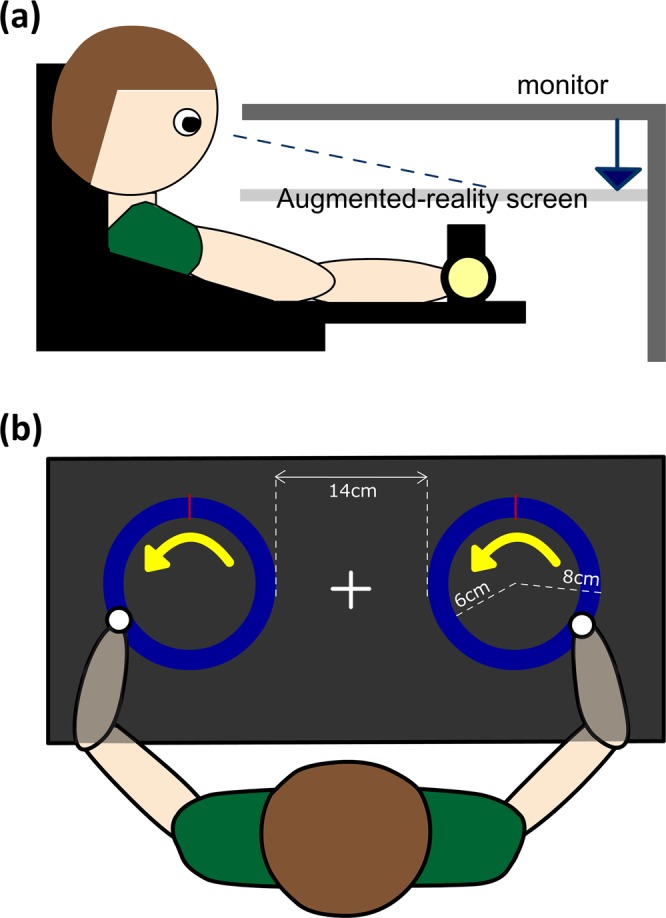
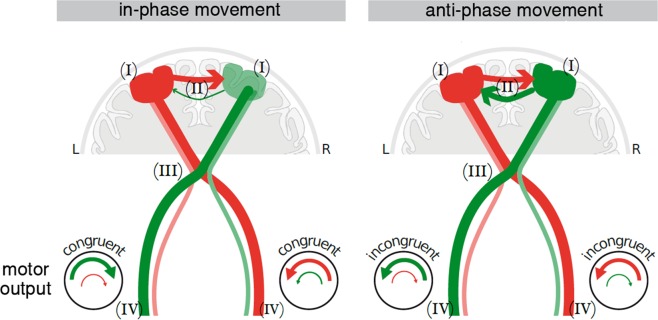
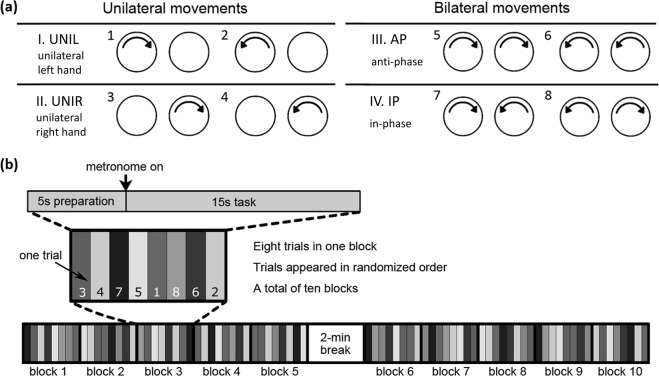
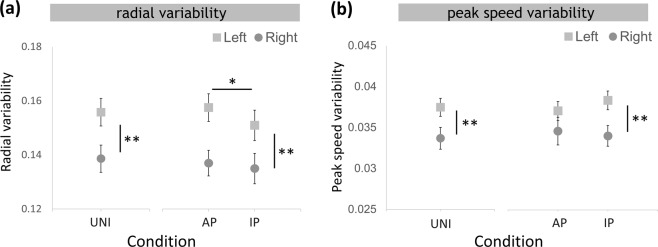
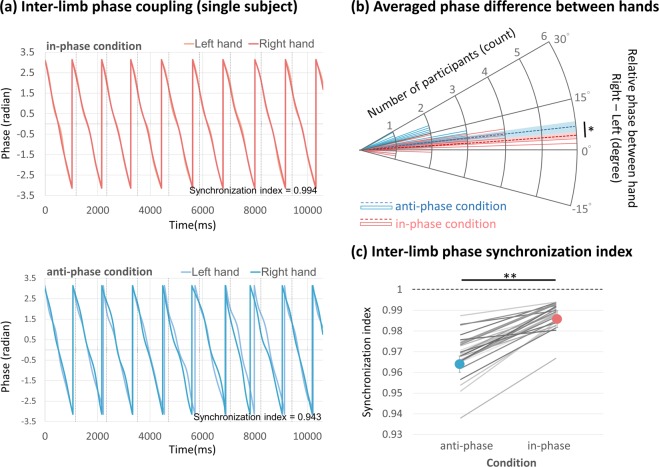
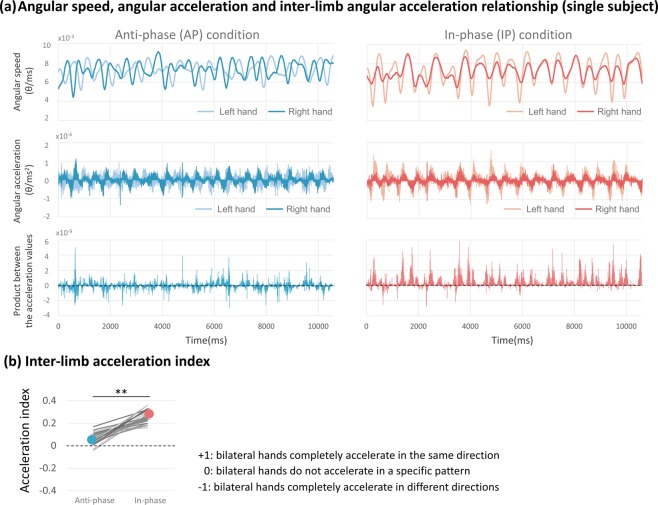
In-phase and anti-phase movements represent two basic coordination modes with different characteristics: during in-phase movements, bilateral homologous muscle groups contract synchronously, whereas during anti-phase movements, they contract in an alternating fashion. Previous studies suggested that in-phase movements represent a more stable and preferential bilateral movement template in humans. The current experiment aims at confirming and extending this notion by introducing new empirical measures of spatiotemporal dynamics during performance of a bilateral circle drawing task in an augmented-reality environment. First, we found that anti-phase compared to in-phase movements were performed with higher radial variability, a result that was mainly driven by the non-dominant hand. Second, the coupling of both limbs was higher during in-phase movements, corroborated by a lower inter-limb phase difference and higher inter-limb synchronization. Importantly, the movement acceleration profile between bilateral hands followed an in-phase relationship during in-phase movements, while no specific relationship was found in anti-phase condition. These spatiotemporal relationships between hands support the hypothesis that differential neural processes govern both bilateral coordination modes and suggest that both limbs are controlled more independently during anti-phase movements, while bilateral in-phase movements are elicited by a common neural generator.
在同相运动中,双侧同源肌肉群同步收缩,而在反相运动中,它们交替收缩。先前的研究表明,同相运动在人类中代表了一种更稳定和优先的双侧运动模板。本实验旨在通过在增强现实环境中执行双边圆形绘图任务时引入新的时空动力学经验测量来证实和扩展这一概念。首先,我们发现与同相运动相比,反相运动的径向变化更大,这一结果主要是由非优势手驱动的。其次,同相运动时,双侧肢体的耦合更高,这得到了较低的肢体间相位差和更高的肢体间同步性的支持。重要的是,在同相运动中,双侧手之间的运动加速度曲线遵循同相关系,而在反相条件下则没有发现特定的关系。这些手之间的时空关系支持这样一种假设,即不同的神经过程控制着两种双侧协调模式,并表明在反相运动中,四肢的控制更加独立,而双侧同相运动则由一个共同的神经发生器引发。