
表面浸润疏水分子使得超深度过冷却成为可能,这解释了越冬芽在极端冰冻条件下的存活。
Deep supercooling enabled by surface impregnation with lipophilic substances explains the survival of overwintering buds at extreme freezing.
机构信息
Department of Botany, Unit Functional Plant Biology, University of Innsbruck, Innsbruck, Austria-Europe.
出版信息
Plant Cell Environ. 2019 Jul;42(7):2065-2074. doi: 10.1111/pce.13545. Epub 2019 Apr 4.
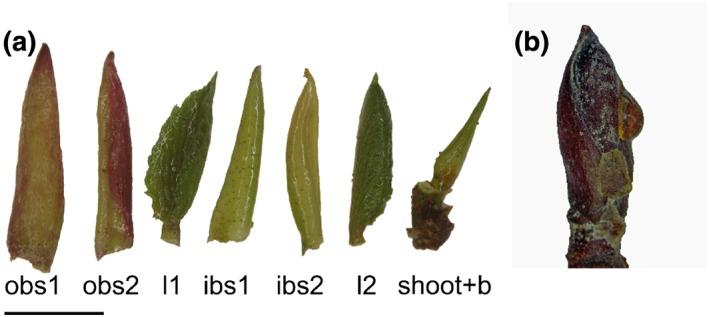
The frost survival mechanism of vegetative buds of angiosperms was suggested to be extracellular freezing causing dehydration, elevated osmotic potential to prevent freezing. However, extreme dehydration would be needed to avoid freezing at the temperatures down to -45°C encountered by many trees. Buds of Alnus alnobetula, in common with other frost hardy angiosperms, excrete a lipophilic substance, whose functional role remains unclear. Freezing of buds was studied by infrared thermography, psychrometry, and cryomicroscopy. Buds of A. alnobetula did not survive by extracellular ice tolerance but by deep supercooling, down to -45°C. An internal ice barrier prevented ice penetration from the frozen stem into the bud. Cryomicroscopy revealed a new freezing mechanism. Until now, supercooled buds lost water towards ice masses that form in the subtending stem and/or bud scales. In A. alnobetula, ice forms harmlessly inside the bud between the supercooled leaves. This would immediately trigger intracellular freezing and kill the supercooled bud in other species. In A. alnobetula, lipophilic substances (triterpenoids and flavonoid aglycones) impregnate the surface of bud leaves. These prevent extrinsic ice nucleation so allowing supercooling. This suggests a means to protect forestry and agricultural crops from extrinsic ice nucleation allowing transient supercooling during night frosts.
被子植物营养芽的抗冻机制被认为是细胞外冷冻导致脱水,提高渗透压以防止冻结。然而,为了避免在许多树木遇到的-45°C以下的温度下冻结,需要极端脱水。桤木营养芽与其他抗寒被子植物一样,会分泌一种亲脂物质,但其功能作用尚不清楚。通过红外热成像、湿度测定法和低温显微镜研究了芽的冻结。桤木芽不是通过细胞外冰耐性而是通过深过冷来存活的,最低可达-45°C。内部冰障阻止了冰从冻结的茎进入芽。低温显微镜揭示了一种新的冻结机制。到目前为止,过冷的芽会向在支撑茎和/或芽鳞中形成的冰体失去水分。在桤木中,冰在受冻叶子之间的芽内形成无害。这将立即引发细胞内冻结,并在其他物种中杀死过冷的芽。在桤木中,亲脂物质(三萜和黄酮苷元)浸渍在芽叶的表面。这些物质阻止了外在冰核的形成,从而允许过冷。这为保护林业和农业作物免受外在冰核的形成提供了一种方法,允许在夜间霜冻期间短暂过冷。



 Zotero 插件