Javed Aamir, Talkad Muralidhar Srinivasaih, Ramaiah Manjula Kannasandra
Department of Biotechnology, REVA University, Yelahanka, India.
Department of Biotechnology, Dayananda Sagar University, Bangalore, India.
Clin Exp Reprod Med. 2019 Mar;46(1):14-21. doi: 10.5653/cerm.2019.46.1.14. Epub 2019 Mar 1.
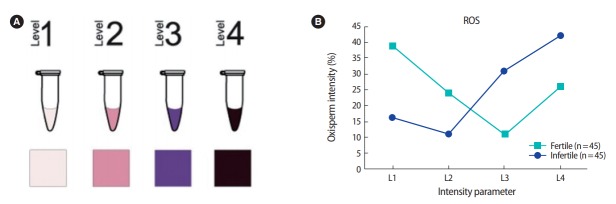
The usual seminal profile has been customarily used for diagnosing male infertility based on an examination of semen samples. However, sperm DNA fragmentation has also been causally linked to reproductive failure, suggesting that it should be evaluated as part of male infertility assessments. To compare the ability of the five most widely utilized methodologies of measuring DNA fragmentation to predict male infertility and reactive oxygen species by Oxisperm kit assay.
In this case-control study, which received ethical committee approval, the participants were divided into fertile and infertile groups (50 patients in each group).
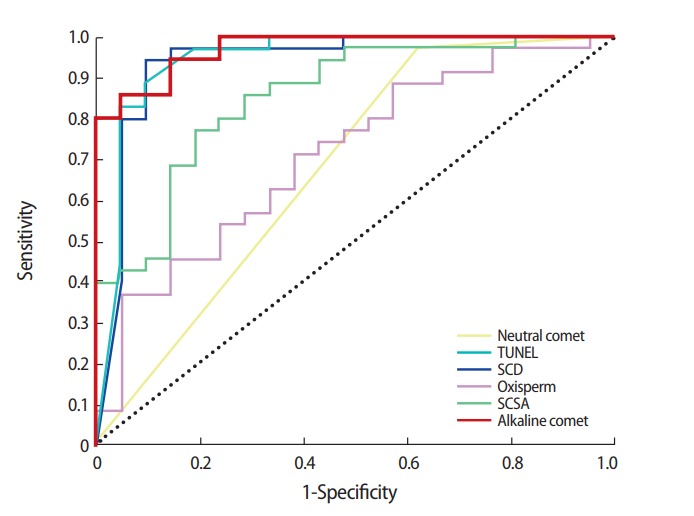
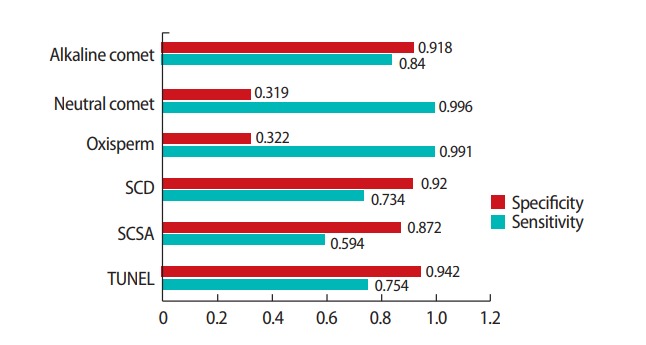
The alkaline comet test showed the best ability to predict male infertility, followed by the terminal deoxynucleotidyl transferase dUTP nick end labelling (TUNEL) assay, the sperm chromatin dispersion (SCD) test, and the sperm chromatin structure assay (SCSA), while the neutral comet test had no predictive power. For our patient population, the projected cut-off point for the DNA fragmentation index was 22.08% using the TUNEL assay, 19.90% using SCSA, 24.74% using the SCD test, 48.47% using the alkaline comet test, and 36.37% using the neutral comet test. Significant correlations were found between the results of the SCD test and those obtained using SCSA and TUNEL (r =0.70 and r =0.68, respectively; p<0.001), and a statistically significant correlation was also found between the results of SCSA and the TUNEL assay (r =0.77, p<0.001). Likewise, the results of the alkaline comet test showed significant correlations with those of the SCD, SCSA, and TUNEL tests (r =0.59, r =0.57, and r =0.72, respectively; p<0.001).
The TUNEL assay, SCSA, SCD, and the alkaline comet test were effective for distinguishing between fertile and infertile patients, and the alkaline comet test was the best predictor of male infertility.
通常的精液分析指标一直被习惯用于通过精液样本检查来诊断男性不育症。然而,精子DNA碎片化也与生殖失败存在因果关系,这表明它应作为男性不育评估的一部分进行评估。比较五种最广泛使用的测量DNA碎片化方法通过Oxisperm试剂盒检测预测男性不育和活性氧的能力。
在这项获得伦理委员会批准的病例对照研究中,参与者被分为生育组和不育组(每组50例患者)。
碱性彗星试验显示出预测男性不育的最佳能力,其次是末端脱氧核苷酸转移酶dUTP缺口末端标记(TUNEL)试验、精子染色质扩散(SCD)试验和精子染色质结构分析(SCSA),而中性彗星试验没有预测能力。对于我们的患者群体,使用TUNEL试验时DNA碎片化指数的预计截断点为22.08%,使用SCSA时为19.90%,使用SCD试验时为24.74%,使用碱性彗星试验时为48.47%,使用中性彗星试验时为36.37%。发现SCD试验结果与使用SCSA和TUNEL获得的结果之间存在显著相关性(分别为r = 0.70和r = 0.68;p<0.001),并且SCSA结果与TUNEL试验结果之间也存在统计学显著相关性(r = 0.77,p<0.001)。同样,碱性彗星试验结果与SCD、SCSA和TUNEL试验结果之间存在显著相关性(分别为r = 0.59、r = 0.57和r = 0.72;p<0.001)。
TUNEL试验、SCSA、SCD和碱性彗星试验对于区分生育和不育患者有效,且碱性彗星试验是男性不育的最佳预测指标。