Smith Kathleen Beth, Tisserant Jean-Nicolas, Assenza Salvatore, Arcari Mario, Nyström Gustav, Mezzenga Raffaele
Department of Health Sciences and Technology Swiss Federal Institute of Technology in Zurich 8092 Zurich Switzerland.
Nanotechnology Group Swiss Federal Institute of Technology in Zurich 8803 Rüschlikon Switzerland.
Adv Sci (Weinh). 2018 Dec 18;6(4):1801540. doi: 10.1002/advs.201801540. eCollection 2019 Feb 20.
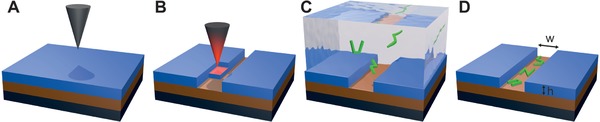
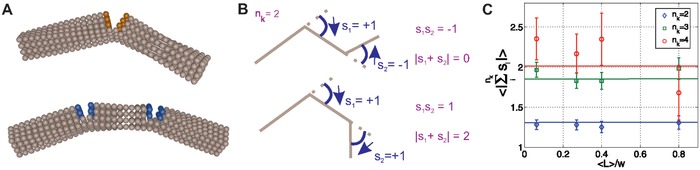
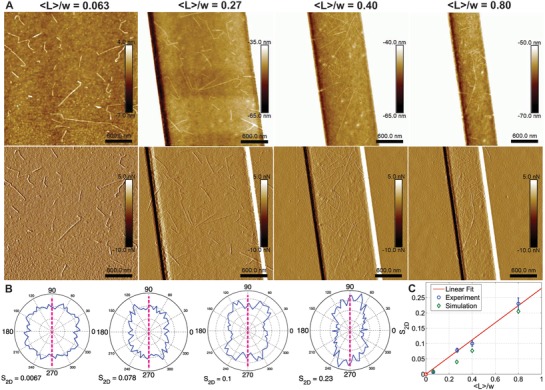
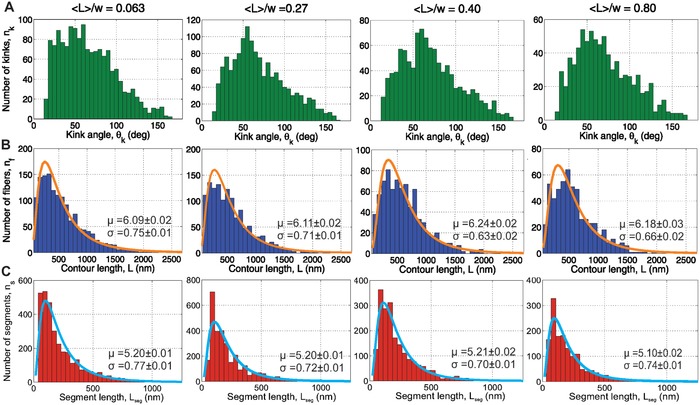
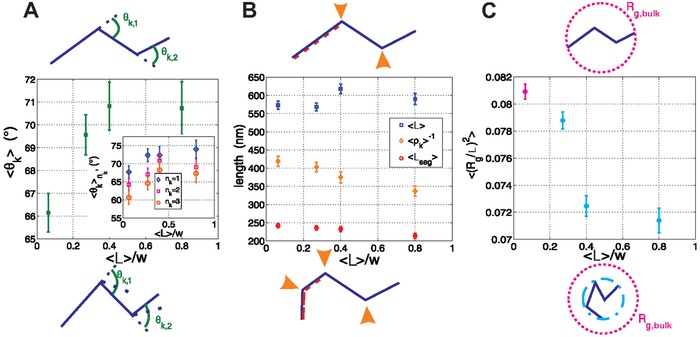
Cellulose is a pervasive polymer, displaying hierarchical lengthscales and exceptional strength and stiffness. Cellulose's complex organization, however, also hinders the detailed understanding of the assembly, mesoscopic properties, and structure of individual cellulose building blocks. This study combines nanolithography with atomic force microscopy to unveil the properties and structure of single cellulose nanofibrils under weak geometrical confinement. By statistical analysis of the fibril morphology, it emerges that confinement induces both orientational ordering and self-folding of the fibrils. Excluded volume simulations reveal that this effect does not arise from a fibril population bias applied by the confining slit, but rather that the fibril conformation itself changes under confinement, with self-folding favoring fibril's free volume entropy. Moreover, a nonstochastics angular bending probability of the fibril kinks is measured, ruling out alternating amorphous-crystalline regions. These findings push forward the understanding of cellulose nanofibrils and may inspire the design of functional materials based on fibrous templates.
纤维素是一种普遍存在的聚合物,具有分级的长度尺度以及卓越的强度和刚度。然而,纤维素复杂的组织结构也阻碍了人们对单个纤维素结构单元的组装、介观性质和结构的详细理解。本研究将纳米光刻技术与原子力显微镜相结合,以揭示在弱几何约束条件下单根纤维素纳米纤维的性质和结构。通过对纤维形态的统计分析发现,约束会导致纤维的取向有序化和自折叠。排除体积模拟表明,这种效应并非由约束狭缝施加的纤维群体偏差引起,而是纤维构象本身在约束条件下发生了变化,自折叠有利于纤维的自由体积熵。此外,还测量了纤维扭结的非随机角弯曲概率,排除了交替的非晶态-结晶区域。这些发现推动了对纤维素纳米纤维的理解,并可能启发基于纤维模板的功能材料的设计。