Key Laboratory of Carcinogenesis and Translational Research (Ministry of Education), Department of Lymphoma, Peking University Cancer Hospital and Institute, Beijing, China.
National Center for Chronic and Noncommunicable Disease Control and Prevention, Chinese Center for Disease Control and Prevention, Beijing, China.
J Hematol Oncol. 2019 Mar 4;12(1):22. doi: 10.1186/s13045-019-0706-9.
There is a dearth of accurate information about patterns of mortality of lymphoid neoplasms and temporal trends in China. In this nationwide mortality study, we aimed to assess the mortality of lymphoma and myeloma in 2017 and the changes in the trend from 2004 to 2016.
Death certificate data obtained from the Chinese Center for Disease Control and Prevention's disease surveillance points system (CDC-DSP) and population data from the National Bureau of Statistics of China were used in this study. We described the mortality of lymphoma and myeloma in 2017 by age group, sex, residence, and region and evaluated the temporal trend from 2004 to 2016 using joinpoint regression.
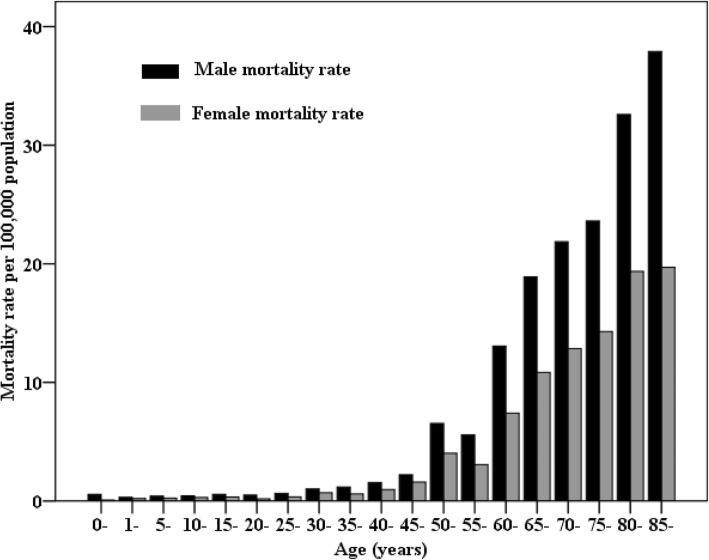
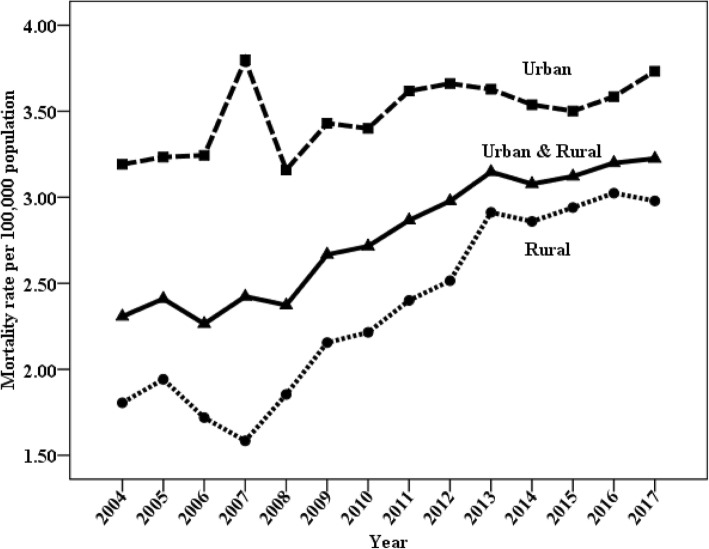
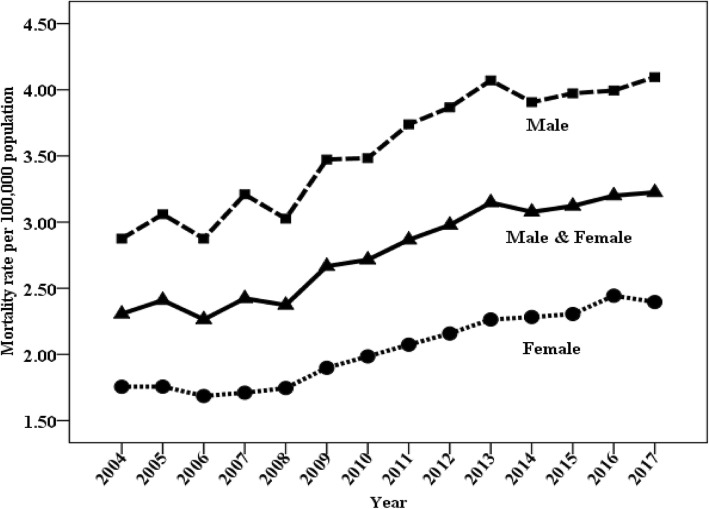
An estimated 52,000 deaths associated with lymphoma and myeloma occurred in 2017. The age-standardized mortality rate China (ASMRC) and age-standardized mortality rate worldwide (ASMRW) per 100,000 were 3.74 and 2.60, respectively. Males had higher ASMRC than females (4.54 vs. 2.91 per 100,000). The ASMRC in urban areas was significantly higher than that in rural areas (4.35 vs. 3.47 per 100,000). The age-specific mortality rate showed an upward trend with age and reached a maximum in the age group of over 85 years. In terms of regional variation, Eastern China had the highest mortality rate (3.43/100,000), followed by Central China (3.10/100,000) and Western China (3.02/100,000). The mortality rates of lymphoma and myeloma increased annually by 4.5% during the period 2004-2016, with a significant rapid upward trend in rural areas since 2007.
The mortality of lymphoma and myeloma increased in China from 2004 to 2017. The rapid increase in disease burden in rural areas highlights new challenges for disease prevention and control strategies.
关于中国淋巴肿瘤死亡率模式和时间趋势的准确信息匮乏。在这项全国死亡率研究中,我们旨在评估 2017 年淋巴瘤和骨髓瘤的死亡率以及 2004 年至 2016 年的趋势变化。
本研究使用了中国疾病预防控制中心疾病监测点系统(CDC-DSP)获取的死亡证明数据和国家统计局的人口数据。我们按年龄组、性别、居住地和地区描述了 2017 年淋巴瘤和骨髓瘤的死亡率,并使用 joinpoint 回归评估了 2004 年至 2016 年的时间趋势。
据估计,2017 年有 5.2 万人死于淋巴瘤和骨髓瘤。年龄标准化死亡率(ASMRC)和每 10 万人年龄标准化死亡率(ASMRW)分别为 3.74 和 2.60。男性的 ASMRC 高于女性(每 10 万人分别为 4.54 和 2.91)。城市地区的 ASMRC 明显高于农村地区(每 10 万人分别为 4.35 和 3.47)。年龄特异性死亡率随年龄增长呈上升趋势,在 85 岁以上年龄组达到最高。在区域差异方面,中国东部地区的死亡率最高(3.43/10 万人),其次是中部地区(3.10/10 万人)和西部地区(3.02/10 万人)。2004 年至 2016 年期间,淋巴瘤和骨髓瘤的死亡率每年增长 4.5%,自 2007 年以来农村地区呈显著快速上升趋势。
2004 年至 2017 年期间,中国淋巴瘤和骨髓瘤的死亡率上升。农村地区疾病负担的快速增加给疾病防控策略带来了新的挑战。