Liu Chih-Ching, Sun Yu, Lee Pei-Chen, Li Chung-Yi, Hu Susan C
Department of Public Health, College of Medicine, National Cheng Kung University, Tainan, Taiwan.
Department of Neurology, En Chu Kong Hospital, New Taipei City, Taiwan.
BMJ Open. 2019 Mar 3;9(3):e025274. doi: 10.1136/bmjopen-2018-025274.
A nationwide cohort study on the risk of dementia onset after first diagnosis of Parkinson's disease (PD) is lacking. This study aims to assess 11 years of incidence and the HRs for developing dementia in patients with PD compared with matched controls.
A population-based cohort study.
National Health Insurance database in Taiwan.
A total of 5932 patients with PD were identified, and 29 645 age-matched, sex-matched and index year-matched PD-free individuals were randomly selected.
All subjects were linked to the claim data to identify the first diagnosis of dementia. The Poisson assumption was used to estimate the incidence rate. Cause-specific hazards models with a partitioning of time at 1 year to account for proportionality were used to estimate the risk of dementia onset.
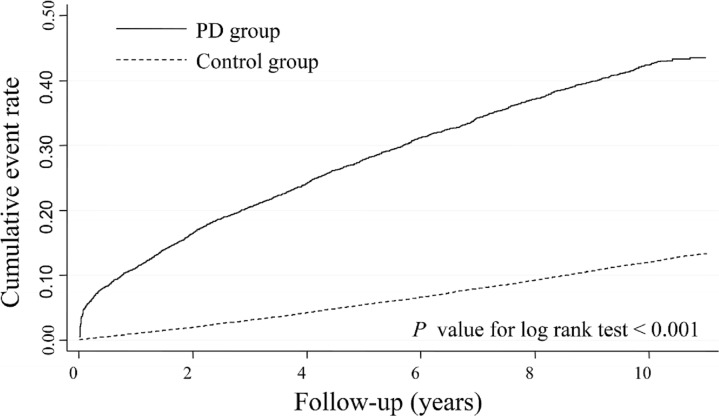
The median duration from the first diagnosis of PD to the development of dementia was 9.02 years. In the first partition (≦ 1 year), the incidence of dementia in the PD and control groups was 114.49 and 9.76 per 1000 person-years, respectively, with an adjusted HR of 6.43 (95% CI 5.46 to 7.57). In the second partition (>1 year), the incidence of dementia in the PD and control groups was 30.99 and 10.83 per 1000 person-years, with an adjusted HR of 2.42 (95% CI 2.23 to 2.61). Notably, in the second partition, both men and women aged <70 years had the highest HR (3.82, 95% CI 2.79 to 5.22 and 4.27, 95% CI 3.25 to 5.63, respectively).
This study noted an increased risk of dementia after a diagnosis of PD. The magnitude of effect estimation was higher in men in the first partition but was similar in both genders in the second partition. PD patients aged <70 years have the highest risk of dementia in any given partition time.
目前缺乏一项关于帕金森病(PD)首次诊断后痴呆发病风险的全国性队列研究。本研究旨在评估PD患者与匹配对照组相比,11年期间痴呆的发病率及风险比(HRs)。
一项基于人群的队列研究。
台湾地区国民健康保险数据库。
共纳入5932例PD患者,并随机选取29645例年龄、性别和索引年份匹配的非PD个体。
所有受试者与理赔数据进行关联,以确定痴呆的首次诊断。采用泊松假设估计发病率。使用特定病因风险模型,并将时间划分为1年以考虑比例性,来估计痴呆发病风险。
从PD首次诊断到痴呆发生的中位持续时间为9.02年。在第一个时间段(≤1年),PD组和对照组痴呆的发病率分别为每1000人年114.49例和9.76例,校正后的HR为6.43(95%CI 5.46至7.57)。在第二个时间段(>1年),PD组和对照组痴呆的发病率分别为每1000人年30.99例和10.83例,校正后的HR为2.42(95%CI 2.23至2.61)。值得注意的是,在第二个时间段,年龄<70岁的男性和女性HR最高(分别为3.82,95%CI 2.79至5.22和4.27,95%CI 3.25至5.63)。
本研究指出PD诊断后痴呆风险增加。在第一个时间段,男性的效应估计值更高,但在第二个时间段,两性的效应估计值相似。在任何给定的时间段内,年龄<70岁的PD患者患痴呆的风险最高。