Central Laser Facility, Research Complex at Harwell, STFC Rutherford Appleton Laboratory, Harwell Campus, Didcot, OX11 0FA, UK.
Protein Production UK, Research Complex at Harwell, Rutherford Appleton Laboratory, Harwell Campus, Didcot, OX11 0FA, UK.
Sci Rep. 2019 Mar 4;9(1):3408. doi: 10.1038/s41598-019-39410-z.
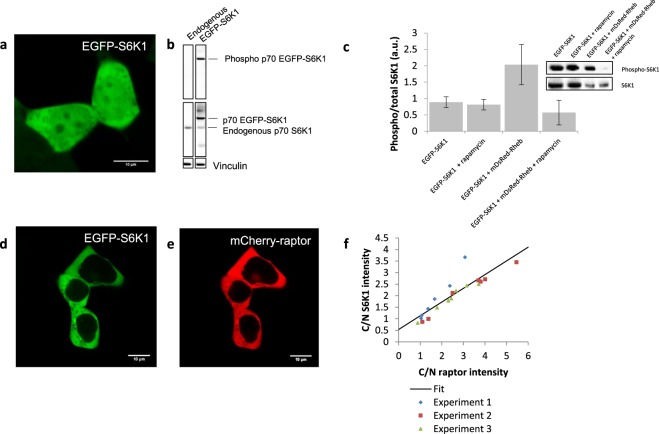
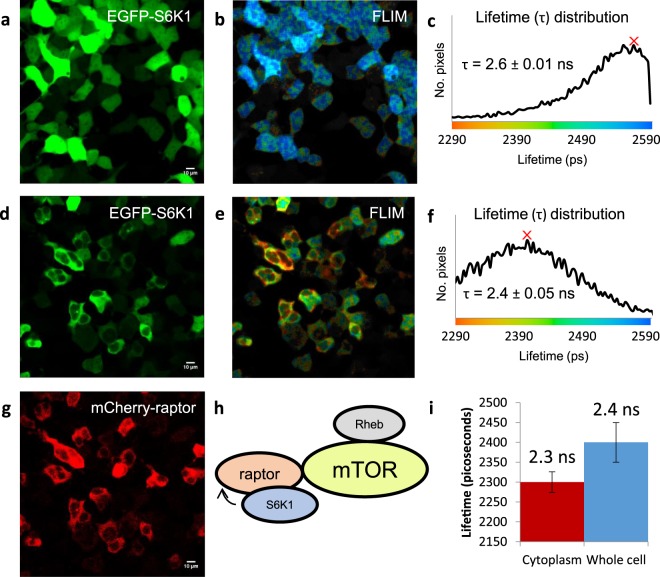
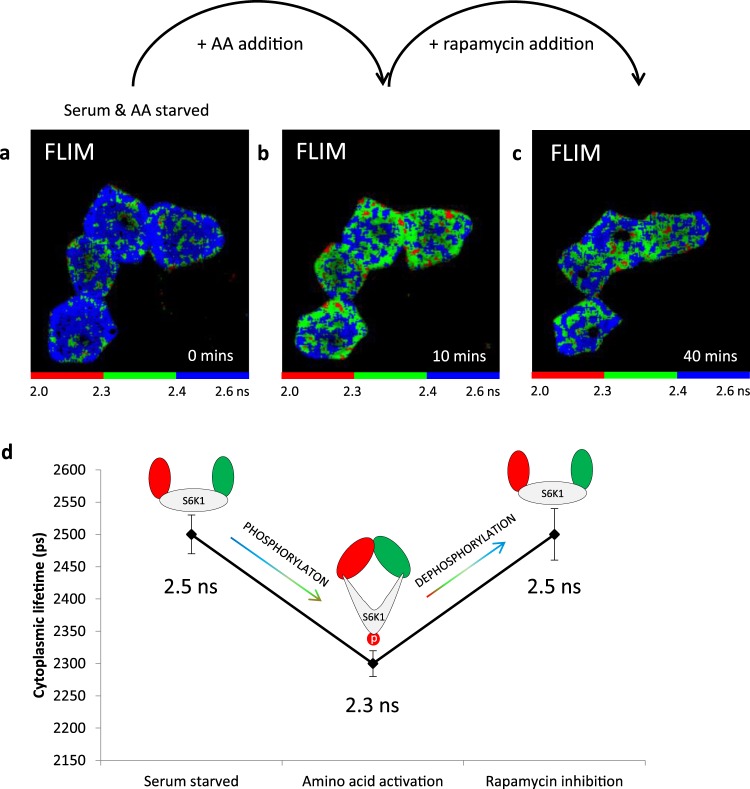
Knowledge of protein signalling pathways in the working cell is seen as a primary route to identifying and developing targeted medicines. In recent years there has been a growing awareness of the importance of the mTOR pathway, making it an attractive target for therapeutic intervention in several diseases. Within this pathway we have focused on S6 kinase 1 (S6K1), the downstream phosphorylation substrate of mTORC1, and specifically identify its juxtaposition with mTORC1. When S6K1 is co-expressed with raptor we show that S6K1 is translocated from the nucleus to the cytoplasm. By developing a novel biosensor we demonstrate in real-time, that phosphorylation and de-phosphorylation of S6K1 occurs mainly in the cytoplasm of living cells. Furthermore, we show that the scaffold protein raptor, that typically recruits mTOR substrates, is not always involved in S6K1 phosphorylation. Overall, we demonstrate how FRET-FLIM imaging technology can be used to show localisation of S6K1 phosphorylation in living cells and hence a key site of action of inhibitors targeting mTOR phosphorylation.
在工作细胞中,对蛋白质信号通路的了解被视为识别和开发靶向药物的主要途径。近年来,人们越来越意识到 mTOR 通路的重要性,使其成为几种疾病治疗干预的有吸引力的靶点。在该通路中,我们专注于 S6 激酶 1(S6K1),它是 mTORC1 的下游磷酸化底物,并特别确定其与 mTORC1 的并置。当 S6K1 与 raptor 共表达时,我们发现 S6K1 从细胞核转位到细胞质。通过开发一种新的生物传感器,我们实时证明 S6K1 的磷酸化和去磷酸化主要发生在活细胞的细胞质中。此外,我们表明,支架蛋白 raptor 通常招募 mTOR 底物,但并不总是参与 S6K1 的磷酸化。总的来说,我们展示了如何使用 FRET-FLIM 成像技术来显示活细胞中 S6K1 磷酸化的定位,从而显示针对 mTOR 磷酸化的抑制剂的关键作用部位。